
Is your social ad spend a strategic asset or a fragmented liability? Most executives recognize that the traditional model of siloed platform management has reached its breaking point. You're likely wrestling with disparate data from Meta and TikTok while trying to reconcile inaccurate attribution models against a backdrop of rising algorithmic volatility. It's frustrating to watch performance fluctuate when your mandate is stability and scale. To achieve true enterprise paid social management, you must stop viewing these channels as independent silos and start treating them as a unified, algorithmic engine.
You'll discover how to transition from reactive spending to a predictive performance model that scales executive ROI through data science and automated intelligence. We'll examine how to architect a system that integrates predictive modeling and automated bidding while remaining compliant with the 2026 regulatory shifts. This includes navigating the new neural data protections under the CCPA and New York’s synthetic performer disclosure laws. The goal isn't just to keep pace with the market, but to build a disciplined framework that turns social complexity into a measurable competitive advantage.
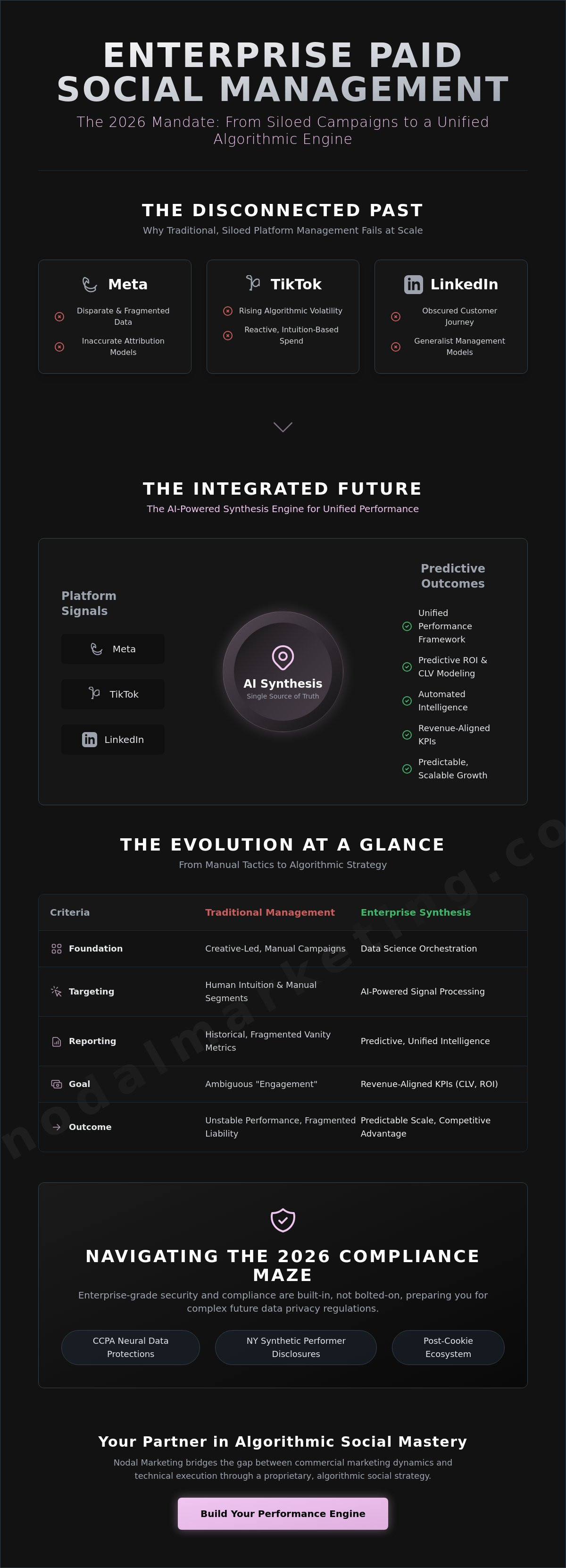
Modern enterprise paid social management requires a shift from creative-led campaigns to data science orchestration to ensure scalable ROI. In this guide, you'll learn how to leverage AI as a synthesis engine, linking fragmented platform data from Meta, TikTok, and LinkedIn into a unified performance framework. We'll identify the hidden costs of generalist management models and why a specialized tech-consultancy approach is necessary for precision at scale. You'll also discover the critical role of enterprise-grade security and compliance in navigating 2026's complex data privacy regulations, including new neural data protections and AI disclosure laws. Finally, we'll outline how to bridge the gap between commercial marketing dynamics and technical execution through a proprietary, algorithmic social strategy.
The Evolution of Enterprise Paid Social Management: Beyond the Feed
The digital environment of 2026 is defined by algorithmic saturation and a relentless density of data. In this landscape, the era of organic reach has transitioned into a complex ecosystem where visibility is a commodity bought through technical precision. For the modern organization, enterprise paid social management is no longer an exercise in creative coordination; it's a rigorous data science discipline. While entry-level social media marketing focuses on community management and brand sentiment, enterprise management at scale focuses on the orchestration of machine-learned signals.
Traditional methods relied on manual audience targeting, where human intuition dictated segments. Today, that model is obsolete. We've moved into an era of signal processing, where AI agents identify high-intent behaviors across billions of data points in real-time. This evolution requires a shift in infrastructure. Utilizing specialized ai marketing services allows a brand to bridge the gap between abstract commercial goals and granular technical execution. It's not about chasing trends, but about predicting them. It's not about managing feeds, but about architecting performance engines.
The Complexity of Global Scale
Scaling a brand across multiple regions requires more than just a larger budget; it requires a systemic approach to local relevance without losing central control. The primary challenge lies in the post-cookie ecosystem, where cross-platform attribution has become increasingly opaque. You can't rely on fragmented reporting that credits every platform for the same conversion. Modern enterprise paid social management demands a transition from vanity metrics toward revenue-aligned KPIs:
- Diagnosis: Auditing fragmented data silos to identify attribution leakage.
- Identification: Pinpointing high-value customer journeys across Meta, TikTok, and LinkedIn.
- Integration: Merging multi-region spend into a single, cohesive performance framework.
The 2026 Performance Mandate
Executive leadership no longer accepts the ambiguity of historical reporting. In a volatile market, the mandate has shifted toward predictive certainty. You need to know not just what happened last month, but what the ROI will be next quarter based on current algorithmic trends. This requires a unified intelligence hub that aggregates global ad spend into a single source of truth. Enterprise paid social management is the technical orchestration of multi-platform ad spend through automated intelligence and data science to achieve predictable, revenue-focused outcomes.
The Synthesis Engine: AI and Data Science in Social Orchestration
The core of modern enterprise paid social management lies in its ability to unify disparate data streams into a single, cohesive narrative. We call this "Synthesis." It's not the simple aggregation of metrics; it's the deep integration of fragmented platform data to create a single source of truth. Most organizations treat Meta, TikTok, and LinkedIn as separate entities. This results in data silos that obscure the true customer journey. By applying data science frameworks, you can link these touchpoints, allowing for granular audience analysis that identifies intent across the entire social ecosystem.
Strategic evaluation is critical when launching a social media promotion campaign at the enterprise level. Generic automation tools often lack the depth required to handle the nuances of high-volume spend. Instead, sophisticated AI-powered insights refine audience modeling by identifying subtle behavioral patterns that human analysts might overlook. This level of precision allows for predictive modeling of Customer Lifetime Value (CLV). You aren't just buying clicks; you're investing in long-term revenue streams. Leveraging ai marketing campaigns enables the automation of creative iteration, ensuring that your messaging evolves as quickly as the algorithms that distribute it.
Automated Intelligence Hubs
Effective orchestration requires a unified reporting environment where disparate data sources are synthesized into actionable intelligence. Real-time bidding optimization shouldn't rely on platform-native tools alone. Proprietary machine learning models provide a competitive edge by adjusting bids based on broader business context rather than narrow platform goals. AI agents for marketing are now capable of identifying high-value segments before they reach peak saturation. This allows for early-mover advantages in competitive auctions where timing is as valuable as budget.
Bridging the Gap: Commercial vs Technical
The primary failure of most social strategies is the disconnect between boardroom objectives and campaign execution. A board-level revenue goal must be translated into technical bidding parameters with surgical accuracy. Generic automation fails because it treats every business as a standard template. True enterprise paid social management requires a bespoke approach where marketing technology is tailored to the specific architecture of your organization. This is why bespoke reporting solutions are essential; they provide the executive transparency needed to validate complex technical strategies against commercial outcomes. It's about moving from data extraction to normalization and finally to strategic visualization.
Strategic Evaluation: Choosing an Enterprise Management Model
Selecting an operational model for enterprise paid social management is a decision that dictates your long-term scalability. You aren't just choosing a service provider; you're selecting the architect of your data infrastructure. Most organizations find themselves caught between three distinct paths: the in-house team, the generalist agency, or the specialized tech-consultancy. While in-house teams offer cultural alignment, they often struggle to maintain the technical velocity required to outpace platform volatility. Conversely, the generalist agency provides scale but frequently lacks the technical depth to manage spend as a data science problem.
The hidden cost of the generalist model isn't just a high cost-per-acquisition. It's the accumulation of dirty data. When campaigns are managed without a rigorous data strategy, the machine learning signals sent back to platforms like Meta or TikTok become diluted. This creates a feedback loop of inefficiency. To avoid this, you must evaluate a partner's technical capability. Can they build custom ML models to optimize your bidding? This is where data science consulting services become indispensable, providing the intellectual rigor to turn social spend into a predictable revenue driver.
The Generalist Agency Trap
In 2026, "full-service" has become a euphemism for shallow expertise. Many agencies rely heavily on platform-native automation, which we call the black box trap. These tools are designed to maximize platform revenue, not yours. You can identify an underperforming partner by their reliance on vanity metrics and their inability to explain the technical logic behind their bidding strategies. If your enterprise paid social management doesn't go deeper than the platform's default settings, you're leaving performance on the table.
The Tech-Consultancy Advantage
A specialized tech-consultancy prioritizes precision over volume. Instead of casting a wide net, the focus is on identifying high-intent audience signals that align with your specific commercial goals. This approach treats social as a core component of your broader MarTech stack rather than an isolated channel. By adopting a data strategy services framework, you ensure that every dollar spent on social contributes to a unified intelligence hub. It's about building a system that is disciplined, forward-thinking, and technically superior.
Constructing the Framework: Security, Compliance, and Unified Intelligence
Structural integrity is the prerequisite for performance. In 2026, enterprise paid social management requires more than just budget allocation; it requires a robust security architecture that protects global assets while enabling technical agility. Managing role-based permissions across multi-region teams is no longer a back-office task. It's a strategic necessity to prevent brand dilution and ensure that only verified, high-stakes content reaches the feed. You aren't just managing ads; you're safeguarding the digital reputation of a global entity.
The regulatory landscape has shifted from a series of guidelines into a complex web of enforceable mandates. With the 2026 implementation of new consumer data privacy laws in Indiana, Kentucky, and Rhode Island, alongside California’s inclusion of neural data in the CCPA, the cost of non-compliance is catastrophic. You must manage sensitive personal information within an algorithmic targeting framework that respects these boundaries. This is why a marketing attribution consulting plan is vital. It provides the methodology to track performance without compromising user privacy or violating the New York AI advertising law’s disclosure requirements for synthetic performers.
Unified Intelligence Hubs
A unified intelligence hub is the architectural blueprint for scaling ROI. It functions by connecting CRM data directly to social platforms, enabling closed-loop reporting that reveals the true value of every impression. This eliminates the persistent data silos between paid search and paid social. Our process follows a strict tripartite progression. We begin with a diagnosis of existing data fragmentation. We move to the identification of cross-channel synergy. We conclude with the integration of these signals into a single performance engine.
Agentic Social Orchestration
We've entered the era of agentic social orchestration. This isn't the static automation of the past, but the deployment of ai agents for marketing that act with autonomous precision. These agents monitor global ad spend for real-time anomalies and manage high-stakes crisis communications before they escalate. They automate the approval process for enterprise content, ensuring brand safety at a scale no human team could match. If your current framework lacks this level of technical oversight, it's time to re-architect. Partner with Nodal Marketing to build a secure, unified intelligence framework today.
Nodal Marketing: Your Partner in Algorithmic Social Mastery
Nodal Marketing functions as the indispensable bridge between high-level commercial dynamics and the technical execution required to dominate the 2026 digital landscape. We don't view enterprise paid social management as a series of creative posts, but as a rigorous data science challenge. Our role is to act as a specialized strategic partner, translating your board-level revenue objectives into precise, algorithmic parameters. We provide the intellectual rigor and technological depth that generalist agencies lack, ensuring your social spend is an investment in measurable growth rather than a recurring expense.
Our proprietary approach applies the same sophisticated principles found in our ai powered ppc management to the social ecosystem. We prioritize strategic stability and predictive ROI over the fleeting validation of vanity metrics. While others chase likes and shares, we focus on granular audience analysis and unified data modeling to drive executive-level results. It's a shift from fragmented, reactive spending to a composed, visionary engine that scales with certainty.
The Nodal Methodology
Our methodology is built on the concept of synthesis; we link fragmented data points to create a unified intelligence hub. We provide bespoke reporting solutions that ignore industry noise to focus on the KPIs that matter to your leadership team. This isn't a standard dashboard, but a strategic visualization of your competitive advantage. Through custom machine learning models, we perform continuous optimization that outpaces platform-native tools. We offer a disciplined framework that values depth over breadth, ensuring every decision is backed by technical evidence and commercial logic.
Initiating the Partnership
The transition toward algorithmic mastery begins with a consultative audit. We move through a methodical tripartite process to ensure your success. First, we perform a diagnosis of your current data environment to identify attribution gaps and technical inefficiencies. Second, we focus on the architecting of a unified MarTech stack that integrates social signals into your wider business intelligence. Finally, we move to the integration of our AI-powered insights into your daily operations. This structured growth model transforms your social presence from a chaotic cost center into a disciplined performance engine. For CMOs and performance leaders ready to scale with precision, the next step is a technical consultation to audit your current data architecture and reclaim your social ROI.
Architecting Your Social Performance Engine
The transition from traditional marketing to technical orchestration is no longer optional. It's the baseline for survival in 2026. You've seen how fragmented data and opaque attribution models erode ROI. By adopting a framework built on synthesis and automated intelligence, you transform social spend from an unpredictable cost into a stable revenue driver. Modern enterprise paid social management isn't about chasing engagement; it's about building a disciplined system that outpaces algorithmic volatility.
Success requires a partner that bridges the gap between commercial goals and technical execution. Nodal Marketing provides the intellectual rigor needed to navigate this complexity through AI-Powered Intelligence Hubs and Global Performance Optimization. Our bespoke executive reporting ensures your leadership team has total transparency into the metrics that matter. It's time to move beyond the black box of platform automation and claim your competitive advantage. Architect Your Enterprise Social Strategy with Nodal Marketing and secure your brand's future in the algorithmic age.
Frequently Asked Questions
What is the difference between social media management and enterprise paid social management?
Social media management focuses on community engagement and organic content distribution across various feeds. In contrast, enterprise paid social management is a technical data science discipline centered on the orchestration of high-volume ad spend. It prioritizes algorithmic precision and revenue-aligned KPIs over brand sentiment. This approach treats social platforms as interconnected components of a unified performance engine rather than isolated marketing channels.
How does AI improve ROI in enterprise social campaigns?
AI enhances ROI by transitioning from manual targeting to machine-learned signal processing. It identifies high-intent audience patterns across disparate platforms like Meta and TikTok in real-time. By utilizing predictive modeling for customer lifetime value, AI agents optimize bidding strategies to favor long-term revenue over short-term clicks. This level of automated intelligence ensures that your capital is always allocated to the most efficient performance nodes.
Can Nodal Marketing integrate with our existing MarTech stack?
Integration is a foundational element of our synthesis methodology. We don't operate in a vacuum; we connect your CRM and existing data infrastructure to social platforms for closed-loop reporting. This process involves a rigorous diagnosis of your current data silos to ensure seamless synchronization. Our goal is to create a unified intelligence hub where your MarTech stack and social spend work in total technical harmony.
How do you handle cross-platform attribution for global brands?
We solve attribution challenges through a tripartite process of diagnosis, identification, and integration. First, we audit fragmented data streams to locate attribution leakage. Next, we identify the specific touchpoints that drive high-value customer journeys across global regions. Finally, we integrate these signals into a bespoke reporting environment. This provides a single source of truth that eliminates the inaccuracies inherent in platform-native reporting tools.
What security measures are in place for enterprise-level ad account management?
Security involves managing role-based permissions to protect global assets while maintaining technical agility. We implement frameworks that ensure compliance with the 2026 data privacy laws in Indiana, Kentucky, and Rhode Island. Our systems also account for the updated CCPA requirements regarding neural data and New York’s synthetic performer disclosure laws. This isn't just about password management; it's about architecting a secure, compliant environment for automated intelligence.
Why is data science necessary for social media advertising in 2026?
Data science is required to move beyond the black box automation of platform-native tools. In 2026, algorithmic saturation makes traditional targeting obsolete. You need enterprise paid social management that utilizes signal processing to identify high-intent behaviors across billions of data points. By applying unified data modeling, we link fragmented signals into a single source of truth that drives predictable, measurable ROI for the organization.
How do AI agents assist in large-scale social media orchestration?
AI agents act with autonomous precision to monitor global ad spend for real-time anomalies. They manage high-stakes crisis communications and automate approval processes for enterprise-level content. This agentic orchestration ensures brand safety at a scale that human teams cannot achieve. These agents don't just follow rules; they adapt to shifting algorithmic trends to maintain strategic stability across your entire social ecosystem.
What should I look for when auditing an enterprise social agency?
Look for technical depth and intellectual rigor rather than creative flair or vanity metrics. A qualified partner must demonstrate the ability to build custom machine learning models and integrate social data into your broader MarTech stack. Ask for transparency regarding their bidding logic and their approach to regulatory compliance. If an agency relies solely on platform-native tools, they lack the technical sophistication required for true enterprise-level performance.