
The era of the "AI experiment" has officially concluded. With the EU AI Act coming into full force on August 2, 2026, and the FTC clarifying AI’s role in commerce earlier this March, the digital landscape has shifted from unregulated hype to a disciplined search for certainty. You've likely felt the friction of this transition. While 94% of your peers plan to use AI for content this year, most remain trapped in a cycle of information overload and disconnected tools. The real challenge isn't just adopting ai marketing services; it's architecting a system that turns fragmented data into a predictable growth engine.
We understand the hesitation to invest in "black box" technology that promises transformation but delivers silos. This guide offers an executive framework for evaluating partners and integrating disparate data into a unified intelligence hub. You'll discover how to move from channel-based execution to an autonomous, agentic infrastructure that prioritizes first-party data. We will show you how to build a foundation that reduces production costs by the industry average of 42% while maintaining the rigorous compliance standards required in this new era of marketing.
Key Takeaways
- Transition from basic automation to Agentic AI to manage autonomous customer journeys that go beyond single-channel execution.
- Resolve the "Dirty Data" dilemma by architecting a unified intelligence hub that turns fragmented silos into a single source of truth for your growth engine.
- Evaluate ai marketing services through a strategic lens, choosing partners who offer the technical depth required to scale revenue rather than just deploying isolated tools.
- Master the three pillars of modern marketing, generative, predictive, and agentic, to ensure your brand voice remains consistent while your scaling becomes predictable.
- Use the "Connect" methodology to bridge the gap between marketing strategy and data science, replacing speculative guesswork with architectural certainty.
Beyond the Hype: The Evolution of AI Marketing Services in 2026
By April 2026, the marketplace has matured beyond the chaotic experimentation of previous years. We've entered an era where 88% of marketers utilize AI daily, yet the winners are distinguished by their infrastructure rather than their prompts. High-impact ai marketing services now function as the underlying architecture for growth, replacing the "black box" uncertainty of early adopters with data-driven precision. This shift represents a move away from isolated software toward a model of strategic intelligence. It's no longer enough to simply automate tasks; you must architect outcomes.
The Evolution of AI Marketing Services has transitioned from surface-level content generation to deep, agentic integration. While 2024 was defined by the novelty of GPT-4, 2026 belongs to Agentic AI. These systems don't just suggest headlines; they autonomously navigate customer journeys, optimize media modelling in real time, and manage one-to-one interactions at a global scale. This is the year of certainty over guesswork. Decisions are no longer based on "best guesses" or "industry trends" but on the rigorous application of data science to your specific ecosystem.
The Maturation of Marketing Technology
AI has evolved from a creative assistant into a strategic architect. While generalist agencies struggle to keep pace with the technical demands of GPT-5.2 and cinematic tools like Google Veo, specialized partners are thriving by speaking the dual languages of marketing and data science. We define ai marketing services as a sophisticated blend of machine learning and strategic human oversight. This hybrid model ensures that while AI enables companies to publish 42% more content, every asset remains anchored in brand equity and compliance. The decline of the generalist agency is inevitable; the rise of the data-science-led partner is already here.
Why Enterprise Brands are Consolidating AI Stacks
The hidden cost of "tool fatigue" has become an executive-level concern. Fragmented intelligence leads to inefficient data silos, preventing clear attribution and creating a "noisy" digital landscape. Enterprise leaders are now moving toward a "Unified Intelligence Hub" model to achieve global scale. This architectural approach connects disparate data sources into a single source of truth, allowing for hyper-granular audience segments and predictable ROI. Unlike standard SaaS platforms that offer generic workflows, a specialized consultancy provides the bespoke reporting and media modelling necessary to justify large-scale investments. It's the difference between buying a tool and building a foundation; one offers a feature, while the other offers a future.
The Three Pillars of Modern AI Marketing: Generative, Predictive, and Agentic
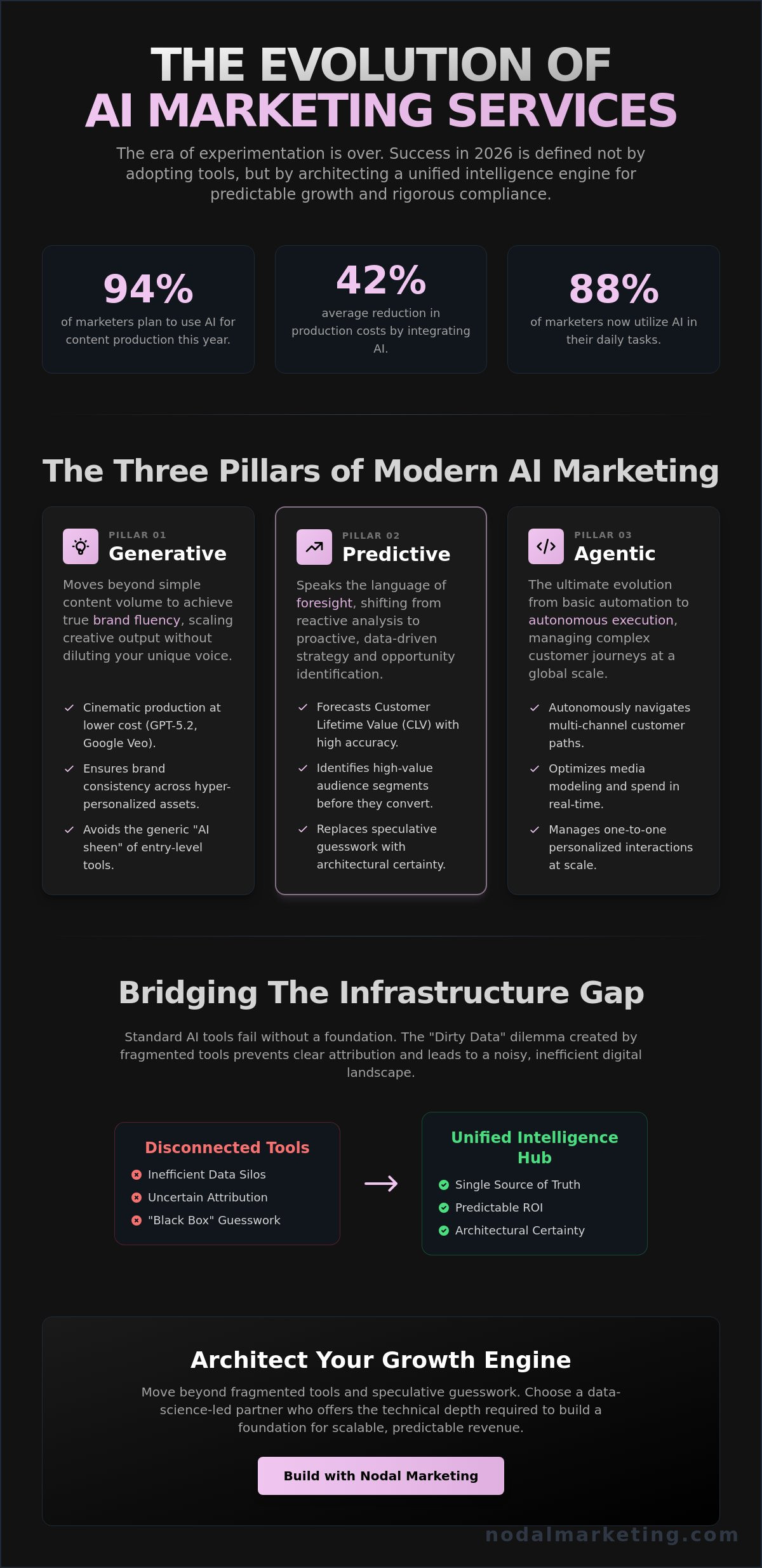
While most lists of ai marketing services focus on a disorganized collection of tools, true growth requires a structured architectural approach. In 2026, we categorize these capabilities into three distinct pillars: generative, predictive, and agentic. Each serves a specific function in your marketing ecosystem; together, they create an unprecedented competitive advantage. This is not about deploying software in a vacuum. It's about building an infrastructure where creative output, data foresight, and autonomous execution work in perfect harmony.
Generative AI and Brand Fluency
Content production is no longer a bottleneck. With 94% of marketers using AI for creative output in 2026, the challenge has shifted from volume to brand fluency. It's about ensuring your voice remains consistent across hyper-personalized video and social assets. Tools like GPT-5.2 and Google Veo allow for cinematic production at significantly lower costs, but they require a brand-aware infrastructure to avoid the generic "AI sheen" that plagues entry-level agencies. True generative power lies in the ability to scale without diluting your unique market positioning.
Predictive Analytics: Speak the Language of Foresight
Predictive analytics represents the language of foresight in a saturated digital landscape. Rather than reacting to historical data, machine learning models now forecast customer lifetime value (CLV) and identify high-value audience segments before they enter the funnel. As noted by Harvard on the future of AI in marketing, the ability to anticipate consumer behavior is the ultimate differentiator. This pillar transforms your media modelling from a reactive report into a proactive roadmap for capital allocation, allowing you to identify trends before they hit the mainstream.
Agentic AI: The New Frontier of Execution
Agentic AI is the most transformative shift of 2026. These are not just automated scripts; they are intelligent agents capable of managing end-to-end workflows. From autonomous bidding on Meta to real-time targeting adjustments on TikTok, agentic systems move marketing from manual execution to intelligent orchestration. They handle the complex "how" of performance marketing so your team can focus on the strategic "why." This shift ensures less guesswork and more certainty in every campaign, moving your brand toward a model of autonomous growth.
When these pillars converge, they form a unified intelligence hub. Generative AI creates the assets, Predictive AI identifies the targets, and Agentic AI executes the delivery. This is the foundation of intelligent growth architecture, ensuring your brand operates at the intersection of technology and human strategy. By integrating these three pillars, you don't just participate in the market; you lead it with architectural precision.
The Infrastructure Gap: Why Standard AI Tools Fail Without Data Science
Many organizations mistake software acquisition for strategic transformation. While 94% of marketers plan to scale content via AI in 2026, most will fail to see a significant ROI because they neglect the underlying data infrastructure. Standard ai marketing services often promise "intelligence" but deliver a mirror of your existing data silos. If your inputs are fragmented, your AI-driven bidding on TikTok or Meta will be equally erratic. True scaling requires more than a tool; it requires a disciplined data science foundation that serves as the bedrock for every automated decision.
The "Dirty Data" dilemma is the primary reason why "black box" technologies fail to deliver. AI is a powerful accelerator, but it accelerates whatever you feed it. If your customer data is trapped in disconnected legacy systems, your predictive models will produce flawed forecasts. This isn't just a technical inconvenience; it's a financial drain. Without a single source of truth, your attribution becomes guesswork, and your capital allocation becomes a gamble. We move our partners away from this uncertainty by treating data engineering as the prerequisite for any AI implementation.
Diagnosing the Fragmented Ecosystem
The modern data environment is often a collection of disconnected silos that prevent real-time attribution. These legacy systems create friction, making it impossible for Agentic AI to optimize campaigns with precision. For example, with the CCPA updates operative as of January 1, 2026, businesses meeting specific thresholds must now conduct annual cybersecurity audits, making rigorous data governance a legal mandate. Poor data quality doesn't just mislead your human team; it actively degrades the performance of the machine learning algorithms managing your ad spend. Our process focuses on diagnosing these challenges, identifying the underlying friction, and integrating solutions that "connect the dots" across your entire MarTech stack.
Building the Unified Intelligence Hub
Architecting a unified intelligence hub is about building for permanence rather than chasing the latest feature. This foundation supports every aspect of your growth engine, from hyper-granular audience segmentation to media modelling. It requires a partner who possesses technical fluency in both marketing dynamics and deep data engineering. A unified hub transforms raw, disparate data streams into a singular, transparent source of strategic certainty. By centralizing your intelligence, you eliminate the "infrastructure gap" and ensure your ai marketing services operate at peak efficiency. This methodical approach replaces the noise of the digital landscape with the calm authority of data-driven foresight.
Selecting Your Growth Partner: A Framework for Evaluating AI Marketing Agencies
The market for ai marketing services is currently saturated with generalist agencies rebranded as "AI-first" to capture executive attention. Selecting a partner in this environment is a decision of architectural permanence; the wrong choice leads to fragmented intelligence and wasted capital. In the same way that premium design studios like Nispero Kitchens focus on bespoke quality and structural integrity, you don't need a vendor to sell you a software subscription—you need an architect to build your digital infrastructure. The distinction between a tool-led approach and a service-led consultancy is the difference between purchasing a feature and investing in a future.
Agency vs. SaaS: The Strategic Choice
Standard SaaS platforms often provide "off-the-shelf" solutions that fail to account for the unique nuances of your brand voice or data ecosystem. While a tool might offer 1% of the price of an agency, it often results in oversimplified workflows that ignore enterprise complexity. A strategic consultancy provides bespoke machine learning models designed to integrate with your specific first-party data. This model favors depth over breadth, focusing on diagnosing challenges, identifying applications, and integrating solutions. While monthly retainers represent a higher initial commitment than a software seat, the ROI is found in the certainty of a unified growth engine rather than the variable performance of isolated tools.
The CMO’s Evaluation Checklist
To avoid the "black box" dilemma, every CMO should subject potential partners to a rigorous evaluation. Following the FTC’s March 11, 2026 policy statement on AI in commerce, transparency and explainability are no longer optional. Your evaluation should prioritize technical depth and strategic foresight over superficial features. Consider these five critical questions during your selection process:
- How does your platform integrate with our existing first-party data to eliminate silos?
- Can you demonstrate the "human-in-the-loop" protocols that ensure brand safety and compliance with the EU AI Act?
- Is your technology truly agentic, or is it merely a series of automated scripts?
- What specific data science qualifications do the architects of your media modelling possess?
- How do you provide transparency into the algorithmic decisions that drive our bidding and targeting?
The most successful partnerships utilize a "human-in-the-loop" model where AI handles the high-velocity execution while human experts provide the strategic oversight. This ensures that your brand fluency is never sacrificed for the sake of efficiency. We specialize in building these elite, reliable systems that move your brand from speculative guesswork to structured, intelligent growth. If you are ready to move beyond isolated tools and toward a unified intelligence hub, request a consultation with our strategic architects to begin connecting the dots of your data ecosystem.
Nodal Marketing: Architecting Certainty Through Unified Intelligence
Nodal Marketing isn't just another provider of ai marketing services; we are the architects of your digital infrastructure. While the industry remains trapped in a cycle of frantic tool adoption, we focus on the foundation. Our philosophy is grounded in intellectual rigor and pragmatic ROI. We believe in less guesswork and more certainty. By applying the principles of data science to the complexities of modern advertising, we transform fragmented data into a unified growth engine. Our global footprint, extending from London to Hong Kong, allows us to support enterprise-level scaling with a level of precision that generalist agencies simply cannot match.
Methodical Thoroughness: Our Process
We approach performance marketing with a disciplined, tripartite structure: diagnosing challenges, identifying applications, and integrating solutions. This methodical thoroughness ensures that every piece of technology we deploy serves a specific strategic purpose. We speak the dual languages of marketing dynamics and AI technology, serving as translators for brands navigating a saturated digital landscape. As strategic architects, we don't just manage campaigns. We build ecosystems that are resilient, compliant, and intensely focused on high-impact results. This level of depth is essential in 2026, as the full implementation of the EU AI Act this August demands total transparency in algorithmic decision-making.
Transformative Results: Case Studies in AI Scale
Our proprietary methodology, "Connect," serves as the hub for this unified intelligence. By integrating SEO, PPC, and Social data into a single source of truth, we provide the foresight that standard reporting lacks. For our global partners, this has meant scaling ad spend through predictive modeling that identifies high-value segments before they enter the funnel. One enterprise partner leveraged our media modelling to reduce content production costs by the industry average of 42% while increasing monthly output. Unified reporting doesn't just look better; it drives faster, smarter executive decisions by providing the clarity needed to lead.
The era of unregulated experimentation is over. If you are tired of the noise and ready for a growth partner that values precision over volume, it's time to build your hub. Partner with the architects of intelligent growth at Nodal Marketing to secure your competitive advantage in 2026.
The Future of Growth is Built on Certainty
The transition from experimental tools to agentic infrastructure is complete. As we move through 2026, the brands that thrive will be those that have successfully bridged the gap between marketing strategy and rigorous data science. High-impact ai marketing services are no longer defined by the tools they use, but by the unified intelligence hubs they architect. By resolving the fragmented data dilemma and integrating disparate silos into a single source of truth, you move from speculative guesswork to a model of structured, predictable performance.
Founded in 2018, Nodal Marketing operates at the intersection of technological fluency and marketing dynamics. With a global presence and our proprietary "Connect" AI platform, we provide the foresight and technical depth required to lead in a saturated digital landscape. We don't just manage your spend; we build the foundations for your long-term dominance. It's time to silence the noise and embrace the power of methodical, data-driven growth.
Architect your certain growth with Nodal Marketing. The path to unprecedented scale is ready for your leadership.
Frequently Asked Questions
What are AI marketing services?
AI marketing services represent a sophisticated integration of machine learning and strategic human oversight designed to architect growth. These services move beyond simple task automation to provide deep insights into media modelling and hyper-granular audience segments. By treating technology as infrastructure, they transform fragmented data points into a unified growth engine that provides strategic certainty.
How much do AI marketing services cost in 2026?
Costs depend on the scale of your infrastructure and chosen tools. In 2026, ChatGPT Plus is $20 monthly while their "Go" tier is $8. Enterprise-level platforms like HubSpot Marketing Hub Pro start at $800 per month; specialized ai marketing services utilizing tools like Surfer SEO or IBM Watson Assistant begin at $99 and $140 respectively. Custom consultancy fees reflect the complexity of your data science requirements.
Will AI replace traditional marketing agencies?
AI is not replacing agencies; it is replacing generalists with specialized, data-science-led partners. While 88% of marketers use AI daily, the technology requires human architects to ensure brand fluency and strategic alignment. The most successful teams use a hybrid model where machine learning handles high-velocity execution while human experts provide the visionary foresight needed to lead.
What is the difference between Generative AI and Predictive AI in marketing?
Generative AI focuses on creative production, utilizing tools like GPT-5.2 or Google Veo to scale text and video assets. Predictive AI uses machine learning models to forecast customer lifetime value and identify market trends before they hit the mainstream. Both pillars must be integrated into a unified intelligence hub to move your brand from reactive guesswork to proactive growth.
How do I know if my data is ready for AI marketing services?
Your data is ready when it is consolidated into a single source of truth rather than trapped in disconnected silos. Fragmented data prevents clear attribution and degrades the performance of machine learning algorithms. Given that the CCPA update operative as of January 1, 2026, requires annual cybersecurity audits for many businesses, rigorous data governance is now a prerequisite for effective ai marketing services.
What is Agentic AI and how does it improve marketing ROI?
Agentic AI consists of autonomous agents capable of managing end-to-end marketing workflows without constant manual intervention. They handle complex tasks like real-time bidding on Meta or targeting adjustments on TikTok with architectural precision. This shift to intelligent orchestration allows companies to reduce content production costs by an average of 42% while increasing monthly output and measurable performance.
How does Nodal Marketing handle data privacy and security?
We utilize a compliance-by-design approach that embeds security and transparency into every workflow. This includes adhering to the EU AI Act requirements coming into full effect on August 2, 2026, and the Colorado AI Act effective June 30, 2026. We prioritize human oversight and explainability to ensure your data remains a secure asset rather than a "black box" liability.
Can AI marketing services help with organic SEO as well as paid ads?
AI has fundamentally transformed organic discovery through the rise of generative search. As of February 2026, Google's AI Overviews appear on 48% of all queries, making it essential for brands to be cited in AI-generated responses. AI services optimize your presence in these search ecosystems while simultaneously refining the predictive bidding strategies used in paid social and search campaigns.