
The era of manual bidding as a competitive advantage is over; it's been replaced by a discipline of data science synthesis that many executives still treat as a black box. You likely feel the mounting pressure of opaque algorithms in Google and Meta, where rising acquisition costs and fragmented data silos make a clear view of ROI feel like a moving target. True ai powered ppc management isn't about surrendering control to a platform's automation. It's about building a sophisticated architecture that bridges the gap between your high-level commercial goals and technical execution.
In this guide, you'll discover how to transition from fragmented manual tactics to a unified, AI-orchestrated ecosystem that synthesizes precision ad execution with deep analytics. We'll outline a predictive framework for your ad spend that moves beyond reactive adjustments. You'll learn how to integrate data science into your daily operations, moving from diagnostic analysis to strategic identification and finally to full-scale integration. We'll also address critical 2026 shifts, such as the EU AI Act transparency obligations and Google's transition to AI Max, ensuring your strategy remains both compliant and dominant.
Key Takeaways
- Evolve your strategy from reactive bid adjustments to proactive algorithmic orchestration to outpace rising customer acquisition costs in saturated markets.
- Define ai powered ppc management as a systemic integration of machine learning into real-time bidding rather than a simple automation tool.
- Replace opaque "black box" automation with transparent intelligence that prioritizes intellectual rigor and executive oversight.
- Follow a structured implementation path by first diagnosing data environment integrity before building a unified hub for commercial and technical signals.
- Achieve synthesis by linking fragmented data points across search and social into a single, high-performance intelligence ecosystem.
The Paradigm Shift: Why Traditional PPC Management Fails in 2026
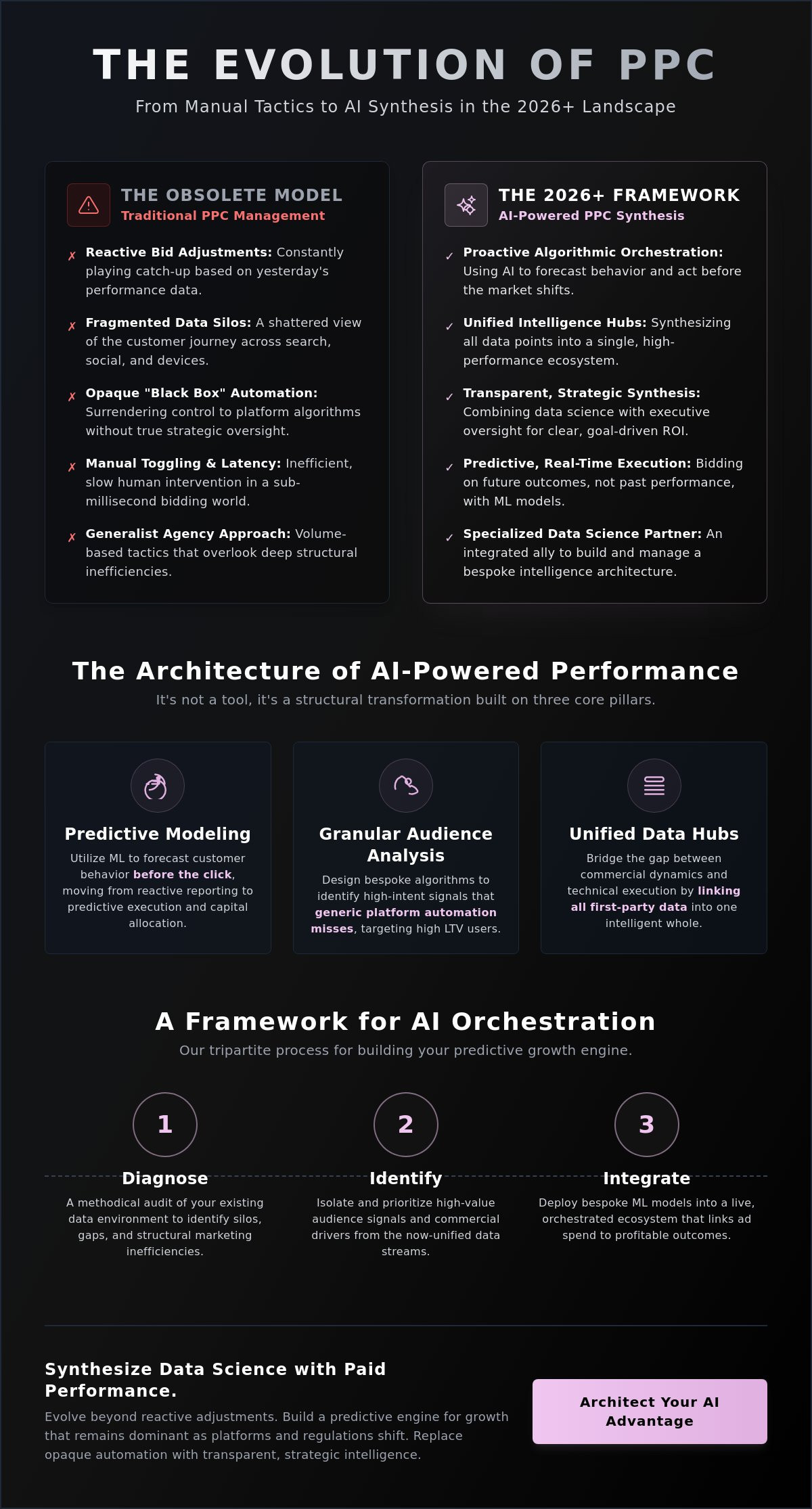
The traditional model of PPC management is no longer just inefficient; it's functionally obsolete. In 2026, the digital landscape has moved past the era of reactive bid adjustments where human managers manually toggled levers based on yesterday's performance. We're witnessing a fundamental transition toward proactive algorithmic orchestration. This evolution isn't about choosing between human intuition and machine speed. The "manual versus automated" debate is a false dichotomy that ignores the reality of modern scale. Success now requires a sophisticated ai powered ppc management framework that treats automation as the engine and data science as the navigator. Moving beyond the generalist agency model toward a specialized data science consultancy is the only way to maintain a competitive edge in a saturated market.
The Complexity of Modern Ad Environments
Fragmented touchpoints across devices and platforms have shattered standard attribution models. We're seeing a paradigm shift in advertising where volume-based tactics simply fail to account for the intricate paths users take before converting. A methodical thoroughness is now required to diagnose structural marketing inefficiencies that a generalist agency would likely overlook. Instead of casting wide nets, executives must invest in a precision-based architecture that synthesizes search and social signals into a single view of the customer. This isn't a task for a standard vendor; it's the work of a specialized partner that understands how to leverage AI marketing services to navigate these complex digital ecosystems and ensure every dollar of ad spend is backed by predictive modeling.
Not Automation, but Synthesis
True performance in 2026 is found in synthesis. The Nodal approach isn't about detached automation, but about linking disparate data points into a unified, intelligent whole. We've moved beyond the role of an external service provider to become a deeply integrated strategic ally. Our methodology focuses on bridging the gap between macro-level commercial dynamics and micro-level execution. This involves a tripartite process: first, the diagnosis of existing data silos; second, the identification of high-value audience signals; and finally, the integration of these insights into a live ai powered ppc management ecosystem. It's not about doing more work, but about ensuring every data point informs a singular, profitable outcome. By connecting commercial ambition with technological precision, we transform fragmented ad spend into a predictive engine for growth that remains stable even as platform algorithms fluctuate.
Defining the Architecture of AI-Powered PPC Management
AI-powered PPC management is the systemic integration of machine learning models into real-time bidding and audience synthesis. It is not a superficial layer of generative copywriting or image creation; it is a structural transformation of how data moves through the ad auction. At its core, this architecture relies on three primary pillars: predictive modeling, granular audience analysis, and unified data hubs. While generalist competitors treat AI as a bolt-on tool for efficiency, true algorithmic performance requires a foundational shift where first-party data serves as the primary building block. This systemic approach ensures that AI marketing campaigns utilize agentic intelligence to maintain continuous optimization without the latency of manual intervention.
The Mechanics of Predictive Ad Performance
The modern programmatic environment demands sub-millisecond decision making that human oversight cannot replicate. By utilizing machine learning to forecast customer behavior before the click occurs, we move from reactive reporting to predictive execution. Bespoke algorithms are designed to identify high-intent signals that generic, platform-level automation often misses. This level of precision allows for a sophisticated allocation of capital, ensuring that spend is directed toward users with the highest lifetime value potential. It's not about bidding on keywords; it's about bidding on outcomes through a disciplined application of data science.
Unified Intelligence Hubs vs. Fragmented Dashboards
Marketing certainty is built on structural integrity, not fragmented dashboards. A unified intelligence hub connects your CRM data, web analytics, and ad platforms into a single source of truth, eliminating the data silos that prevent a clear view of ROI. This synthesis allows for bespoke reporting solutions that provide executive-level clarity on how technical execution impacts commercial goals. When you bridge the gap between disparate data points, you move from a state of diagnostic confusion to one of strategic mastery. If your current framework lacks this level of systemic cohesion, it may be time to partner with a consultancy that prioritizes precision-engineered data architecture over simple campaign management.
In the 2026 landscape, the ad auction is won by those who possess the most refined data modeling. By establishing a unified intelligence ecosystem, you ensure that every algorithmic decision is grounded in your specific business logic. This creates a self-reinforcing loop where better data leads to better models, which in turn drive superior returns. It's a move from the chaotic to the composed, providing the stability needed to scale in increasingly competitive digital markets.
Strategic Intelligence vs. Blind Automation: Solving the PPC Black Box Problem
The black box isn't an inevitability; it's a symptom of a detached management model. Executives often fear that adopting AI means surrendering their brand to an unaccountable system where logic is obscured and spend is untethered from strategy. This concern is valid when automation is treated as a replacement for oversight. In 2026, enterprise brands must demand a model of transparent intelligence that prioritizes intellectual rigor over blind trust. True ai powered ppc management functions as a glass box, providing full visibility into how algorithms interpret your commercial goals. By establishing proprietary performance guardrails, you ensure that machine speed is always directed by human intent.
The emergence of AI agents for marketing has fundamentally changed the relationship between advertisers and platforms. These agents act as strategic auditors, continuously monitoring platform bidding behavior to ensure alignment with your specific business logic. They provide the necessary friction against the "set it and forget it" mentality that often leads to inefficient spend. Ownership of your algorithmic logic is no longer optional; it's a requirement for maintaining brand integrity in an increasingly automated auction.
Eliminating Algorithmic Opaque-ness
The shift from trusting the platform to verifying the data is the hallmark of a mature digital operation. Advanced analytics now allow us to audit platform bidding behavior in real-time, identifying when an algorithm's pursuit of volume conflicts with your pursuit of profit. We use a technical data science lexicon to define performance guardrails that prevent the "drift" often seen in generic automation. This methodical approach ensures that every bid is a calculated decision rather than a statistical guess. With the EU AI Act transparency obligations taking full effect in August 2026, having a system that can explain its synthetic outputs isn't just a strategic advantage; it's a regulatory necessity.
Predictive Modeling for Customer Lifetime Value (CLV)
Optimizing for immediate ROAS is a strategic failure for enterprise brands seeking long-term stability. It's a short-sighted metric that ignores the future value of a customer in favor of a quick win. Modern ai powered ppc management utilizes predictive modeling to identify and bid for high-value users based on their projected lifetime value. This represents a transition from reactive reporting to visionary confidence in spend. We help you move from a state of chasing clicks to one of architecting growth. This approach involves three distinct phases: the identification of high-value signals, the modeling of long-term behavior, and the integration of these insights into live bidding environments. By focusing on CLV, you move beyond the noise of the auction and focus on the structural building blocks of sustainable revenue.
A Framework for Implementing AI-Orchestrated Ad Environments
Implementing a high-performance ai powered ppc management ecosystem requires a transition from fragmented experimentation to methodical orchestration. Success is not achieved through the mere adoption of new software, but through the rigorous design of a data-first architecture. This framework follows a logical progression from diagnosis to identification and finally to systemic integration. By treating your ad environment as a structured system rather than a collection of campaigns, you create the stability necessary for scalable growth.
The implementation process begins with a deep-dive diagnosis of your existing data environment to verify tracking integrity across every touchpoint. Once the foundation is secured, we architect a unified data hub designed to connect disparate commercial signals, such as CRM data and offline conversions, with technical execution points. The third phase involves the deployment of bespoke machine learning models that dictate bidding and audience segmentation with granular precision, moving beyond the limitations of standard platform tools. Finally, we establish a continuous feedback loop between live execution and strategic intelligence. This ensures the system doesn't just execute, but learns and adapts to shifting market conditions in real-time.
The Diagnosis Phase: Identifying Structural Inefficiencies
Strategic failure often stems from the hidden costs of "dirty data" within a legacy PPC stack. If the information feeding your algorithms is flawed, the resulting automation will only accelerate your inefficiencies. We analyze the gap between your macro-level marketing dynamics and micro-level technical execution to identify where signals are being lost. Establishing this baseline of certainty is critical before scaling algorithmic spend. It's not about moving faster; it's about moving with greater precision. By auditing your structural health, we eliminate the diagnostic confusion that plagues generalist approaches.
Integration: Building for Methodical Thoroughness
True integration requires selecting MarTech stacks that align with your overarching commercial ambitions rather than just tactical needs. This is where data science consulting services become indispensable; they provide the technical expertise needed for custom model development that bridges the gap between raw data and profitable action. We ensure your ecosystem is scalable across global markets, maintaining stability even when operating across disparate platforms and varying regulatory environments. This architectural approach allows for a unified intelligence that generalist vendors simply cannot replicate. If you're ready to move beyond fragmented tools and build a unified performance engine, explore our bespoke reporting and integration solutions. Marketing certainty is a byproduct of structural integrity; it's time to build for the long term.
Nodal Marketing: Synthesizing Data Science with Paid Performance
Nodal Marketing bridges the gap between commercial ambition and technological precision. We don't rely on the frantic, high-energy tactics of entry-level agencies; we opt instead for a composed, executive-level discourse grounded in measurable results and intellectual rigor. Our proprietary methodology focuses on the concept of synthesis, linking fragmented data points into a unified intelligence hub that serves as the foundation for your growth. This approach ensures that ai powered ppc management isn't a detached service, but a deeply integrated component of your business architecture. Enterprise brands choose us because we prioritize the structural integrity of their data over short-term, volume-based gains.
The long-term value of a strategic partnership with Nodal Marketing lies in our ability to act as a translator between complex marketing dynamics and technical execution. We move through a methodical process of diagnosis, identification, and integration to ensure every algorithmic decision aligns with your macro-level business goals. This isn't about opaque automation; it's about transparent intelligence that provides the clarity needed to scale with certainty. By establishing a unified whole from disparate signals, we provide a level of strategic mastery that generalist vendors simply cannot replicate.
Architecting Marketing Certainty
Our approach to predictive modeling allows for accurate customer behavior forecasting before the click even occurs. By deploying bespoke AI tools, we significantly improve enterprise programmatic ROI while maintaining the strategic control you require. We've moved beyond the traditional vendor relationship to become a deeply integrated strategic ally. This partnership allows us to build precision-engineered ai powered ppc management systems that adapt to market shifts in real-time. We focus on the building blocks of your business, ensuring that every data point contributes to a state of marketing certainty rather than diagnostic confusion.
Your Visionary Path to Market Dominance
The digital landscape of 2026 is defined by volatility and increasing algorithmic complexity. We invite you to move from digital chaos to a state of structured growth through a stable, data-first partnership. Maintaining market dominance requires more than just reactive adjustments; it demands a visionary approach to data science and paid performance. It's time to replace fragmented tools with a unified intelligence engine that drives sustainable revenue. Engage Nodal Marketing for a Strategic Data and PPC Audit to begin your transition from opaque automation to precision-engineered success. Your path to market leadership is built on the synthesis of ambition and technical mastery.
Architecting the Future of Algorithmic Performance
The transition from manual bid management to a unified, AI-orchestrated ecosystem isn't a luxury; it's a structural requirement for enterprise growth in 2026. We've explored how a precision-based architecture replaces the diagnostic confusion of fragmented data silos with the clarity of a unified intelligence hub. By prioritizing intellectual rigor and predictive modeling over opaque platform automation, you regain strategic control of your customer acquisition costs. True ai powered ppc management serves as the bridge between your macro-level commercial ambitions and the micro-level technical execution required to achieve them.
As a global consultancy specializing in the synthesis of fragmented data into unified intelligence, Nodal Marketing helps enterprise brands navigate this complex digital landscape. Our methodical, data-first approach ensures that your marketing technology stack isn't just a collection of tools, but a scalable engine for ROI. We act as a deeply integrated strategic partner, providing the technical expertise needed to translate business goals into algorithmic success.
Architect Your AI-Powered PPC Future with Nodal Marketing and move from digital chaos toward composed, structured growth. Your path to market dominance begins with a foundation of certainty.
Frequently Asked Questions
What is the difference between AI-powered PPC management and standard Google Ads automation?
Standard automation is a platform-specific toolset designed to optimize within a single ecosystem; ai powered ppc management is a systemic data science discipline that operates across your entire digital landscape. While platform tools often prioritize volume to satisfy their own algorithms, a bespoke AI framework synthesizes data across multiple channels to prioritize your specific business logic. This move from generic levers to a precision-engineered architecture ensures that spend is directed by your commercial goals rather than a platform's internal targets.
How does data science improve the ROI of enterprise PPC campaigns?
Data science improves ROI by replacing reactive bid adjustments with predictive modeling and granular audience synthesis. It allows for the identification of high-value signals within disparate data sets, enabling you to bid based on projected customer lifetime value rather than immediate clicks. This methodical approach reduces capital waste by ensuring every dollar of ad spend is backed by technical rigor and a deep understanding of customer behavior patterns.
Can AI-powered PPC management work without third-party cookies?
Yes, this framework is specifically designed to thrive in a cookieless landscape by shifting the foundation to first-party data. By architecting a server-side tracking environment and utilizing machine learning to model audience behavior, you maintain precision without relying on external tracking. This transition from fragmented signals to internal data modeling ensures long-term stability and compliance with evolving privacy regulations.
What are the risks of using "black-box" AI in digital advertising?
The primary risk is the erosion of strategic control and intellectual rigor. When algorithms operate without transparent guardrails, they can optimize for vanity metrics that don't align with your high-level commercial dynamics. This opaque-ness often leads to "algorithmic drift," where the system prioritizes short-term efficiency over the structural building blocks of sustainable growth and brand integrity.
How do you ensure transparency in AI-driven bidding strategies?
Transparency is achieved by deploying strategic auditing agents that monitor platform bidding behavior in real-time. Instead of trusting platform-level reporting, we use bespoke reporting solutions to verify data integrity and algorithmic logic. This creates a "glass box" environment where executives can audit every technical execution against their macro-level strategic intent, ensuring the machine speed is always directed by human intent.
Is AI-powered PPC management suitable for B2B enterprise brands?
It is essential for B2B brands dealing with long sales cycles and high-value lead generation requirements. AI-powered ppc management identifies the specific signals that lead to long-term revenue rather than just immediate lead volume. By linking CRM data with live bidding environments, we ensure your marketing spend is perfectly aligned with the nuanced requirements of enterprise-level commercial ambition.
What role do unified intelligence hubs play in modern marketing?
Intelligence hubs act as the structural foundation of a unified marketing ecosystem. They link fragmented data points from disparate platforms into a single source of truth, eliminating the data silos that prevent a clear view of performance. This synthesis allows for the creation of a predictive framework where every technical execution is informed by a holistic view of the business, moving you from diagnostic confusion to strategic mastery.
How long does it take to implement a bespoke AI-driven PPC framework?
A bespoke framework typically requires a 90 to 120 day implementation period to reach full orchestration. The process begins with a 4 to 6 week diagnosis of your existing data environment and tracking integrity to establish a baseline of certainty. This is followed by the identification of proprietary signals and the final integration of machine learning models into your daily PPC operations, ensuring a scalable and stable performance engine.