
The pursuit of a single, perfect source of truth is no longer a viable strategy; it's a legacy distraction that stalls executive growth. While 38% of marketers still cite attribution as their greatest analytics challenge, the most successful brands have stopped chasing perfection. They've shifted toward a directional-truth mindset where professional marketing attribution consulting serves as the bridge between raw data and commercial clarity. You've likely experienced the frustration of fragmented data silos across global regions and a MarTech stack that commands a premium price but delivers an opaque ROI. This gap between investment and insight isn't just a technical hurdle. It's a strategic bottleneck.
By reading further, you'll learn how to transcend these fragmented reports and architect a unified intelligence ecosystem. We'll show you how to move from diagnosis to identification and finally to integration, ensuring your data science actually dictates your commercial strategy. This article provides a clear roadmap for MarTech integration and predictive insights, teaching you to translate technical complexity into a language of executive-level ROI that secures your budget for the years ahead.
Key Takeaways
- Understand why marketing attribution consulting is the critical architectural discipline needed to link fragmented global data to definitive revenue outcomes.
- Explore the technical foundations of a unified intelligence hub, moving from isolated data points to a systemic framework of strategic application.
- Shift your focus from mere dashboard consumption to strategic architecting, ensuring your MarTech stack delivers clarity rather than analysis paralysis.
- Master a methodical five-pillar roadmap-moving from initial audit and diagnosis to final integration and optimisation-for a seamless data ecosystem.
- Leverage AI-powered insights to bridge the gap between technical execution and executive-level ROI, creating a predictive model for future budget allocation.
The Attribution Crisis: Why Strategic Consulting Outperforms Tool-Centric Reporting
Traditional reporting functions like a rearview mirror. It captures the echoes of past decisions without illuminating the path forward. In contrast, marketing attribution consulting operates as an architectural discipline; it's the methodical process of linking fragmented data points to definitive revenue streams through structural integrity. Most enterprises rely on off-the-shelf tools that promise automated clarity. These platforms often fail because they're designed for generic ecosystems, not the nuanced, multi-regional complexities of a global brand. When your data stays siloed across different territories and platforms, a standard dashboard doesn't provide a solution. It merely visualizes the chaos.
The "Dirty Data" problem remains the silent killer of marketing ROI. It's a foundational truth: your AI-powered insights are only as robust as the data they consume. Poor data hygiene creates a scenario where strategic decisions are based on statistical noise rather than commercial reality. Professional marketing attribution consulting moves beyond the surface. It involves a rigorous cycle of diagnosis, identification, and integration. We don't just install a tool; we build a unified intelligence hub that cleanses and synthesizes inputs before the first model is ever run. This ensures that the intelligence you receive is grounded in certainty, not just probability.
The Shift to Prospective Intelligence
Modern strategy demands a shift from descriptive analytics to predictive modeling. It's not enough to know which ad was clicked yesterday; you need to understand the projected customer lifetime value of the audience segments you're reaching today. Synthesis is the key. By linking disparate touchpoints into a unified whole, we help brands predict where the next dollar will be most effective. This isn't just reporting. It's the strategic application of data science to refine budget allocation for global scale, ensuring stability in a volatile digital landscape.
Why Generalist Agencies Struggle with Attribution
Generalist agencies often provide standard reporting that focuses on vanity metrics. They lack the technical depth to offer bespoke reporting solutions that align with specific business goals. A partner must possess dual expertise: a deep understanding of marketing dynamics and a mastery of technical execution. This is the role of the Strategic Architect. We don't just manage campaigns. We build the performance marketing ecosystems that AI performance marketing agencies use to scale ROI with intellectual rigor and visionary confidence.
Architecting the Intelligence Hub: Technical Foundations for 2026
To build a resilient commercial strategy, one must look past the surface interface of standard tools and focus on the architecture beneath. The intelligence hub isn't a single software purchase; it's a systemic synthesis of Data Infrastructure, Unified Modeling, and Strategic Application. In an era where 56% of marketers report that privacy regulations have complicated their tracking, the reliance on browser-based cookies has become a liability. We advocate for server-side tracking as a non-negotiable standard. This approach bypasses browser limitations, ensuring that your data streams remain uninterrupted and your audience analysis remains granular. By leveraging specialized data analytics consulting services, brands can move Beyond Traditional Attribution Models and establish a foundation of absolute certainty.
The goal is to create a unified ecosystem where disparate data sources, from CRM deals to TikTok ad campaign performance, converge into a single directional truth. This requires more than just technical connectivity. It demands a strategic partner who can bridge the gap between marketing dynamics and technical execution. Professional marketing attribution consulting ensures that your MarTech stack isn't just a collection of expensive tools, but a cohesive engine that drives executive-level ROI.
Pillar 1: Advanced Data Governance and Tracking
Data governance is the bedrock of automated intelligence. Without clean, structured inputs, even the most sophisticated AI models will produce distorted results. Architecting a complex data environment requires connecting API-driven streams across diverse global regions, ensuring every touchpoint is captured with precision. This custom-built infrastructure allows for the level of granular audience analysis that off-the-shelf solutions simply cannot replicate. It's about moving from raw collection to refined intelligence, a process that ensures your data is ready for the rigours of machine learning training.
Pillar 2: Custom Machine Learning and Predictive Models
Transitioning from simple, rule-based attribution to unified data modeling requires a deep integration of data science. Through bespoke data science consulting services, we develop machine learning models that account for the "dark funnel" of untrackable user activity. Our approach doesn't just look at what happened; it predicts what's likely to occur. By synthesizing historical performance with real-time variables, we create a predictive roadmap for future budget allocation. If you're ready to move beyond fragmented reporting, consider how a bespoke attribution strategy can transform your MarTech spend into visible ROI.
- Diagnosis: Identifying the cracks in current data collection.
- Identification: Mapping the 6.5 to 14 touchpoints typical of modern customer journeys.
- Integration: Building the automated pipelines that feed your intelligence hub.
The Strategic Architect vs. The Dashboard Vendor
True commercial clarity is not found in the volume of data points collected, but in the precision with which they are synthesized. Many enterprises fall into the trap of hiring a dashboard vendor when what they actually require is a strategic architect. A vendor delivers a static interface; an architect builds a dynamic ecosystem. This distinction is critical because Beyond Traditional Attribution Models, the value lies in the interpretation of complexity, not just its visualization. When you engage in professional marketing attribution consulting, you aren't just buying a view of your spend. You're investing in a structural framework that translates technical execution into executive-level ROI.
The marketplace is saturated with solutions that lead directly to analysis paralysis. Without a strategic layer, a dashboard is merely an expensive digital paperweight. It presents what happened without explaining why it matters or what to do next. This is where the modern data analytics company differentiates itself. We don't just act as a service provider. We function as a translator, possessing the linguistic mastery to bridge the gap between the CMO's commercial vision and the data scientist's technical reality. It's a methodical approach that values depth over breadth, moving beyond the frantic pace of generalist agencies toward a more composed, results-driven discourse.
Dashboards vs. Intelligence Hubs: A Comparison
Static reporting creates a significant manual overhead for executive teams who must spend hours deciphering conflicting metrics. In contrast, an intelligence hub uses automated intelligence to link commercial goals directly to technical performance. These bespoke reporting solutions act as a unified engine, providing a directional truth that allows for rapid, confident decision-making. It's the difference between looking at a map and having a GPS that predicts traffic patterns before they emerge. By reducing manual overhead, we allow your team to focus on strategy rather than spreadsheet maintenance.
The Translator Role: Bridging the Divide
The efficacy of our marketing attribution consulting is rooted in a tripartite process of diagnosis, identification, and integration. We begin by diagnosing the structural weaknesses in your current data silos. We then move to the identification of granular audience behaviors that drive revenue. Finally, we execute the integration of these insights into your broader MarTech stack. This thoroughness ensures that your marketing dynamics are perfectly aligned with your business objectives, creating a stable foundation for long-term growth. We don't just show you the data. We architect the intelligence that makes that data indispensable.
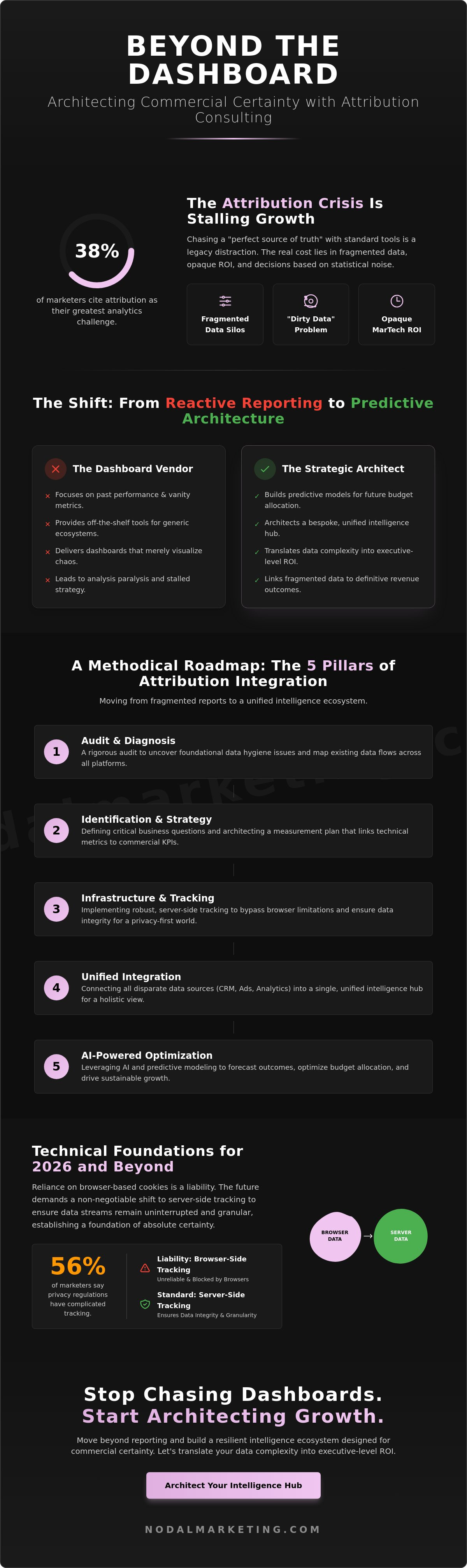
A Methodical Roadmap: The 5 Pillars of Attribution Integration
The transition from fragmented reporting to a unified intelligence hub requires a disciplined, linear progression. Many organizations rush to purchase software before they have defined the structural requirements of their data environment. This is where professional marketing attribution consulting provides the necessary friction; it forces a pause to architect a blueprint before a single line of integration code is written. Our framework follows a tripartite rhythm of diagnosis, identification, and integration, expanded into five rigorous pillars designed for the enterprise landscape of 2026.
- Audit: Identifying blind spots in cross-channel tracking where revenue attribution is lost.
- Diagnosis: Evaluating data quality and the efficacy of the existing MarTech stack.
- Design: Architecting the strategic blueprint for a centralized intelligence hub.
- Integration: Connecting CRM, social, and search streams into a unified whole.
- Optimisation: Refining models for predictive accuracy and strategic budget allocation.
Implementation without a blueprint is a recipe for technical debt. Through methodical analytics consulting, we ensure each phase is executed with precision, moving your organization from reactive reporting to proactive commercial strategy. This roadmap isn't just a guide; it's the structural foundation for your future ROI.
Phase 1 & 2: Ecosystem Audit and Strategic Diagnosis
Before building, one must assess the stability of the ground. We begin by evaluating the efficacy of your current MarTech stack to identify "blind spots" in cross-channel tracking where revenue attribution is lost. A Data Audit is the diagnostic baseline for all strategic growth. In B2B environments, where the average customer interacts with over 14 touchpoints before converting, the primary pitfall is often a failure to account for this complexity. Standard models often overlook the middle of the funnel, leading to poor budget allocation. We expose these gaps and establish a clean data foundation for future machine learning training.
Phase 3 & 4: Architectural Design and System Integration
Once the diagnosis is complete, we move into the architectural phase. This is not about simple connectivity; it's about creating a unified whole from fragmented international data points. We design the technical support systems required to link your CRM, paid social, and paid search data into a central hub. This process ensures that your global regions aren't operating in isolation. By synthesizing these disparate streams, we provide the technical execution necessary to bridge the gap between marketing dynamics and commercial results. If you're ready to move past superficial reporting, partner with our strategic architects to begin your data transformation.
The Nodal Perspective: Synthesising AI and Commercial Certainty
Commercial certainty in 2026 isn't found in the volume of data you collect, but in the precision with which that data is architected into a unified intelligence hub. At Nodal Marketing, we position ourselves as the strategic designer of performance marketing ecosystems. We don't just provide reports; we build the structural frameworks that allow data science to dictate commercial strategy. By moving from diagnosis to identification and finally to integration, we help global enterprises transcend the limitations of fragmented data silos. This is not merely about tracking clicks, but about architecting a unified intelligence hub that translates complex interactions into definitive revenue outcomes.
As one of the leading AI performance marketing agencies, we understand that attribution is the engine of scale. Without a granular understanding of how every touchpoint contributes to the journey, budget allocation remains a matter of guesswork. Professional marketing attribution consulting provides the intellectual rigor needed to manage complex, multi-regional ad spend with visionary confidence. In a landscape where the average B2B journey involves 14 touchpoints, a global partner who can bridge the gap between technical execution and marketing dynamics is no longer optional. It's an essential requirement for stability.
Bespoke Solutions for Enterprise Scale
Generic SaaS platforms often fail to capture the specific nuances of an enterprise data environment. They offer a "one size fits all" approach that ignores the unique building blocks of your business. Nodal focuses on bespoke solutions, developing custom machine learning models that provide intellectual superior insights. These models are built to handle the "dark funnel" of untrackable activity, ensuring your strategic decisions are based on directional truth rather than incomplete snapshots. We prioritize precision over volume, opting for a composed discourse that values depth and measurable results.
Implementing the Intelligence Blueprint
The management of performance marketing must be viewed through a permanent attribution lens. Our approach involves the ongoing optimization of bidding and targeting through proprietary AI tools that adapt to real-time market shifts. We don't just set a strategy and walk away; we act as an indispensable, deeply integrated ally. This methodical thoroughness ensures that your MarTech stack remains perfectly aligned with your evolving commercial goals. If you're ready to move beyond static reporting and embrace a future of predictive intelligence, it's time to refine your foundations. Enquire about a strategic attribution audit with Nodal Marketing to begin architecting your path to executive-level ROI.
Securing Commercial Certainty in a Fragmented Future
Transitioning from fragmented reporting to a unified intelligence ecosystem is no longer a technical luxury; it's a strategic mandate for the modern enterprise. By adopting a methodical roadmap of diagnosis and integration, your brand can move past the limitations of static dashboards and legacy silos. Professional marketing attribution consulting acts as the catalyst for this transformation. It ensures that your MarTech spend translates into visible, executive-level ROI through structural integrity and intellectual rigor.
Nodal Marketing has operated as a specialized data science consultancy since 2018. We are AI-powered performance marketing specialists who provide bespoke reporting for global enterprise scale. We don't just provide data; we architect the structural frameworks that allow your commercial vision to thrive in a volatile digital landscape. It's time to bridge the gap between marketing dynamics and technical execution with a partner that values precision over volume. Architect Your Marketing Intelligence with Nodal and begin your journey toward predictive clarity today. Your future growth depends on the stability of your data foundations.
Frequently Asked Questions
What is the primary difference between a tool and a marketing attribution consultant?
A tool provides a static interface for data collection; a consultant architects a dynamic ecosystem for strategic intelligence. While software captures raw touchpoints, a consultant translates those data points into a coherent commercial strategy. It is the distinction between possessing a map and engaging a strategic designer who builds the infrastructure necessary to navigate a complex digital landscape.
How does marketing attribution consulting help with cross-channel budget allocation?
Consulting establishes a unified intelligence hub that identifies the true weight of every touchpoint across global regions. By moving beyond the limitations of last-click models, we use data science to predict where your next dollar will yield the highest ROI. This ensures your budget is allocated based on directional truth rather than the fragmented, often conflicting reports provided by individual platforms.
What are the most common data gaps found during an attribution audit?
The most frequent gaps include "dark funnel" activity, misclassified AI search traffic, and broken hand-offs between CRMs and ad platforms. Audits often reveal that traffic from AI search interfaces is misclassified as direct or referral, which obscures its true origin. We identify these blind spots to ensure your AI-powered insights are trained on a foundation of clean, structured data.
How long does it typically take to implement a unified intelligence hub?
Implementation follows a methodical tripartite process of diagnosis, identification, and integration that typically spans several months. The exact timeline depends on the complexity of your international data silos and the current state of your data governance. We prioritize methodical thoroughness and systemic stability over a rushed, superficial setup that fails to deliver long-term commercial clarity.
Can attribution consulting help with privacy-first tracking?
Professional marketing attribution consulting addresses privacy limitations by architecting server-side tracking and robust first-party data strategies. We help brands move beyond a reliance on third-party cookies toward a resilient framework that maintains granular audience analysis. This approach ensures compliance with evolving regulations like GDPR and the AI Act while preserving the integrity of your marketing intelligence.
What is the ROI of hiring an attribution consultant vs. using an in-house team?
A consultant provides specialized intellectual rigor and cross-industry insights that in-house teams, often focused on daily operations, may lack. While your internal team manages execution, the consultant acts as a strategic architect who bridges the gap between technical data science and CMO-level strategy. Companies that effectively use this specialized guidance see a 15% to 30% higher marketing ROI through the elimination of wasted ad spend.
Do I need to replace my entire MarTech stack to work with a consultant?
Replacement is rarely the primary objective; synthesis is the goal. We evaluate the efficacy of your existing tools and identify the specific building blocks needed to link them into a unified whole. Our focus is on integrating disparate data sources into a central hub that enhances your current investments rather than discarding them for a generic, off-the-shelf alternative.
How does AI-driven predictive modeling change the attribution landscape in 2026?
In 2026, marketing attribution consulting uses AI to shift from retrospective reporting to prospective intelligence. Predictive models now account for the 6.5 to 14 touchpoints typical of modern customer journeys, allowing marketers to simulate budget scenarios and anticipate behavior before it occurs. This transition ensures that your commercial strategy is dictated by data science rather than historical echoes.