
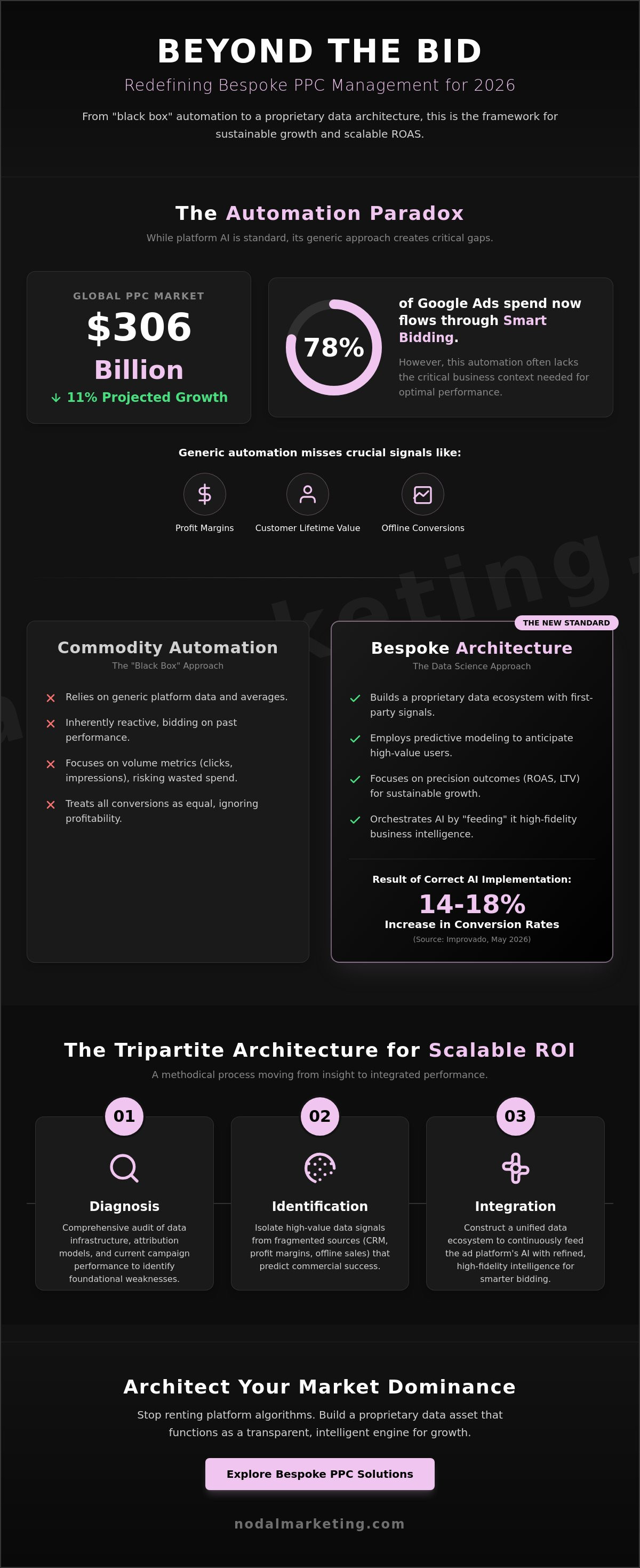
The $306 billion global PPC market has reached a critical inflection point where automation is no longer a luxury; it is a baseline. While 78% of Google Ads spend now flows through Smart Bidding, generic algorithms frequently fail to capture the subtle complexities of high-stakes enterprise markets. True bespoke ppc management in 2026 is not a rejection of AI; it is a sophisticated orchestration of it. It requires moving beyond standard campaign settings to build a proprietary data architecture that translates raw clicks into meaningful business intelligence.
You've likely seen how "black box" automation leads to wasted spend when it lacks the context of your specific margins or customer lifetime value. We understand that your goal isn't just more traffic, but a sustainable way to scale ROAS through precision and technical rigor. This guide provides the framework to distinguish commodity services from high-performance strategies that function as an extension of your data team. We'll examine how to move from diagnostic audits to signal identification and finally to full system integration, ensuring your paid media becomes a transparent engine for growth.
Key Takeaways
- Understand how to align data science with media buying to create a strategic framework that transcends basic automated bidding.
- Learn the mechanics of "algorithmic feeding" and why high-fidelity data inputs are the primary driver of AI-powered campaign performance.
- Identify the specific operational markers of bespoke ppc management to distinguish strategic architects from agencies that rely on generic automation.
- Equip yourself with the essential technical and commercial questions required to evaluate a partner's ability to synthesize disparate data sources.
- Discover a methodical tripartite approach to marketing architecture that moves from initial diagnosis to full system integration for scalable ROI.
Beyond the Bid: Redefining Bespoke PPC Management for 2026
The era of the tactical "button-pusher" has reached its conclusion. In 2026, Pay-per-click (PPC) is no longer a game of manual bid adjustments; it's a discipline of architectural oversight. Bespoke ppc management represents a strategic alignment where data science meets media buying. It's not about the volume of ads, but the precision of the signals. While entry-level agencies rely on high-energy sales pitches and frantic activity, the sophisticated executive seeks a calm, expert guide. This partner doesn't just react to market noise. They architect a stable foundation for scalable ROI by focusing on intellectual rigor over simple volume.
The Evolution of the PPC Landscape
The $306 billion global PPC market is projected to grow by 11% this year, yet this expansion brings increased complexity. Platform automation has effectively commoditized the basic tasks of keyword selection and bidding. With 78% of Google Ads spend now managed through Smart Bidding, the competitive edge is no longer found within the platform's standard interface. Standard "off-the-shelf" management fails because it treats every enterprise like a generalist, missing the niche nuances of your specific market. The value has shifted from campaign setup to data integrity and the quality of the signals fed into the machine. A specialized AI performance marketing agency recognizes that the algorithm is only as effective as the data it consumes. We move beyond the "black box" by providing the strategic oversight necessary to ensure AI serves your specific business objectives rather than platform averages.
Why "Bespoke" is a Data Strategy, Not Just a Service
Bespoke ppc management is not a collection of manual tweaks; it is the construction of a proprietary ecosystem. This approach requires a synthesis of fragmented data points, linking CRM insights, offline conversions, and real-time profit margins into a unified whole. It's a methodical process of diagnosis, identification, and integration. We don't settle for volume-based metrics that often mask poor attribution or wasted spend. Instead, we focus on precision-based outcomes that connect marketing performance directly to actual business intelligence. By treating PPC as a structural component of your data architecture, we transform a simple ad channel into a sophisticated engine for sustainable growth. This isn't about pushing buttons. It's about designing the frameworks that define your market dominance in an increasingly crowded digital landscape.
The Architecture of Performance: How Data Science Powers Bespoke PPC
High-performance search marketing is no longer about responding to the market; it's about anticipating it. While competitors focus on finding high-intent users through standard platform tools, bespoke ppc management leverages proprietary machine learning to define intent before the click occurs. This isn't a surface-level adjustment. It's an integration of advanced analytics that ensures the underlying search algorithms receive only the highest quality data signals. We call this "algorithmic feeding." By providing the machine with refined, first-party data rather than raw platform noise, brands can achieve the 14-18% increase in conversion rates observed by Improvado in May 2026 when AI is implemented correctly.
The value of this approach lies in its precision. It requires a shift from viewing PPC as an isolated channel to seeing it as a structural component of your business intelligence. This methodology doesn't just manage ads; it architects a data ecosystem where every dollar spent is informed by a unified view of your commercial landscape. It's a move from vanity metrics to measurable stability, ensuring that your scaling efforts are grounded in mathematical rigor rather than platform optimism.
Predictive Modeling vs. Reactive Bidding
Standard automation is inherently reactive. It looks at what happened yesterday to decide what to spend today. Predictive modeling reverses this dynamic. By forecasting customer lifetime value (CLV) directly within the campaign architecture, we identify high-value signals that generalist automation simply cannot perceive. A predictive bid adjustment is a core differentiator for 2026, allowing an AI-driven marketing strategy to bypass low-margin traffic in favor of long-term profitability. This foresight ensures your budget is always allocated to the segments with the highest potential for sustainable growth.
Unified Intelligence Hubs: Connecting PPC to the Business
The gap between a lead and a sale is where ROI often goes to die. Bridging this chasm requires a unified intelligence hub that links CRM data directly with ad platform APIs. This isn't a mere convenience. It's a necessity for eliminating attribution blind spots. When marketing technology and data science are synthesized, the result is a move from siloed ads to systemic marketing intelligence. This structural approach allows you to architect a more resilient performance engine that scales with certainty. Bespoke reporting solutions then serve as the final layer, translating technical data science execution into commercial certainty for the executive suite. While 45% of PPC managers now use AI for basic reporting, according to Digital Applied research from April 2026, these automated summaries often lack business context. True bespoke reporting doesn't just show clicks; it synthesizes marketing dynamics with technical execution to provide a unified view of performance.
Bespoke Strategy vs. Commodity Automation: Navigating the Gap
Distinguishing between a strategic partner and a vendor that simply checks boxes is the first step toward enterprise stability. Many agencies position themselves as experts while merely supervising Google’s "Auto-Apply" recommendations. This is commodity automation. It is a passive approach that assumes the platform's goals are perfectly aligned with your profit margins. True bespoke ppc management requires the courage to override platform-native suggestions when they conflict with your specific business intelligence. It's the difference between letting the machine drive and architecting the road itself. While 78% of Google Ads spend is now managed via Smart Bidding, the differentiator in 2026 is the quality of the strategic overrides that prevent the algorithm from chasing low-value traffic.
The primary objection often heard in boardrooms is simple: "Isn't Google Ads doing this for me already?" The answer is technically yes, but strategically no. Google's AI is designed to optimize for its own ecosystem's liquidity. It doesn't understand your specific supply chain constraints, your real-time inventory levels, or your long-term brand equity goals. Without bespoke intervention, you're essentially handing your budget over to a system that prioritizes volume over value. This leads to the "dirty data" trap, where automated bidding environments become polluted with low-intent signals, eventually causing the performance cliff that many generalist agencies fail to diagnose.
The "Black Box" Problem in Standard PPC
Platform-native AI operates within a closed loop. It lacks the context of your broader commercial landscape. Relying solely on this "black box" leads to inefficient spend because the AI optimizes for platform-centric metrics like click volume or broad conversion targets. You risk losing granular control over brand positioning when the algorithm pursues any conversion at any cost. A bespoke partner acts as a translator. We bridge the gap between commercial dynamics and technical execution, ensuring the AI understands the nuances of your niche. This structural oversight ensures your marketing spend remains a disciplined investment rather than a speculative expense.
The ROI of Intellectual Rigor
The value of human strategic oversight hasn't diminished; it has changed shape. It is now about the synthesis of human intuition and algorithmic scale. While 92% of PPC managers use AI for ad copy generation, the elite 2026 strategist focuses on the architectural changes that drive performance. For example, identifying when a campaign requires a structural reset to bypass the "Smart Bidding Performance Cliff" is a task that requires human diagnosis. We move from identifying these technical gaps to integrating custom data feeds that provide the machine with a superior map. This intellectual rigor transforms PPC from a cost center into a resilient asset that scales with certainty.
The Executive Framework: Choosing Your AI Marketing Partner
Selecting a partner for bespoke ppc management is a decision that moves beyond mere vendor selection; it is an exercise in architecting your enterprise's future data integrity. In a landscape where 92% of managers utilize AI for basic creative tasks, the true differentiator is the ability to synthesize disparate data sources into a unified commercial strategy. You aren't looking for a team that reacts to platform alerts. You require a strategic designer who views your marketing technology stack as a single, interconnected framework. The complexity of 2026 demands a partner that functions as an extension of your data team, moving from diagnosis to identification and finally to integration with methodical thoroughness.
To ensure your partner offers more than just commodity automation, every CMO should employ a rigorous vetting framework. Use these five critical questions to expose the gap between surface-level service and deep technical execution:
- How do you integrate offline conversion data and CRM signals to override platform-native "Auto-Apply" recommendations?
- Can you demonstrate a specific instance where your data science consulting services identified a high-value audience segment that standard Google Ads automation missed?
- What is your methodology for protecting ROI when 8-15% of digital marketing budgets are now consumed by GDPR and CCPA compliance costs?
- How does your bespoke reporting translate fragmented technical metrics into a unified view of business intelligence?
- Does your team own the proprietary models used for predictive segmentation, or do you rely entirely on third-party black-box tools?
Vetting the Technical Infrastructure
A partner's value is often hidden within their technical stack. It is vital to determine if an agency owns their infrastructure or if they're simply reselling standard platform capabilities. In 2026, handling data privacy is no longer a peripheral concern; it is a central pillar of performance. A sophisticated partner will demonstrate a clear process for navigating regulations like the New York AI disclosure laws and the FTC's rules on synthetic testimonials. This level of methodical thoroughness during onboarding ensures that your data architecture is both compliant and competitive. If you're ready to move beyond generic automation, contact Nodal Marketing to architect your bespoke performance engine.
Aligning Incentives: Retainers vs. Performance
The traditional percentage-of-spend model often creates a conflict of interest, encouraging agencies to prioritize volume over precision. Enterprise brands are increasingly opting for strategic partnership models where growth is tied directly to bottom-line ROI rather than top-line spend. This shift requires a composed, executive-level discourse that focuses on stability and measurable results. By aligning incentives around actual business outcomes, you ensure your partner remains a disciplined ally. This structural alignment transforms the relationship from a detached third-party service into a deeply integrated strategic partnership.
Nodal Marketing: Architecting Bespoke PPC Through Synthesis
Nodal Marketing does not operate as a peripheral service provider. We position ourselves as the strategic designer of your entire PPC ecosystem, focusing on the building blocks of sustainable growth. In a digital environment where 92% of managers rely on generic AI tools for basic tasks, we offer the intellectual rigor required to architect a truly resilient performance engine. Our focus remains steadfast: precision over volume. For global brands, this means moving beyond the noise of standard platform metrics to achieve a unified view of marketing performance. We don't just manage ads; we construct the interconnected frameworks that allow your business intelligence to drive algorithmic success.
Our methodology follows a rigorous tripartite structure. We move from initial diagnosis to signal identification and finally to seamless system integration. This methodical thoroughness ensures that your bespoke ppc management strategy isn't a static product but a dynamic, evolving asset. We identify the specific data signals that correlate with your highest-margin customers and integrate them directly into the search machine. This structural approach transforms paid media from a speculative expense into a disciplined investment grounded in mathematical certainty.
Our Proprietary AI Methodology
We bridge the gap between marketing dynamics and technical execution by deploying proprietary models that translate business intelligence into algorithmic action. This is not a service you buy from a vendor; it's a strategic alliance you build with a partner. By leveraging advanced analytics and AI-powered insights, we eliminate the attribution blind spots that plague standard automation. Our unified intelligence hubs serve as the central nervous system for your marketing technology, ensuring that every data point is synthesized to create a clear picture of ROI. We function as the translator between your commercial ambitions and the technical execution required to reach them in a crowded market.
Next Steps for Strategic Integration
The journey toward scalable ROI begins with a comprehensive audit of your current data environment. During this professional consultation, we evaluate your existing marketing technology stack and identify the structural gaps hindering your performance. We look beyond surface-level CPCs to find the missed opportunities in your data architecture. Following the audit, we implement custom machine learning models tailored to your brand's unique market footprint. This ensures your campaigns are fed with the highest quality first-party data, bypassing the "Smart Bidding Performance Cliff" common in generalist accounts. Schedule your strategic consultation with Nodal Marketing to begin architecting your path to commercial certainty and sustainable scaling.
Architecting the Future of Strategic Performance
The transition from commodity automation to high-fidelity data orchestration is no longer optional for the enterprise. Success in 2026 requires a move away from platform-native "black boxes" toward a proprietary architecture that prioritizes precision over volume. By integrating advanced analytics with strategic oversight, you transform a fragmented marketing budget into a disciplined engine for growth. True bespoke ppc management isn't about simply following platform suggestions; it's about building a stable foundation where your business intelligence dictates the algorithm's path.
Nodal Marketing has delivered AI-powered marketing technology since 2018. We specialize in enterprise-level data science integration, maintaining a global presence with a focus on unified intelligence. Our approach bridges the gap between commercial dynamics and technical execution to ensure measurable stability. It's time to move beyond the limitations of standard automation and embrace a model that values intellectual rigor. Architect your bespoke PPC strategy with Nodal Marketing and secure your competitive advantage in an increasingly complex landscape. Your path to sustainable ROI begins with a unified view of performance.
Frequently Asked Questions
What actually makes PPC management "bespoke" in 2026?
Bespoke ppc management is defined by the architectural oversight of data signals rather than manual bid adjustments. It involves moving beyond standard platform automation to design proprietary models that align with your specific profit margins and business intelligence. This approach prioritizes precision over simple volume. It ensures every marketing dollar is informed by your unique commercial landscape rather than platform-wide averages.
How does an AI marketing agency differ from a traditional digital agency?
An AI-centric partner functions as a technical consultant rather than a simple service provider. While traditional agencies focus on manual campaign setup and creative execution, an AI marketing agency uses data science to bridge the gap between commercial dynamics and algorithmic scale. They architect the data ecosystems that feed automated systems. This ensures machine learning models receive high-fidelity signals for superior performance.
Can bespoke PPC management help with multi-channel attribution?
Strategic management provides a systemic solution to the fragmentation of modern marketing data. By linking disparate data points from various channels into a unified view, bespoke strategies eliminate the attribution blind spots inherent in siloed platform reporting. This synthesis allows for a more accurate understanding of the customer journey. It enables you to scale ROI with certainty across your entire digital footprint.
Is bespoke PPC management suitable for small budgets?
This level of strategic rigor is designed for enterprise environments where complexity and conversion volume are high. Effective AI-driven strategies typically require a sufficient volume of data, such as 100 or more conversions per month per campaign, to train models accurately. Organizations with smaller budgets may find that the overhead of advanced data science integration outweighs the immediate performance gains provided by these systems.
How do you integrate CRM data with PPC campaigns safely?
Integration is achieved through secure API connections and the use of customer match lists derived from first-party data. This process is essential for navigating the increasing costs of GDPR and CCPA compliance. Research from May 2026 indicates these costs now account for 8-15% of budgets for mid-market companies. By using encrypted data transfers, we ensure that your marketing remains both privacy-centric and technically superior to generalist competitors.
What is the typical ROI improvement when switching from automated to bespoke management?
Brands that transition from generic automation to refined AI implementation see an average conversion rate increase of 14-18% according to May 2026 Improvado research. This improvement is driven by the elimination of "dirty data" and the introduction of higher-quality conversion signals. Bespoke ppc management ensures that your budget is allocated to high-value segments that standard, reactive bidding systems often overlook.
How does data science improve Google Ads performance?
Data science transforms Google Ads from a reactive tool into a predictive engine. It allows for the identification of subtle patterns in audience behavior that standard Smart Bidding cannot perceive. By applying advanced analytics to your search campaigns, we can forecast customer lifetime value. This enables you to adjust bids based on long-term profitability rather than immediate, low-margin conversions.
What are unified intelligence hubs in the context of PPC?
These hubs are interconnected frameworks that synthesize data from CRMs, ad platform APIs, and offline conversion sources. They serve as a single source of truth. This allows you to move from siloed advertising to systemic marketing intelligence. By creating a unified view of performance, these hubs provide the structural foundation needed to architect scalable ROI for complex enterprise organizations.