
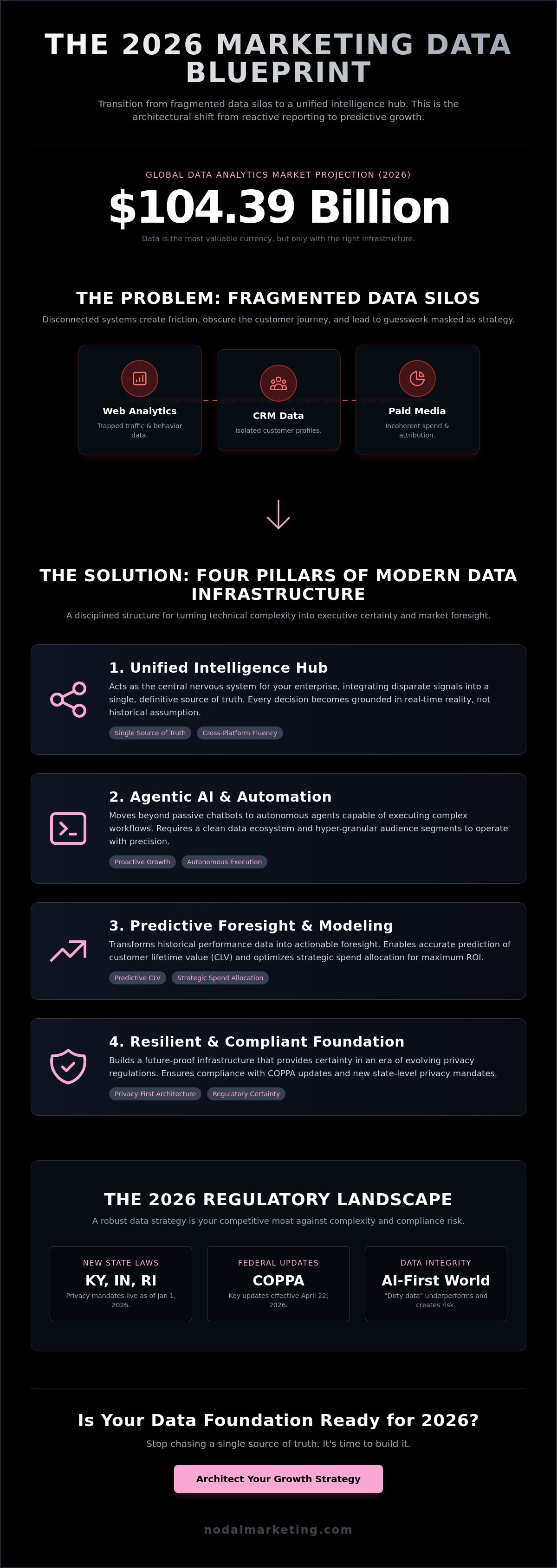
In 2026, the difference between marketing dominance and obsolescence isn't the size of your media budget; it's the structural integrity of your data foundation. You likely feel the friction of disconnected silos every time you attempt to justify multi-channel spend or adapt to the new privacy mandates that went live in Kentucky, Indiana, and Rhode Island on January 1. It's exhausting to chase a single source of truth while the global data analytics market scales toward its projected $104.39 billion valuation this year.
We understand that you're seeking more than just technical upkeep; you're looking for a way to turn "noise" into "foresight." This guide shows you how elite data strategy services act as the architectural blueprint needed to bridge the gap between fragmented technical execution and executive-level certainty. You'll discover how to transition from reactive reporting to a unified intelligence hub that provides a clear roadmap for spend allocation and predictive customer lifetime value.
Key Takeaways
- Replace fragmented data silos with a unified intelligence hub that serves as the definitive source of truth for every marketing decision.
- Discover the "Strategic Architect" framework for evaluating data strategy services, ensuring your partner possesses the dual fluency required to bridge the gap between data science and marketing execution.
- Implement a methodical diagnostic roadmap to identify hidden friction points and align your technological infrastructure with measurable business outcomes.
- Leverage Agentic AI and predictive modeling to transform historical performance into actionable foresight for customer lifetime value and strategic spend allocation.
- Build a resilient data foundation that provides certainty in an era of evolving privacy regulations and rapid technological acceleration.
Beyond the Noise: Why Marketing Data Strategy Services are Non-Negotiable
The digital environment is no longer just crowded; it's often structurally compromised by fragmentation. Most enterprises operate within a collection of disconnected platforms where information is trapped, preventing a coherent view of the customer journey. Professional data strategy services are the only way to dismantle these silos and create a foundation for scalable growth. Without a unified intelligence hub, your marketing efforts are essentially guesswork masked by high-volume metrics. Effective Data management ensures that every byte of information serves a specific commercial objective. It's the difference between merely collecting data and actually owning your market's foresight.
The Executive Shift from Volume to Precision
Generalist agencies often fail because they focus on surface-level execution rather than the underlying infrastructure. They're comfortable counting clicks, but they lack the technical fluency to architect intelligence. In 2026, the priority has shifted. We aren't just looking for more traffic; we're looking for high-intent precision. Data strategy is the architectural bridge between raw digital assets and the realization of executive ROI. By diagnosing structural gaps, identifying specific AI applications, and integrating unified solutions, we move your brand from reactive reporting to a state of proactive growth. This leadership mindset is echoed by Jannine Barron, who guides businesses in architecting regenerative supply chains and nature-aligned value networks for long-term resilience.
The 2026 Data Landscape: Saturated, Complex, and Lucrative
The global data analytics market is projected to reach $104.39 billion by the end of 2026. This massive valuation reflects a reality where data is the most valuable currency, yet many brands are still drowning in "dirty data" that underperforms in an AI-first world. A bespoke strategy creates a competitive moat by ensuring your infrastructure is compliant with the April 22, 2026, COPPA updates and the new state-level privacy laws in Kentucky and Indiana. Positioning yourself as an AI performance marketing agency requires more than just tools; it requires a philosophy of "connecting the dots." Integrating high-level data strategy services allows enterprise brands to navigate this complexity with visionary confidence, transforming a noisy landscape into a predictable ecosystem for growth.
The Four Pillars of a Modern Marketing Data Infrastructure
To lead in 2026, you don't need more data; you need a more disciplined structure. Marketing performance is no longer a creative gamble but a technical certainty built on four indispensable pillars. These pillars form the core of high-level data strategy services, moving beyond generalist execution toward a rigorous growth architecture. Without these foundations, your MarTech stack is just a collection of expensive, disconnected tools. With them, it becomes a unified engine capable of delivering unprecedented foresight.
Architecting the Unified Intelligence Hub
Disconnected data is dead weight. A Unified Intelligence Hub acts as the central nervous system for your enterprise, integrating disparate signals into a single source of truth. This isn't just about storage; it's about accessibility and fluency across the entire organization. When evaluating ai marketing companies, the ability to engineer this specific hub architecture is what separates strategic architects from mere vendors. It requires a meticulous connection of CRM data, web analytics, and paid media signals to ensure every decision is grounded in real-time reality rather than historical assumptions.
Agentic AI and the Future of Automation
By late 2026, the industry has moved from passive chatbots to autonomous agents capable of executing complex workflows without constant human intervention. This is Agentic AI. However, these agents are only as effective as the data foundations they inhabit. Infrastructure must precede application; an AI agent without a clean data ecosystem is simply a faster way to make mistakes. To function with precision, agentic AI requires hyper-granular audience segments that are refreshed in real-time rather than static, month-old lists. If your current stack feels more like a collection of silos than a unified engine, it's time to audit your data infrastructure for 2026 readiness.
The final two pillars, Advanced Analytics and Strategic Governance, turn this architecture into a competitive moat. Predictive modeling allows you to transition from asking "what happened?" to "what will happen?" by leveraging media modeling and customer lifetime value forecasts. Simultaneously, robust governance ensures you stay ahead of the August 1, 2026, deadline for the California "Delete Act" DROP platform processing requirements. Data strategy services provide the methodical thoroughness needed to balance this predictive power with absolute compliance. It's not about reacting to the market, but about architecting the intelligence to lead it.
From Assessment to Execution: Navigating the Data Strategy Roadmap
A vision without an architectural path is merely a hallucination. While the four pillars provide the structural requirements for success, the roadmap is what transforms abstract potential into measurable marketing ROI. High-performance data strategy services don't begin with software installation; they begin with a rigorous diagnostic phase designed to uncover the friction points that currently throttle your growth. This isn't a generic checklist, but a methodical inquiry into how information flows from a lead to a lifetime customer.
The Discovery Workshop: Diagnosing Challenges
Our Discovery Workshop serves as a deep dive into the organizational psyche. We don't just audit your MarTech stack for tool sprawl; we conduct stakeholder interviews to align high-level business goals with ground-level technical capabilities. This is where the Nodal concept takes shape. We identify the specific connection points between your CRM, your paid media channels, and your customer service logs to reveal hidden applications for AI. By bridging the marketing-technology fluency gap through design thinking, we ensure the resulting infrastructure serves the executive vision rather than just the IT department's convenience. We look for the "noise" in your current reporting and architect the silence of certainty.
Execution: Integrating Solutions into the Ecosystem
Integrating solutions into a complex ecosystem requires more than just technical support; it requires a phased transition from legacy silos to unified intelligence hubs. We prioritize high-impact, low-friction wins to deliver tangible outcomes within the first 90 days, a critical window for establishing internal buy-in. This methodical progression ensures that the organization adapts to new workflows without operational disruption. It's not about a sudden overhaul, but an intelligent evolution of your existing assets.
Success in this phase isn't measured by standard automation metrics like open rates or click-throughs. Instead, we focus on KPIs that reflect true business health: customer lifetime value (CLV) accuracy, media modeling precision, and the reduction of wasted spend allocation. As the global data analytics market prepares for a compound annual growth rate of 21.50% through 2034, your strategy must remain fluid. We don't just build a static system; we create a self-optimizing environment that evolves alongside shifting market dynamics and emerging technologies. The goal is to move from a state of constant catching up to a position of permanent foresight.
Evaluating Data Strategy Partners: Moving Beyond Generalist Agencies
Selecting a partner in 2026 requires a shift in perspective. Worldwide IT spending is projected to increase by 9.8% this year, yet much of this capital is wasted on generalist agencies that prioritize volume over precision. These vendors often treat data as a byproduct of media execution rather than a strategic asset. To achieve true marketing certainty, you must look for a Strategic Architect. High-level data strategy services are defined by intellectual rigor and a refusal to participate in the "hype-heavy" discourse of entry-level digital marketing. You don't need a vendor to manage your tools; you need a growth partner to architect your intelligence.
The Dual Expertise Requirement
Technical skill without marketing context inevitably leads to "dead data." It's common to find data scientists who don't understand customer acquisition costs, or marketers who don't understand the nuances of media modeling. This fluency gap is where ROI goes to die. A true strategic partner possesses dual expertise, acting as a translator between the world of technical infrastructure and executive-level business goals. They don't just provide reports; they provide the foresight needed to dominate a saturated landscape. This is the "not just compete, but to lead" mindset. It requires a partner who can diagnose structural challenges, identify specific AI applications, and integrate solutions that move the needle on your bottom line.
Transparency and Certainty in Reporting
In an era of increasing complexity, "black box" algorithms are a liability. Generalist agencies often hide behind opaque proprietary tools that offer no visibility into how decisions are made. In contrast, a sophisticated consultancy prioritizes explainable AI. This ensures that every predictive model and spend allocation is grounded in logic you can verify. Bespoke reporting solutions are superior to off-the-shelf dashboards because they're built around your specific ecosystem's requirements. These custom hubs provide less guesswork and more certainty, allowing you to allocate budgets with visionary confidence. If you're tired of the noise and ready for methodical thoroughness, it's time to partner with a strategic architect who speaks the languages of both technology and growth. We connect the dots so you can focus on leading your market.
The Nodal Approach: Unified Intelligence Hubs and Agentic AI
Strategic growth in 2026 isn't a matter of luck; it's a matter of architecture. While many enterprises struggle with fragmented silos, we specialize in "connecting the dots" between isolated data points to create a coherent, high-performance whole. Our data strategy services are designed for global organizations that demand more than just technical upkeep. We provide the foresight required to lead. By utilizing our proprietary platform, Connect, we transform raw information into a unified intelligence hub that powers both human decision-making and the next generation of autonomous systems. This isn't just a technical upgrade; it's a total repositioning of your marketing assets for an AI-first era.
Unified Intelligence in Action
The real-world application of these hubs goes beyond mere data storage. In the context of global ad spend optimization, our infrastructure allows for real-time adjustments based on hyper-granular audience segments rather than delayed, aggregated reports. This level of precision is essential as the intelligent data analysis service market scales toward its projected $8.12 billion valuation by 2034. Predictive modeling revolutionizes customer lifetime value by identifying high-intent behaviors before they fully manifest, allowing you to allocate budget where it generates the highest return. Nodal Marketing integrates disparate data, from CRM logs to real-time pixel events, into a unified intelligence hub to ensure every node of the ecosystem is synchronized. This methodical thoroughness eliminates the "noise" of modern marketing, replacing it with the calm certainty of data science.
The Path to Strategic Ambition
Engaging us as your growth partner means moving from a state of reactive maintenance to one of visionary leadership. We don't believe in long, opaque onboarding cycles that delay results. During the first 90 days of a data strategy engagement, we focus on diagnosing structural friction, identifying specific Agentic AI applications, and integrating the foundational layers of your new ecosystem. This structured approach ensures that your transition from fragmented data to strategic market dominance is both earned and sustainable. Our role is to act as the Strategic Architect, providing the intellectual rigor that generalist agencies lack. It's time to stop chasing the market and start architecting the intelligence that defines it. Architect your data strategy with Nodal Marketing to secure your position at the intersection of technology and growth.
Architecting Your Competitive Advantage in 2026
The transition from fragmented data silos to a unified intelligence hub is no longer a luxury for the ambitious; it's a requirement for survival. By late 2026, the cost of disconnected systems will only rise as the global analytics market continues its climb toward a $104.39 billion valuation. We've established that true market dominance requires a partner who speaks the dual languages of marketing dynamics and data science. It's about moving beyond reactive reporting to a state of permanent foresight. You need to lead, not just follow.
Nodal Marketing serves as your strategic architect, bridging the gap between raw technical assets and executive-level ROI. As AI-powered marketing technology specialists with a global presence in London, New York, and Hong Kong, we provide the expertise in Agentic AI and Unified Intelligence Hubs that generalist agencies lack. Engaging our data strategy services transforms your infrastructure from a source of friction into an engine of certainty. You don't have to navigate this noisy landscape alone. Architect your marketing certainty with Nodal’s data strategy services. The future of your enterprise depends on the foundations you build today.
Frequently Asked Questions
What is the primary difference between data strategy and data management?
Data strategy defines the high-level roadmap for utilizing information as a competitive asset, whereas data management focuses on the daily operations of storage and quality. Strategy acts as the architect's blueprint; management serves as the construction and maintenance of the infrastructure. Without a clear strategy, your management efforts lack commercial direction and long-term purpose.
How long does it typically take to see ROI from data strategy services?
You can expect to see measurable performance improvements within the first 90 days of engaging data strategy services. These early wins typically come from identifying wasted spend and consolidating redundant platforms. Full-scale ROI, driven by predictive modeling and unified intelligence, usually matures within 6 to 12 months as the ecosystem achieves total structural stability.
Can data strategy services help with existing MarTech stack integration?
Optimizing your current MarTech stack is a fundamental component of a strategic audit. Most enterprises utilize only 42% of their existing technology's capabilities according to 2025 industry benchmarks. We identify underutilized features and integrate disparate platforms to eliminate the friction of manual data exports, ensuring your existing tools work as a unified engine.
Is a data strategy necessary if we already have an internal analytics team?
Internal teams are essential for descriptive reporting, but data strategy services provide the external foresight and specialized architecture they often lack. Internal analysts are frequently buried in daily requests; we provide the high-level framework that allows them to move from reactive tasks to predictive insights. This partnership elevates their output from simple data points to strategic intelligence.
How does Agentic AI change the requirements for modern data strategy?
Agentic AI shifts the requirement from static data storage to real-time, autonomous-ready infrastructure. These agents require hyper-granular audience segments that refresh instantly to execute complex workflows without constant human intervention. If your data isn't structured for high-velocity accessibility, your AI applications won't deliver the efficiency required to lead your market.
What are the key components of a unified intelligence hub?
A unified intelligence hub consists of automated connectors for disparate sources, a robust governance layer for quality control, and a predictive engine for foresight. It's anchored by a bespoke reporting interface that translates complex technical signals into executive-level clarity. This hub serves as the definitive source of truth for every node in your global marketing ecosystem.
How do you ensure data privacy and governance within a marketing strategy?
We integrate privacy by design, ensuring your ecosystem complies with the 45-day deletion requirements of the California "Delete Act" DROP platform. Governance isn't an obstacle; it's a foundational layer that ensures data quality and security are maintained throughout the customer lifecycle. This methodical approach protects your brand while maintaining the agility needed for unprecedented growth.
What specific industries benefit most from bespoke data strategy consulting?
Industries with complex, multi-touch customer journeys benefit most from architectural strategy. E-commerce, Financial Services, and B2B SaaS organizations often face the highest levels of data fragmentation. These sectors require the "Strategic Architect" approach to connect the dots between high-volume lead generation and long-term customer lifetime value in a saturated landscape. For specialized support in the retail sector, check out NB eCommerce & Design.