
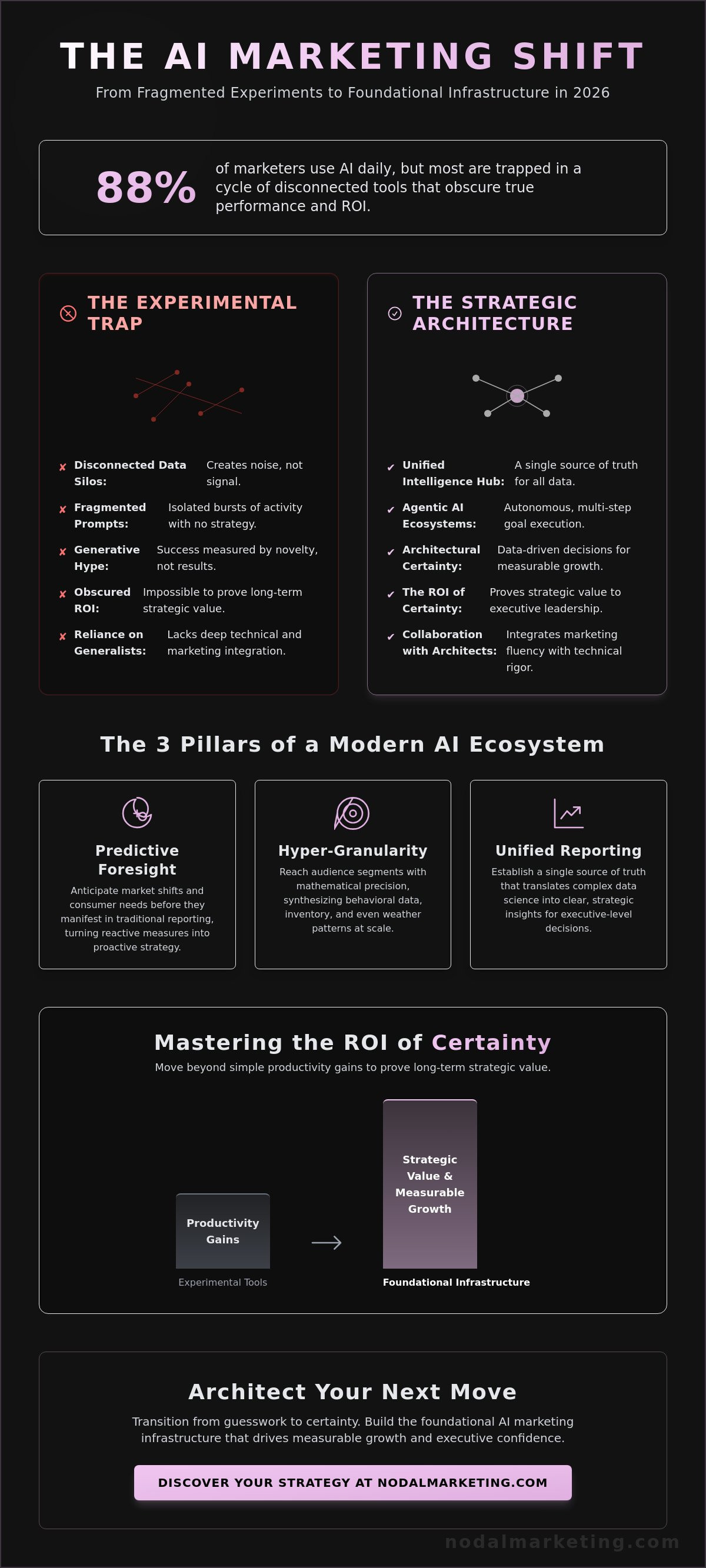
By 2026, the distinction between a marketing experiment and a market leader is no longer defined by the tools you use, but by the infrastructure you build. While 88% of marketers now use AI daily, most remain trapped in a cycle of fragmented prompts and disconnected data silos that obscure true performance. You've likely seen the statistics: global spending on AI-driven marketing technology reached $82 billion in 2025, yet many enterprises still struggle to bridge the gap between generative hype and measurable ROI.
We understand that the noise of the current landscape makes it difficult to find clarity. This article promises to move you beyond the experimental phase into the era of the strategic architect. You'll discover how to deploy high-performance ai marketing campaigns that leverage agentic AI and unified intelligence hubs to drive certainty in every decision. We'll preview the shift from single-task tools to foundational AI ecosystems, showing you exactly how to achieve hyper-granular audience targeting while maintaining the rigorous data transparency required by the 2026 regulatory landscape.
Key Takeaways
- Transition from fragmented generative experiments to autonomous, self-optimizing ecosystems that function as foundational business infrastructure.
- Deploy high-performance ai marketing campaigns using sophisticated data science mechanisms like Media Mix Modeling to ensure architectural certainty.
- Master the "ROI of Certainty" to move beyond simple productivity gains and prove the long-term strategic value of AI to executive leadership.
- Resolve the "Dirty Data" dilemma by establishing a Unified Intelligence Hub, providing the necessary foundation for agentic AI to function at scale.
- Evolve your operational model from relying on generalist agencies to collaborating with strategic architects who integrate marketing fluency with technical rigor.
The Evolution of AI Marketing Campaigns: From Novelty to Infrastructure
By May 2026, the definition of Artificial Intelligence Marketing (AI Marketing) has matured into something far more robust than the generative chatbots of years past. Modern ai marketing campaigns are no longer isolated bursts of creative output; they're autonomous, data-integrated ecosystems that self-optimize in real time. We've moved beyond the "Generative Hype" of 2024, where success was often measured by the novelty of AI-generated imagery. Today, elite brands demand architectural certainty. This shift means that executive-level ROI is no longer a byproduct of creative intuition. It's the result of agentic intelligence that connects the dots between disparate data points to drive measurable growth.
The transition from experimental to foundational is built upon three specific pillars:
- Predictive Foresight: The ability to anticipate market shifts and consumer needs before they manifest in traditional reporting.
- Hyper-Granularity: Reaching audience segments at a level of detail that was previously impossible to manage at scale.
- Unified Reporting: Establishing a single source of truth that translates complex data science into clear, strategic insights.
The Death of the Experimental AI Pilot
In 2026, the "pilot program" has become a relic of a less disciplined era. With 88% of marketers now using AI daily, the competitive advantage isn't found in testing tools, but in integrating them into the brand's foundational infrastructure. Many organizations suffer from AI fragmentation, where a dozen different platforms operate in silos without a central strategy. This creates noise, not signal. To lead, you must deploy Agentic Intelligence. We define Agentic Intelligence as the ability for AI to execute multi-step marketing goals independently, moving from simply generating a single asset to orchestrating an entire multi-channel journey based on high-level business objectives.
Speak the Dual Language: Marketing Dynamics and Data Science
Architecting these high-performance ai marketing campaigns requires a new level of fluency. It's not enough to understand brand sentiment; you must also understand the data science that fuels the engine. This necessitates a deep CMO-CTO partnership that many generalist agencies aren't equipped to facilitate. Nodal Marketing acts as the essential translator between these two disparate worlds. We bridge the gap between creative ambition and technical rigor through our Unified Intelligence Hub. This hub serves as the campaign brain, ensuring that every insight is grounded in data and every action is aligned with the pursuit of certainty over guesswork.
5 Performance-Driven AI Marketing Campaign Examples for 2026
While many competitors focus on flashy creative "activations" that offer little more than temporary engagement, the elite enterprise prioritizes architectural performance. In 2026, successful ai marketing campaigns are defined by their ability to synthesize vast data sets into high-velocity growth engines. We've moved past the era of broad segments. Today, we build hyper-granular audience syntheses that operate with mathematical precision. These five archetypes represent the current standard for brands that value certainty over guesswork.
Archetype 1: The Predictive Churn Mitigation Engine
A leading B2B SaaS enterprise recently implemented a system that identifies customer exit points 90 days before they occur. By analyzing subtle shifts in platform engagement and support ticket sentiment, automated ai marketing services trigger bespoke retention workflows. This foresight allows the brand to deploy personalized value-add content and strategic check-ins, effectively transforming customer lifetime value from a reactive hope into a calculated metric.
Archetype 2: Hyper-Granular Creative Synthesis
In the high-end retail sector, a global brand moved beyond traditional A/B testing to embrace "Continuous Multivariate Evolution." They generated 10,400 unique ad variants by synthesizing real-time weather patterns, local inventory levels, and individual behavioral data. This level of sophistication is central to the future of marketing, where Agentic AI manages ad spend across dozens of micro-segments simultaneously to ensure the right message reaches the right person at the optimal moment.
Archetype 3: The Unified Intelligence Global Rollout
One multinational brand synchronized its advertising spend across 12 distinct regions using a data strategy services framework. By normalizing disparate data sources into a single reporting dashboard, they eliminated the "noise" of fragmented regional reporting. This allowed the CMO to achieve marketing certainty in complex global markets, reallocating budgets in real time based on a unified intelligence hub rather than delayed local spreadsheets.
Archetype 4: Real-Time Media Mix Modeling
Fintech leaders have abandoned the lag of quarterly reporting. They now utilize real-time Media Mix Modeling (MMM) to reallocate capital across 50+ micro-segments every hour. This ensures that every dollar spent on ai marketing campaigns is optimized for current market volatility and shifting consumer interest. It's a pragmatic shift from historical analysis to real-time financial orchestration.
Archetype 5: Agentic Lifecycle Orchestration
High-end brands are employing Agentic AI to orchestrate the entire customer lifecycle. These autonomous systems evaluate the conversion probability of each individual user, adjusting touchpoint frequency and channel selection without manual intervention. They don't just follow a sequence; they make decisions based on the live data flow. If you're ready to transition from a generalist approach to this level of precision, you can partner with a strategic architect to build these systems today.
Beyond the Gimmick: Identifying Scalable AI ROI
"Is this just another shiny new toy?" This remains the primary objection in executive suites across the globe. It's a valid concern, particularly given the unfounded claims about generative AI that characterized the early experimental phase. However, the distinction in 2026 lies in the architecture. Elite ai marketing campaigns are no longer about the novelty of the tool; they're about moving from the ROI of Efficiency-simply doing things faster-to the ROI of Certainty. While manual optimization struggles to keep pace with market volatility, AI-driven bidding strategies within a structured AI performance marketing framework consistently outperform human capacity by processing millions of signals per second. This isn't just optimization; it's the application of media modelling to attribute value to every touchpoint with mathematical precision.
Efficiency vs. Effectiveness: The AI Trap
Many organizations fall into the trap of cost-saving AI, deploying cheap content that eventually leads to brand erosion and audience fatigue. True growth requires a shift toward effectiveness. High-level data science consulting services prioritize the quality of the intelligence over the quantity of the output. In the context of predictive analytics, marketing effectiveness is the quantifiable ability of a system to accurately forecast future demand while simultaneously minimizing wasted spend on non-converting segments. It's about doing the right things, not just doing things cheaply.
The Framework for AI Campaign Evaluation
To move beyond surface-level metrics, every CMO must track three specific pillars of performance:
- Data Fluency: The speed and accuracy with which your organization translates raw data into actionable campaign adjustments.
- Segment Velocity: The rate at which your ai marketing campaigns identify, test, and scale new hyper-granular audience segments.
- Attribution Accuracy: The precision of your media modelling in identifying the true drivers of conversion across complex, multi-channel journeys.
Nodal Marketing benchmarks these metrics against Global Intelligence Standards to ensure your infrastructure isn't just functional, but superior. We focus on diagnosing structural gaps, identifying high-impact applications, and integrating bespoke solutions that turn fragmented data into a unified engine of growth. This methodical thoroughness is what separates a strategic partner from a generalist agency, providing the foresight necessary to lead in a saturated digital landscape.
The Hidden Infrastructure: Why Campaigns Fail Without Data Strategy
The most sophisticated ai marketing campaigns of 2026 often falter not because of a lack of creative vision, but due to structural decay within the underlying data foundation. This is the "Dirty Data" problem. While organizations increased their spending on AI-native apps by 108% year-over-year as of May 15, 2025, many failed to address the fragmentation of their internal silos. Off-the-shelf AI solutions are designed for generalist application; they lack the bespoke integration required to navigate complex enterprise ecosystems. Without a unified foundation, even the most advanced tools produce noise rather than actionable intelligence. Success requires an architectural approach that prioritizes the data strategy before the deployment of the tool.
The necessity of a Unified Intelligence Hub cannot be overstated. For ai agents for marketing to execute multi-step goals, they require a clean, high-velocity stream of information. When data remains trapped in disparate departments, AI agents become paralyzed by conflicting signals. We solve this by architecting a data-first culture that values precision over volume, ensuring that your AI ecosystem has the foresight to act independently and accurately. This is how we move from experimental pilots to foundational infrastructure.
Connecting the Dots: The Nodal Methodology
Nodal Marketing bridges the critical gap between the CMO's growth objectives and the CTO's technical infrastructure. We don't just collect data; we architect intelligence. Our methodology focuses on three distinct phases: diagnosing structural fragmentation, identifying high-impact growth nodes, and integrating bespoke reporting solutions. This transition from data collection to data intelligence is what allows a brand to move beyond surface-level metrics. By establishing a Unified Intelligence Hub, we provide the essential environment for agentic systems to function with unprecedented precision. We identify the hidden growth nodes that generalist agencies overlook, connecting the dots between fragmented touchpoints to create a unified whole.
Solving the Attribution Crisis with AI
The post-cookie landscape has rendered legacy attribution models obsolete. In an agentic marketing world, the path to conversion is non-linear and increasingly opaque. AI addresses this by utilizing advanced media modeling to normalize disparate signals into a single source of truth. Privacy-first data science is the non-negotiable standard for 2026 campaigns, ensuring compliance with the phased-in obligations of the EU AI Act while maintaining granular targeting capabilities. This is not about guessing which channel worked; it's about establishing a mathematical certainty that informs every dollar of spend. If your current infrastructure is preventing you from scaling, it's time to consult with a strategic architect who speaks the dual language of marketing and data science.
Architecting Your Next Move with Nodal Marketing
In an era where 91% of marketers report active AI usage, the primary challenge for the enterprise is no longer adoption, but orchestration. Most generalist agencies provide volume without vision, leading to the structural fragmentation that obscures true ROI. Nodal Marketing operates as a Strategic Architect. We don't just manage accounts; we build the foundational intelligence required for ai marketing campaigns to deliver measurable certainty. By moving beyond the role of a traditional vendor, we become a growth partner dedicated to transforming your marketing department into a data-driven profit center.
Our proprietary platform, Connect, serves as the central nervous system for this transformation. While others rely on fragmented third-party tools, Connect provides the foresight necessary to identify hidden growth nodes across your entire ecosystem. It's the difference between reacting to market shifts and architecting the market itself. We provide the dual expertise required to translate complex data science into high-velocity marketing dynamics, ensuring your infrastructure is built for the realities of 2026.
Our Process: Diagnose, Identify, Integrate
We approach every partnership with a tripartite methodology designed for maximum precision. We begin by diagnosing the structural gaps and data silos that prevent sophisticated automation. From there, we identify the specific high-impact applications where agentic AI can drive the most significant growth. Finally, we integrate bespoke reporting and intelligence hubs that offer a single source of truth for your entire organization. This process values intellectual rigor over high-volume hype, prioritizing the "ROI of Certainty" that executive leadership demands. We don't just compete in the digital landscape; we lead it through methodical thoroughness and technical fluency.
Ready to Revolutionize Your Performance?
The transition from experimental AI to foundational infrastructure is a journey that requires an expert guide. We invite you to step away from the noise of the saturated market and move toward a future of structured, intelligent growth. With a global presence in London, New York, and Hong Kong, our team is uniquely positioned to architect your 2026 strategy across diverse markets and regulatory environments. It's time to stop guessing and start building with the foresight provided by elite data science. Take the first step toward total campaign visibility and schedule your AI Performance Audit with Nodal Marketing today.
Securing Market Leadership Through Architectural Certainty
The transition from experimental AI pilots to foundational infrastructure is no longer a strategic option; it's a prerequisite for enterprise survival. We've moved beyond the generative hype of the early 2020s into an era where ai marketing campaigns must deliver mathematical precision. By establishing a Unified Intelligence Hub and prioritizing the ROI of Certainty over simple efficiency gains, your organization can move from reacting to market noise to architecting its own growth trajectory. This shift requires a partner who speaks the dual languages of data science and marketing dynamics with equal fluency.
Since 2018, Nodal Marketing has functioned as a strategic architect for brands that value intellectual rigor over high-volume noise. Our proprietary Connect platform and global presence across London, Hong Kong, and New York City provide the foresight necessary to identify hidden growth nodes that generalist agencies overlook. It's time to replace guesswork with a structured ecosystem built on technical precision and visionary confidence. You don't have to navigate this saturated landscape alone.
Architect Your AI Marketing Strategy for 2026
The digital landscape is noisy, but your results don't have to be. We're ready to help you build a future grounded in measurable certainty.
Frequently Asked Questions
What is the difference between a generative AI campaign and an agentic AI campaign?
Agentic AI differs from generative AI by its capacity for independent orchestration rather than just content creation. While generative models produce assets, agentic systems execute complex marketing objectives across multiple channels without constant manual intervention. This shift allows ai marketing campaigns to function as autonomous ecosystems that optimize for business outcomes rather than just creative variety.
How do you measure the ROI of AI marketing campaigns in 2026?
ROI in 2026 is measured through the lens of "Marketing Certainty" rather than simple productivity gains. Organizations prioritize metrics like Segment Velocity and Attribution Accuracy to quantify the impact of their investments. With businesses seeing a 68% increase in ROI from AI content integration, the focus has shifted to how effectively these tools stabilize growth in volatile markets.
Can AI marketing campaigns work in highly regulated industries like Finance or Healthcare?
AI campaigns are highly effective in regulated sectors when built on a foundation of privacy-first data science. Organizations must comply with the EU AI Act requirements phased in through 2027 and California's Generative AI Training Data Transparency Act effective January 1, 2026. Nodal Marketing ensures these campaigns remain compliant by using architectural safeguards that prioritize transparency and data ethics.
What is a Unified Intelligence Hub, and why is it necessary for AI?
A Unified Intelligence Hub is a centralized data ecosystem that serves as the single source of truth for all AI operations. It's necessary because agentic AI requires clean, non-fragmented data to make accurate decisions. Without this hub, tools operate in silos; this leads to the "noise" that prevents 80% of marketing leaders from achieving clear ROI on their technology spend.
How does Nodal Marketing solve the "Dirty Data" problem for AI?
We solve the "Dirty Data" problem by implementing a methodical tripartite process of diagnosis, identification, and integration. Our proprietary Connect platform normalizes disparate data sources into a cohesive intelligence stream. This approach ensures that the 15% of IT budgets typically allocated to AI initiatives aren't wasted on fragmented or inaccurate foundations.
What are the biggest mistakes enterprise brands make when launching AI campaigns?
The most significant mistake enterprise brands make is treating AI as a series of isolated experiments rather than foundational infrastructure. Many focus on the "ROI of Efficiency" by cutting creative costs, which often leads to brand erosion. They also fail to bridge the CMO-CTO technical gap, leaving ai marketing campaigns without the necessary data strategy to perform at scale.
How do AI-driven bidding strategies compare to traditional PPC management?
AI-driven bidding strategies outperform traditional PPC management by processing millions of behavioral signals in real time. While manual management relies on historical snapshots, AI utilizes predictive modeling to adjust spend every hour. This precision is essential for managing the thousands of ad variants required in modern hyper-granular audience synthesis.
Is bespoke reporting included in Nodal Marketing's AI campaign management?
Bespoke reporting is a core component of our strategic partnership model and is integrated into our campaign management. We don't provide generic dashboards; we architect tailored reporting solutions that identify "Hidden Growth Nodes" unique to your business. These insights allow executives to move beyond surface-level metrics to achieve the foresight needed for long-term market leadership.