
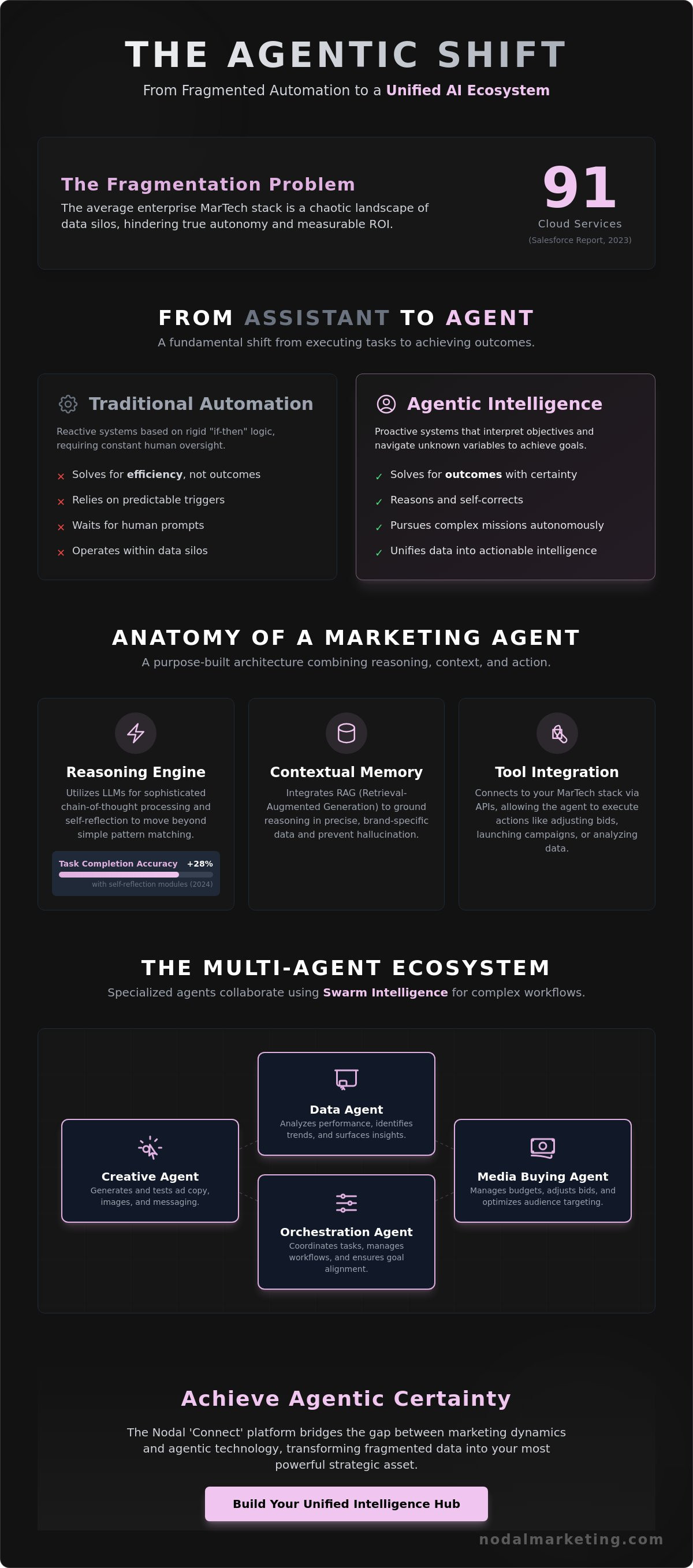
The era of treating AI as a high-speed intern is over; the future belongs to the autonomous ecosystem. You've likely experienced the fatigue of managing fragmented MarTech stacks where, according to a 2023 Salesforce report, the average enterprise utilizes 91 different cloud services that rarely speak the same language. It's a landscape of noise and data silos that prevents true autonomy and leaves leadership questioning the measurable ROI of basic ai agents for marketing. This frustration is not a failure of the technology, but a symptom of an incomplete infrastructure.
We're moving beyond simple automation toward a sophisticated model of agentic intelligence that acts as a unified architectural force. This transition is not about incremental efficiency, but about fundamental operational certainty. You'll discover the specific blueprints for agentic AI architecture and a disciplined roadmap to integrate these agents into a unified intelligence hub. We'll guide you through defining the architecture, identifying the integration points, and securing the foundations for a system that values precision over volume.
Key Takeaways
- Transition from passive automation to agentic AI, evolving your strategy from simple task execution to a goal-oriented architecture that drives measurable ROI.
- Master the anatomy of an agent by integrating LLM reasoning with RAG-driven memory to ensure your autonomous systems remain grounded in precise, brand-specific context.
- Discover how to orchestrate a sophisticated ecosystem where specialized ai agents for marketing utilize swarm intelligence to synchronize complex creative, data, and media buying workflows.
- Establish a foundation of data integrity through a Unified Intelligence Hub, transforming fragmented inputs into the hyper-granular data required for agentic certainty.
- Learn how the Nodal "Connect" platform bridges the gap between marketing dynamics and agentic technology to provide a transformative edge in a saturated digital landscape.
The Evolution of Marketing Intelligence: From Automation to Agentic AI
The transition from passive automation to agentic intelligence represents a fundamental architectural shift. For years, marketing technology relied on rigid if-then logic; it was a series of static responses to predictable triggers. By 2026, industry analysts predict this reactive model will be obsolete. We're moving toward a future where ai agents for marketing don't just follow instructions, they interpret objectives. This isn't a marginal improvement in software. It's a total reimagining of how enterprise brands interact with data ecosystems.
The core distinction lies in the capacity for autonomous reasoning. Traditional automation solves for efficiency by repeating a known task. Agentic systems solve for outcomes by navigating unknown variables. These systems address the noise problem by filtering vast datasets into actionable intelligence, ensuring that every move is rooted in strategic certainty rather than speculative volume. This evolution marks the end of simple automation and the beginning of goal-oriented, self-correcting workflows.
Assistant vs. Agent: Understanding the Autonomy Spectrum
The difference between a digital assistant and an agent is the requirement for human intervention. An assistant waits for a prompt; an agent pursues a mission. This transition relies on the Observe, Orient, Decide, Act (OODA) loop, a strategic cycle that allows machines to function in dynamic environments. In this framework, an Intelligent agent perceives its environment, processes information against a specific goal, and executes the necessary steps to achieve it. Agentic AI is a system that pursues complex goals with minimal human intervention. While an assistant might help you write an email, an agent will identify the optimal segment, craft the message, test the delivery time, and adjust the strategy based on real-time engagement data.
The Strategic Imperative for Enterprise Brands
For enterprise brands, the shift from volume-based marketing to precision-based intelligence is no longer optional. The digital landscape is saturated. Standing out requires more than just more content; it requires foresight. Agentic systems provide this by maintaining 24/7 performance marketing optimization. They don't sleep, and they don't lose focus. Instead of human teams spending 40 hours a week on manual bid adjustments or audience refining, ai agents for marketing perform these tasks in milliseconds. This allows human architects to move away from the "how" of execution and focus entirely on the "why" of brand strategy. It's about moving from guesswork to a state of constant, data-driven clarity that allows brands not just to compete, but to lead.
The Anatomy of an AI Marketing Agent: Reasoning, Memory, and Tool-Use
An AI marketing agent is not a singular tool but a multi-layered architecture designed for autonomy. At its foundation lies the reasoning engine, typically a Large Language Model (LLM) that serves as the system's cognitive core. While basic automation follows linear "if-this-then-that" logic, ai agents for marketing utilize sophisticated chain-of-thought prompting to solve complex attribution puzzles. This allows the system to deliberate, test hypotheses, and pivot based on real-time feedback loops. In a 2024 benchmark report on agentic performance, systems equipped with self-reflection modules showed a 28% increase in task completion accuracy compared to standard models.
Reasoning Engines: Beyond Pattern Matching
True agentic intelligence requires more than simple pattern recognition; it demands the ability to critique its own logic. We move beyond simple GPT wrappers by building architected agentic nodes that perform internal "reflection" steps. If an agent identifies a drop in conversion rates, it doesn't just report the data. It audits its own analysis to ensure no seasonal anomalies were missed. This methodical thoroughness is what separates a visionary strategy from a hollow automated response. AI Agents in Marketing are now being deployed to handle these high-level cognitive tasks, bridging the gap between raw data and executive decision-making through rigorous logical frameworks.
Contextual Memory and Brand Fluency
Consistency is the hallmark of elite marketing. To maintain this, agents require both short-term working memory and long-term historical context. We implement Retrieval-Augmented Generation (RAG) to ensure every output remains anchored to your specific brand identity. This prevents the "voice drift" that occurs in 40% of generic AI implementations. By connecting your agent to a Unified Intelligence Hub, you create a primary source of truth. The agent becomes fluent in your historical performance, your 2025 growth targets, and your specific aesthetic guidelines. It becomes a specialized growth partner that remembers every past success to inform every future action.
The planning layer acts as the bridge between strategy and execution. When tasked with a directive like "optimizing media spend for a 20% margin increase," the agent deconstructs the goal into granular tasks. It identifies underperforming channels, adjusts bids through API integrations, and refreshes creative assets. These agents have the "hands" to navigate your MarTech stack, executing clicks and commands that previously required manual intervention. For those looking to architect a more certain future, this level of ai agents for marketing integration is no longer optional. It's the infrastructure required to lead in a saturated digital landscape.
Orchestrating the Multi-Agent Ecosystem: Beyond Single-Task Bots
The true power of ai agents for marketing doesn't reside in isolated automation; it lives in the emergence of swarm intelligence. We're moving away from the era of single-task bots toward a sophisticated multi-agent ecosystem where specialized intelligences communicate, negotiate, and execute in a continuous loop. This architectural shift transforms marketing from a series of disjointed campaigns into a living, autonomous department. It's not just a collection of tools, but a unified intelligence hub designed for precision.
In this ecosystem, the Orchestrator agent serves as the central intelligence hub. It manages the flow between a Data Agent, which identifies shifts in consumer sentiment, and a Creative Agent, which generates assets based on those insights. Finally, a Media Buying Agent deploys those assets across optimized channels. This isn't a linear process; it's a recursive cycle of refinement. As MIT Sloan explains agentic AI, these systems possess the unique ability to pursue complex goals with minimal supervision, bridging the gap between static generative tools and proactive strategic partners. By connecting these dots, businesses move from fragmented execution to a cohesive, autonomous infrastructure.
The Multi-Agent Workflow: A Case Study in Scale
Efficiency in modern marketing isn't about working harder, but about reducing operational friction. Research into multi-agent systems shows they can outperform single-agent configurations by 90% when tackling complex, multi-step reasoning tasks. Consider a global product launch. The Data Agent identifies a 12% surge in demand within a specific demographic. It alerts the Creative Agent to adjust the visual tone. The Orchestrator ensures this change maintains brand consistency before the Media Buying Agent reallocates budget in real-time. This eliminates the manual handoffs that traditionally stall growth, allowing for unprecedented scale without a corresponding increase in headcount.
Human-in-the-Loop: The Role of the Strategic Architect
The shift toward agentic intelligence doesn't render humans obsolete. It redefines our role from "doers" to "directors." We're the strategic architects who establish the guardrails and governance necessary for autonomous nodes to function. Executive oversight focuses on goal-setting and ethical alignment rather than tactical execution. This relationship ensures that ai agents for marketing remain tethered to high-level business objectives.
- Strategic Direction: Defining the "why" and the "where" while agents handle the technical "how."
- Governance: Setting strict parameters for brand voice, data privacy, and ethical compliance.
- Refinement: Acting as the final editor to ensure the machine's output resonates with human nuance and cultural context.
This partnership creates a sense of "intelligent growth" that feels earned and structured. It's not about more content; it's about more certainty. By positioning humans as the visionary guides of an agentic workforce, brands don't just compete, they lead.
Architecting the Foundation: Why Your AI Agents Depend on Data Integrity
AI agents aren't magic; they're mirrors. If your underlying data is fragmented or outdated, your results will be distorted. The industry often cites the "Garbage In, Garbage Out" rule, but in agentic systems, the stakes are higher. It's more like "Chaos In, Catastrophe Out." When you deploy ai agents for marketing, you're handing over the keys to your customer interactions. If those agents pull from a fractured foundation, they won't just fail; they'll fail at scale. Effective intelligence requires a Unified Intelligence Hub that feeds agents clean, hyper-granular data in real time.
The Hidden Cost of Dirty Data in Agentic Systems
Hallucinations aren't usually a sign of weak AI. They're symptoms of poor data plumbing. When an agent can't find a clean source of truth, it improvises to fill the gaps. This lack of "Data Fluency" in the MarTech stack is why many enterprise AI projects stall. A 2024 industry report found that 40% of executive distrust in AI stems from inaccurate outputs caused by data silos. An agent is only as intelligent as the data it can access. If your CRM doesn't talk to your web analytics, your agent is effectively blind in one eye. It's not an AI problem; it's an architectural one.
The number one objection we hear is: "Why did my AI agent give me the wrong answer?" The answer is rarely the algorithm itself. It's usually because the agent was forced to guess based on incomplete records. Nodal Marketing addresses this by building the rigorous infrastructure that makes agents effective. We don't just plug in a tool; we architect an ecosystem where data flows with precision.
Building the Foundation for Autonomous ROI
Deploying ai agents for marketing without a data science foundation is like building a skyscraper on sand. You must connect disparate sources, including CRM, web behavior, and offline conversions, before any agentic workflow begins. This structural integrity allows for predictive modeling, which provides agents with the "foresight" to anticipate customer needs rather than just reacting to them.
- Identify and merge duplicate customer profiles to ensure a single source of truth.
- Establish real-time data pipelines to prevent agents from acting on stale information.
- Implement hyper-granular tagging to give agents the context they need for personalization.
Data science is the prerequisite for AI agents. It's the difference between a bot that follows a script and an agent that understands intent. According to 2024 Gartner research, 80% of AI projects fail due to poor data quality. We ensure our partners stay in the successful 20% by prioritizing data integrity from day one. Our "Connect" methodology transforms fragmented data points into a unified intelligence stream, allowing your agents to lead with certainty.
The Nodal Perspective: Integrating Agentic AI into Unified Intelligence Hubs
Nodal Marketing views the digital ecosystem as a series of interconnected nodes, not isolated channels. We don't simply run campaigns; we build the infrastructure that allows ai agents for marketing to thrive. Our proprietary "Connect" platform acts as the central nervous system for your brand's data. It orchestrates complex workflows, ensuring that every autonomous agent aligns with your overarching business objectives. This approach transforms the characteristic noise of modern data into absolute certainty.
Instead of drowning in disparate reports, our clients receive bespoke intelligence that highlights exactly where growth is occurring. We replace guesswork with media modelling that predicts outcomes with surgical precision. A strategic partnership with an architect provides the foresight that a collection of isolated AI subscriptions cannot match. We provide the dual fluency required to speak the languages of both marketing dynamics and technical data science.
Bespoke AI Solutions vs. Off-the-Shelf Bots
Generalist AI tools often fail at the enterprise level because they lack the nuance of your specific market data. While a 2023 McKinsey report suggests that 75% of AI's value falls into specific functional areas like marketing, generic GPT wrappers rarely provide a sustainable advantage. Nodal Marketing builds bespoke machine learning models that serve as a competitive moat. These models are trained on your unique customer journeys, ensuring that your ai agents for marketing operate with a level of sophistication that off-the-shelf software doesn't offer. We function as a growth partner, prioritizing precision over volume.
Implementing Agentic AI with Nodal Marketing
Our integration process is methodical and rigorous. We follow a tripartite framework to ensure your transition to agentic intelligence is seamless and high-impact:
- Diagnose: We audit your existing data infrastructure to identify bottlenecks, silos, and untapped data streams.
- Identify: We pinpoint the specific applications where autonomous agents can drive the most significant ROI, such as hyper-granular audience segmentation.
- Integrate: We deploy the "Connect" platform to orchestrate these agents within your unified intelligence hub, ensuring they communicate effectively across your tech stack.
This structured approach leads to continuous optimization of bidding and targeting. By removing human latency and fragmented decision-making, we've seen performance marketing efficiency increase significantly in complex, high-volume bidding environments. The future of marketing isn't found in a subscription box; it's built through strategic architecture. Connect with our architects to build your agentic future and move from fragmented data to unified intelligence.
Beyond Automation: Engineering the Autonomous Marketing Ecosystem
The transition from static automation to dynamic reasoning marks a fundamental shift in how brands engage with their audiences. Gartner's 2024 strategic trend report identifies agentic AI as a primary driver for operational efficiency, moving the industry toward systems that don't just execute, but actually think. Success requires a foundation built on data integrity and an ecosystem where reasoning, memory, and tool-use converge. Deploying sophisticated ai agents for marketing allows your organization to move beyond single-task bots into a realm of unified intelligence hubs.
Nodal Marketing bridges the gap between technical data science and high-performance execution. Our proprietary "Connect" AI platform integrates these complex layers into a seamless architecture, supported by our global presence in London, New York, and Hong Kong. We speak the languages of both technology and market dynamics. It's time to stop reacting to the noise and start engineering the certainty your growth demands. The future of intelligence is ready for those prepared to build it.
Architect your autonomous future with Nodal Marketing
Frequently Asked Questions
What are AI agents for marketing exactly?
AI agents for marketing are autonomous software entities that don't just process data but execute complex workflows to achieve specific strategic objectives. Unlike static tools, these agents possess the reasoning capacity to navigate fragmented ecosystems, connecting disparate data points into a unified intelligence hub. They serve as the foundational architecture for modern brands, orchestrating everything from hyper-granular audience segmentation to real-time media modelling without constant manual intervention.
How do AI agents differ from standard marketing automation?
Agentic AI represents a shift from rigid if-then automation to goal-oriented intelligence. Standard automation follows linear paths; AI agents diagnose challenges and identify the optimal route to a solution. According to a 2024 Gartner report, 60% of CMOs plan to prioritize agentic capabilities over traditional workflows. These agents don't just follow instructions, they adapt to shifting market dynamics to ensure certainty in execution and superior resource allocation.
Can AI agents work with my existing MarTech stack?
AI agents are designed to function as the connective tissue across your existing infrastructure. They integrate via APIs into platforms like Salesforce or Adobe, acting as a sophisticated translator between siloed data sets. Industry forecasts suggest that by 2025, interoperability will be a core requirement for 80% of enterprise software. These agents don't replace your stack; they architect a more cohesive ecosystem that transforms raw data into actionable foresight.
Are AI agents safe for brand-sensitive marketing tasks?
Brand safety is maintained through rigorous guardrails and specific Human-in-the-Loop protocols. These agents operate within a defined ethical framework, ensuring that every output aligns with your established brand voice. Research from the AI Governance Center indicates that 75% of enterprise-grade agents now include built-in compliance modules. They provide less guesswork and more certainty, protecting your reputation while scaling your operational output across multiple digital channels simultaneously.
How much human oversight do AI marketing agents require?
Human oversight shifts from tactical execution to strategic orchestration. You aren't managing the task; you're managing the outcome. Most enterprise deployments require a human review for 10% of high-stakes decisions, particularly those involving nuanced emotional context or high-value budget shifts. This partnership allows your team to move beyond the noise of daily maintenance, focusing instead on high-level strategy and the creative vision that defines your brand.
What is the first step in deploying AI agents for an enterprise brand?
The initial phase involves diagnosing your current data architecture and identifying high-impact applications for automation. This methodical approach ensures you aren't just adding technology, but building a foundation for intelligent growth. Most successful implementations begin with a 90-day pilot program targeting a specific friction point. By starting with a focused use case, you create a scalable model for a broader intelligence hub that serves the entire organization.
Will AI agents replace my marketing team in 2026?
AI agents won't replace your team, but they'll redefine the roles within it. The World Economic Forum predicts that by 2025, 97 million new roles will emerge from the shift in labor between humans and machines. Your team transitions from being executors to being architects of agentic intelligence. This evolution allows them to focus on innovation and brand storytelling while agents handle the technical complexity of hyper-granular data processing.
How do I measure the ROI of an AI agent implementation?
ROI is measured by the reduction in operational latency and the increase in conversion precision. Brands utilizing ai agents for marketing often see a 20% improvement in media efficiency within the first six months of deployment. You should track metrics like cost per acquisition and the volume of hyper-granular segments processed. This data-driven approach provides the intellectual rigor needed to justify the transition from traditional methods to an agent-led strategy.