
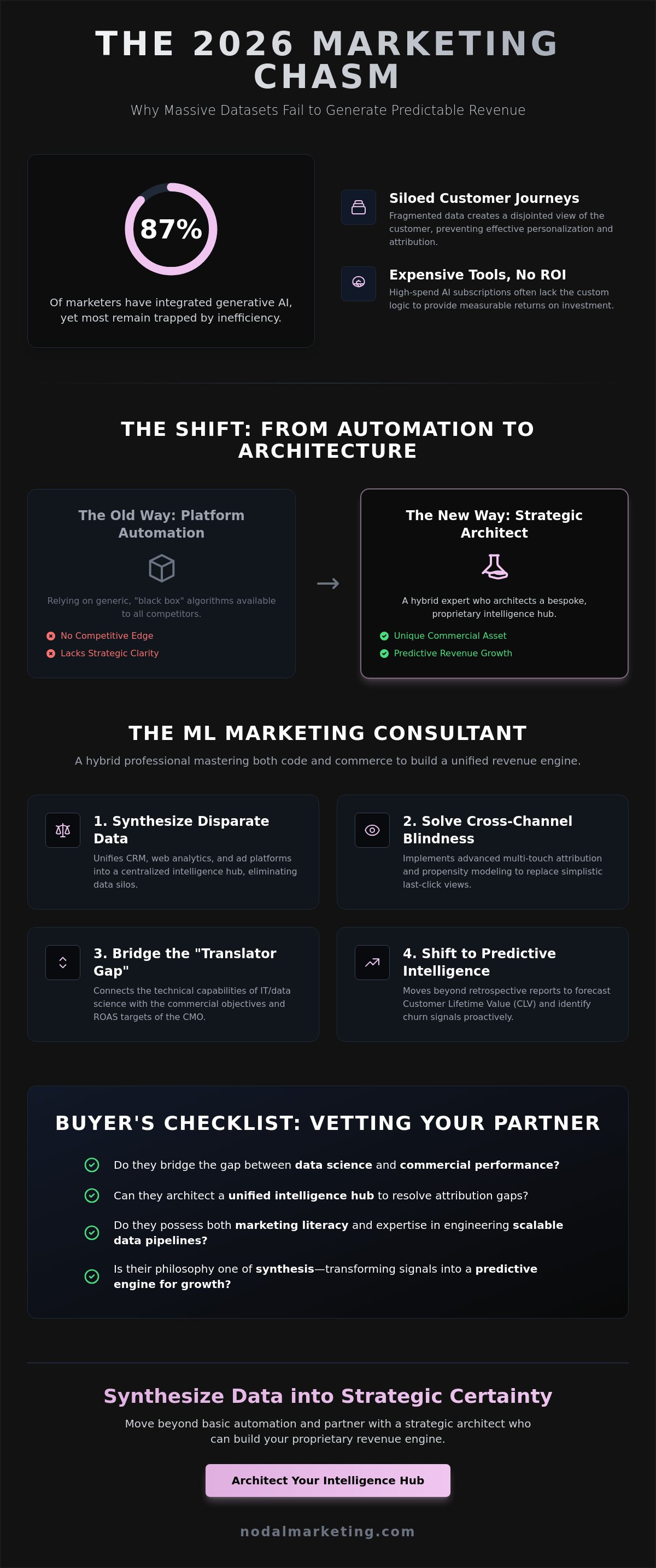
In 2026, the chasm between possessing massive datasets and generating predictable revenue isn't a technical failure; it's a failure of synthesis. While 87% of marketers have integrated generative AI into their workflows, most remain trapped by siloed customer journeys and expensive tools that offer no measurable ROI. You don't need another software subscription. You need a machine learning marketing consultant who functions as a strategic architect, someone capable of translating raw algorithmic potential into a unified intelligence hub.
The friction of fragmented data is a common executive burden, often resulting in high-spend AI tools that fail to provide a unified view of the customer. This guide provides the strategic framework to identify a partner who doesn't just speak code, but masters the commercial language of revenue growth. You'll discover how to move beyond basic automation toward a system that predicts customer behavior and provides clear attribution across your entire multi-channel ecosystem. We'll outline the exact criteria for evaluating expertise, moving from initial diagnosis to the methodical integration of predictive models.
Key Takeaways
- Distinguish between standard platform automation and the strategic depth of a machine learning marketing consultant who bridges the gap between data science and commercial performance.
- Identify the technical requirements for architecting a unified intelligence hub that resolves cross-channel blindness and attribution gaps.
- Navigate the "Build vs. Buy" framework to determine whether in-house development or a specialized consultancy offers the most efficient path to data maturity.
- Apply a rigorous vetting process to audit a partner's marketing literacy alongside their ability to engineer scalable, high-performance data pipelines.
- Embrace a philosophy of synthesis to transform disjointed digital signals into a unified and predictive engine for revenue growth.
The Strategic Shift: Why a Machine Learning Marketing Consultant is Essential in 2026
The digital landscape of 2026 has reached a point of algorithmic saturation. Native automation tools within Google and Meta, once considered cutting-edge, are now standard utilities available to every competitor. When every brand utilizes the same platform-level black box, the competitive advantage shifts from the tool itself to the proprietary intelligence powering it. This is where the role of a machine learning marketing consultant becomes critical. They don't just manage tools; they architect bespoke ecosystems that transform raw data into a unique commercial asset.
A modern consultant is a hybrid professional. They possess the technical rigor of a data scientist and the commercial intuition of a growth strategist. This dual mastery is essential because pure data science often lacks the context of the marketing funnel, while traditional marketing lacks the mathematical depth to build scalable predictive models. Relying on generic algorithms is no longer enough. Precision is the new currency. Without a custom approach, fragmented data silos will continue to erode your ROI, leaving you with high-tech tools that offer no strategic clarity.
From Reactive Reporting to Predictive Intelligence
Traditional analytics have historically been retrospective. They offer a post-mortem of performance, detailing what occurred without explaining why or predicting what follows. In 2026, sophisticated brands prioritize Artificial intelligence in marketing to shift toward a prescriptive model. Machine learning models now allow executives to forecast Customer Lifetime Value (CLV) and identify churn signals long before they manifest in revenue drops. This transition from descriptive dashboards to prescriptive strategy ensures that every dollar spent is an investment in a known outcome.
The Translator Gap: Bridging Code and Commerce
One of the most significant risks in AI adoption is the "Translator Gap." Organizations often hire brilliant data scientists who can build complex neural networks but fail to understand the nuances of a multi-channel customer journey or specific ROAS targets. A specialized machine learning marketing consultant acts as the structural link between the technical capabilities of IT and the commercial objectives of the CMO. They ensure that data engineering serves the bottom line, rather than existing as a siloed academic exercise.
A Strategic Architect is a consultant who prioritizes the generation of sustainable revenue over the mere accumulation of raw data volume.
Architecting Intelligence: Core Competencies of an ML Marketing Specialist
The shift toward algorithmic maturity requires more than technical proficiency. It demands a partner who views machine learning as a strategic marketing evolution rather than an isolated software project. A high-level machine learning marketing consultant provides the structural integrity necessary to turn fragmented digital signals into a unified revenue engine. This process begins with the synthesis of disparate data sources, ensuring that your CRM, web analytics, and ad platforms don't just exist side-by-side but communicate within a centralized intelligence hub. Finding a machine learning marketing consultant who understands both the math and the margin is the difference between a failed pilot and a scalable growth engine.
Solving cross-channel blindness is the primary objective for an executive seeking measurable impact. This is achieved through advanced marketing attribution consulting, which replaces the simplistic last-click models of the past with sophisticated multi-touch frameworks. By implementing custom propensity modeling and granular audience segmentation, a consultant enables your brand to move beyond generic targeting. This level of precision is becoming an imperative for your brand's digital marketing success, as it allows for the deployment of capital toward the most profitable customer segments with mathematical certainty.
Advanced Predictive Modeling for Performance
Proprietary algorithms represent the ultimate competitive edge in a crowded marketplace. While platform-default settings offer a baseline, they lack the specificity required for high-stakes programmatic advertising. Leveraging specialized data science consulting services allows for the development of bespoke models that optimize real-time bidding strategies based on your unique business goals. It's not about accepting the "black box"; it's about building your own.
The Unified Intelligence Hub Architecture
Data decay is the silent killer of marketing ROI. Establishing a single source of truth requires comprehensive data strategy services to ensure seamless flow and integrity across your MarTech stack. A consultant must first diagnose existing silos, then identify the necessary connectors, and finally integrate them into a resilient architecture. This methodical approach ensures that your models are fed high-quality, verified data, which is the only way to generate reliable insights. If you're ready to bridge the gap between your technological stack and commercial execution, exploring a bespoke reporting solution can provide the clarity your executive team requires.
The Evaluation Framework: Consultant vs. Agency vs. In-House Teams
Executives often face a binary choice: build an internal team or hire a generalist agency. In reality, neither path typically solves the structural complexity of 2026's data demands. In-house teams struggle with recruitment and the rapid pace of algorithmic evolution, while generalist agencies often lack the mathematical depth required for high-level data science implementation. Choosing a machine learning marketing consultant offers a third path. It's not about choosing a vendor; it's about choosing a specialized perspective that bridges the gap between raw data and commercial performance.
When evaluating a modern data analytics company, the focus should be on their ability to integrate into your existing ecosystem without the friction of a full-scale rebuild. Many organizations fall into common pitfalls in marketing AI implementation by over-investing in tools before establishing a strategic framework. A consultant provides this framework, ensuring that technical execution serves the revenue goal. They offer a cross-industry perspective that internal teams lack and a technical depth that generalist agencies cannot match.
When to Hire an ML Marketing Consultant
Determining the right time for specialized intervention depends on your current data maturity. Consider these three scenarios:
- Scenario A: You possess abundant data but lack the predictive models to drive real-time decisions. Collecting data is a cost; modeling it is an investment.
- Scenario B: Your current attribution model is failing to justify ad spend across complex, multi-channel journeys. If you can't verify where your revenue comes from, your strategy is based on hope, not math.
- Scenario C: You need to scale global performance without a proportional increase in headcount. Machine learning allows for the automation of high-frequency tasks like bidding and targeting at a scale human teams cannot replicate.
The Hybrid Model: Synthesis of Consulting and Execution
The most effective partnerships in 2026 follow a hybrid model that merges strategic vision with tactical execution. Nodal Marketing combines high-level analytics consulting with active performance management. This approach ensures that the person who designs the model is also responsible for its performance in the live market. It's a commitment to long-term stability and model maintenance. Instead of a detached handover, this model provides a deeply integrated ally who stays through the implementation phase to ensure your unified intelligence hub remains accurate as market dynamics shift. This level of discipline prevents the data decay that often renders isolated AI projects obsolete within months.
The Buyer's Checklist: Vetting Your Machine Learning Marketing Partner
Selecting a machine learning marketing consultant is not a search for the most proficient coder; it's a search for the most disciplined architect of commercial outcomes. Technical brilliance is a baseline requirement, yet it remains insufficient without a deep understanding of the economic frameworks that govern business growth. To ensure your investment translates into a unified revenue engine, you must apply a rigorous evaluation framework that filters for both mathematical precision and strategic acumen.
The vetting process begins with an audit of marketing literacy. A consultant who cannot fluently discuss Customer Acquisition Cost (CAC), Return on Ad Spend (ROAS), and Lifetime Value (LTV) will inevitably build models that are technically sound but commercially irrelevant. Beyond literacy, you must examine their data engineering capabilities. Machine learning is only as resilient as the data pipelines feeding it. If a partner cannot demonstrate a methodical approach to unifying siloed data across your CRM and ad platforms, their models will fail to provide the unified intelligence hub your executive team requires.
Transparency is the third pillar of the checklist. You should prioritize "Explainable AI" over "Black Box" models. In a boardroom environment, "the algorithm decided" is an unacceptable justification for a strategic shift. A sophisticated partner provides the interpretability needed to understand why a model suggests a specific targeting strategy or bidding adjustment. This transparency must extend to the MarTech stack, ensuring that any bespoke model integrates seamlessly with existing tools to prevent data decay and operational friction. Finally, demand proof of revenue-based outcomes. Model accuracy metrics like F1 scores are internal benchmarks; your focus remains on scalable growth and clear attribution.
Critical Questions to Ask During the Discovery Phase
Probing the depth of a consultant's methodology requires specific, technical inquiries. You should ask:
- How do you handle data privacy and compliance? With the EU AI Act being enforced in early 2026 and the Colorado AI Act taking effect on June 30, 2026, your partner must ensure every model adheres to evolving global standards.
- Can you explain a complex model's decision to a non-technical stakeholder? This tests their ability to bridge the gap between technical execution and commercial strategy.
- What is your process for data cleaning and preprocessing? High-quality output is impossible without a rigorous approach to the foundational building blocks of marketing data.
Red Flags in ML Consulting
The market is crowded with generalists who over-promise "instant" results. Machine learning is a process of iterative refinement, not a static product. Be wary of any consultant who neglects the foundational infrastructure or proposes a one-size-fits-all model for a unique business ecosystem. If you are ready to move beyond generic automation and architect a proprietary competitive edge, you should partner with a specialist who prioritizes revenue over raw data volume.
The Nodal Approach: Synthesizing Data into Strategic Certainty
At Nodal Marketing, we reject the notion that machine learning is a peripheral tool for campaign optimization. We view it as the fundamental architecture of modern business growth. Our philosophy centers on the concept of synthesis; we don't just build models, we architect intelligence. By linking fragmented data points across your entire ecosystem, we transform disjointed signals into a unified revenue engine. This approach elevates the role of a machine learning marketing consultant from a temporary vendor to an indispensable strategic ally.
Our dual expertise allows us to serve as a precise translator between your commercial ambitions and technical execution. We understand that a model’s value is not measured by its complexity, but by its impact on your bottom line. We prioritize depth over breadth, ensuring that every algorithmic adjustment serves a specific, measurable revenue goal. It’s not about generating more data; it’s about generating more certainty.
Our Methodology: Diagnosis, Identification, Integration
Our process is defined by a methodical thoroughness that ensures long-term stability. It follows a clear tripartite progression:
- Phase 1: Diagnosis. We conduct a deep-dive audit of your current data environment and MarTech stack to identify structural weaknesses and data decay.
- Phase 2: Identification. We isolate high-impact machine learning use cases tailored to your specific ROI targets, moving beyond generic automation.
- Phase 3: Integration. We manage the seamless integration of bespoke models into your daily operations, ensuring they remain resilient as market dynamics shift.
Scaling Executive ROI with AI Performance Marketing
Achieving scale in 2026 requires more than just increased spend; it requires the mathematical precision of a dedicated AI performance marketing agency. Our services leverage machine learning to automate high-frequency decisions, allowing your team to focus on high-level strategy while our models handle granular targeting. By establishing a unified intelligence hub, we provide the clear attribution necessary to justify investment across complex, multi-channel journeys. If you are prepared to bridge the gap between fragmented data and predictive revenue growth, the time has come to Partner with Nodal Marketing and architect your competitive edge.
Securing Your Algorithmic Competitive Edge
The transition from experimenting with isolated AI tools to architecting a resilient, data-driven ecosystem is the defining executive challenge of 2026. Success no longer depends on the sheer volume of data you collect. It depends on the structural integrity of your models and the mathematical clarity of your attribution. Identifying a specialized machine learning marketing consultant is the final step in moving beyond reactive reporting toward a future of predictive revenue growth and operational stability.
Founded in 2018 with a dedicated focus on enterprise data science, Nodal Marketing specializes in synthesizing fragmented data points into high-performance Intelligence Hubs. We provide the technical depth and commercial mastery required to bridge the gap between complex code and market execution. Our proprietary AI tools for performance marketing optimization ensure your strategy remains as agile as the landscape itself. The complexity of the modern world is a significant opportunity for those who choose precision over volume.
Architect Your Strategic Intelligence with Nodal Marketing
Your path to strategic certainty starts with a single, decisive partnership. We look forward to building your competitive edge together.
Frequently Asked Questions
What does a machine learning marketing consultant actually do?
A machine learning marketing consultant architects the structural bridge between your raw data and your revenue outcomes. They don't simply deploy software; they design bespoke intelligence hubs that unify fragmented signals across your CRM, web analytics, and ad platforms. Their role is to translate complex mathematical models into actionable commercial strategies that drive predictable growth.
How long does it take to see results from an ML marketing implementation?
Initial diagnostic insights and data synthesis usually emerge within the first 4 to 6 weeks of an engagement. However, achieving scalable predictive accuracy typically requires 3 to 6 months of iterative model training. This period allows the algorithms to ingest enough historical and real-time data to move from basic pattern recognition to prescriptive performance optimization.
Do I need to have a perfect data set before hiring an ML consultant?
You don't need perfect data to begin; in fact, waiting for data purity often leads to strategic paralysis. A primary responsibility of a specialized consultant is to diagnose existing data decay and engineer the pipelines necessary to clean and unify your information. They transform your current fragmented landscape into a resilient foundation for future modeling.
What is the difference between a data scientist and an ML marketing consultant?
A pure data scientist focuses on mathematical model accuracy and algorithmic efficiency within a technical vacuum. In contrast, a machine learning marketing consultant prioritizes commercial performance and revenue-based outcomes. They possess the dual expertise required to ensure that technical execution directly serves marketing funnels and executive-level ROI targets.
How much does it cost to hire a machine learning marketing consultant?
Investment levels vary significantly based on the complexity of your data ecosystem and the depth of the required integration. Engagement models typically range from specialized hourly advisory for specific technical hurdles to comprehensive project-based fees for architecting entire intelligence hubs. Most executives find that the reduction in wasted ad spend quickly offsets the initial consulting investment.
Can a consultant help with cookie-less attribution challenges?
A consultant is essential for navigating the post-cookie landscape by implementing first-party data modeling and probabilistic matching. They replace deprecated third-party tracking with sophisticated internal systems that maintain clear attribution. This shift ensures your marketing strategy remains resilient against evolving privacy regulations and browser limitations.
What MarTech tools are best suited for machine learning integration?
Platforms that offer open APIs and robust cloud data warehousing capabilities provide the most stable environment for machine learning integration. Tools like BigQuery, Snowflake, and advanced Customer Data Platforms (CDPs) are ideal because they allow for the seamless ingestion of data. A consultant will audit your current stack to identify which tools can support bespoke algorithmic execution.
How do I measure the ROI of a machine learning consulting project?
Measurement should focus on the incremental lift in predictive accuracy and the subsequent impact on your bottom line. You'll track metrics such as the reduction in Customer Acquisition Cost (CAC) and the long-term increase in Customer Lifetime Value (LTV). True ROI manifests as the ability to deploy capital with mathematical certainty rather than relying on retrospective reporting.