What if the defining strength of your next ai ppc agency isn't found in their ability to manage bids, but in their capacity to architect the very data that feeds the algorithm? For years, enterprise leaders have navigated the friction of fragmented data silos and the opaque nature of "black box" platform tools. You've likely felt the limitations of automation that promises efficiency but delivers a distinct lack of control. It's a common frustration to see performance fluctuate without a clear, unified understanding of the underlying mechanics.
We recognize that the traditional vendor model is no longer sufficient for the technical complexities of 2026. This article demonstrates how the synthesis of artificial intelligence and data science is fundamentally redefining the performance marketing landscape. You'll learn how to move beyond reactive reporting toward a unified view of marketing intelligence that provides predictive accuracy in your spend allocation. We'll examine the structural shift from tactical execution to high-level strategic consultancy, ensuring your partner acts as a disciplined architect of your digital growth rather than a detached service provider.
Key Takeaways
- Distinguish between the traditional agency model and the data-first consultancy required for the 2026 digital landscape.
- Identify why a modern ai ppc agency must prioritize proprietary machine learning over platform-native tools to provide true predictive accuracy in ad spend.
- Learn to overcome the "Data Trap" by integrating MarTech, CRM, and ERP systems into a unified source of marketing intelligence.
- Implement a 5-point executive audit to verify a partner's data science depth and technological ownership before committing capital.
- Explore the methodical synthesis of diagnosis, identification, and integration that transforms fragmented insights into sustained market dominance.
Defining the 2026 AI Digital Marketing Agency
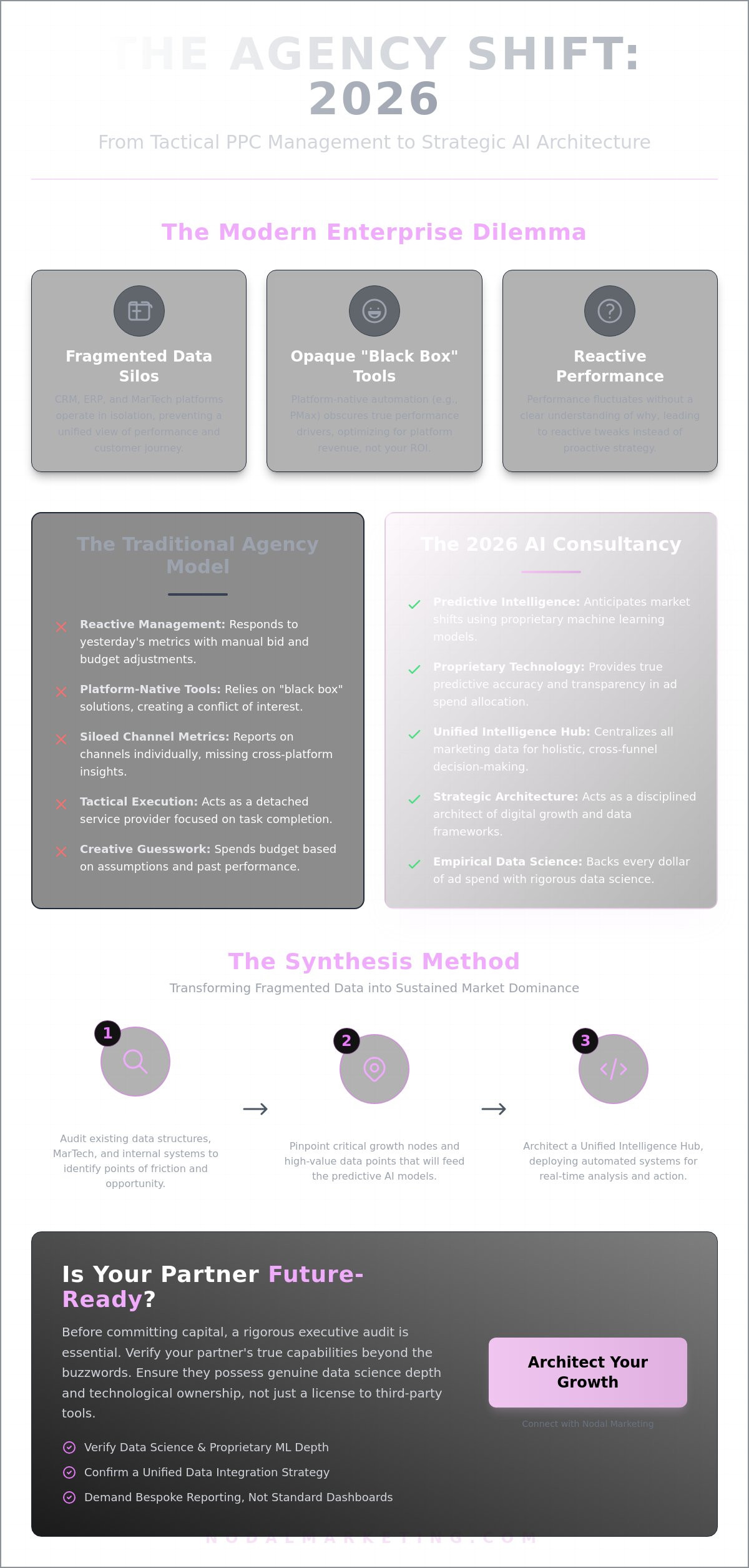
The 2026 AI digital marketing agency represents a fundamental departure from the execution-heavy models of the early 2020s. It's a data-first consultancy that prioritizes the architecture of proprietary machine learning over the manual management of ad accounts. Where traditional agencies were reactive, responding to yesterday's performance metrics with manual tweaks, the modern agency is proactive. It utilizes predictive intelligence to anticipate shifts in consumer behavior before they manifest in a dashboard. This evolution is centered on the concept of synthesis. It's the methodical process of linking fragmented data points from disparate silos into a unified, actionable whole. This process moves through three distinct phases: diagnosis of existing data structures, identification of growth nodes, and integration of automated systems.
Beyond the Buzzwords: What AI Means in 2026
In the current environment, artificial intelligence is no longer defined by simple scripts or basic automation rules. It's built upon sophisticated neural networks and predictive modeling that can process billions of signals in real time. Modern agencies utilize Unified Intelligence Hubs to centralize marketing data, ensuring that every decision is informed by a holistic view of the business rather than isolated channel metrics. This high-level application of Artificial Intelligence in Marketing allows for a level of precision that was previously impossible. The modern agency acts as a translator between commercial goals and technical execution.
The Role of the AI PPC Agency in an Automated World
You might wonder why a specialized AI performance marketing agency remains vital when platforms like Google and Meta offer their own native automation. The reality is that platform-specific tools are designed to maximize the platform's revenue, often functioning as "black boxes" that obscure true performance drivers. A sophisticated ai ppc agency provides the cross-platform intelligence these giants cannot offer. They bridge the gap between fragmented silos, ensuring that your search, social, and programmatic data all speak the same language. This requires Bespoke Reporting Solutions that go beyond standard dashboards to provide deep-funnel attribution. By moving away from a vendor mindset, these agencies become strategic partners that value depth over breadth, ensuring that every dollar of ad spend is backed by empirical data science rather than creative guesswork.
The Evolution of Performance: Why Standard PPC Management is Obsolete
The era of manual bid management has reached its natural conclusion. In the current digital environment, the speed of auction signals has far surpassed the capacity of human intervention. While traditional agencies still cling to the manual adjustment of keyword bids and budget pacing, this approach is fundamentally flawed in a world governed by millisecond processing. The decline of manual management isn't a loss of control; it's a transition toward algorithmic efficiency. However, this shift has birthed the "Data Trap." Most organizations are now drowning in information but starving for insight. Without a methodical synthesis of these points, more data simply leads to more confusion. It's a systemic failure where volume is mistaken for value.
To survive this shift, enterprise leaders must move toward "Strategic Architecture." This is the new baseline for performance. It's not about the tactical execution of a campaign, but the design of the data frameworks that feed the machine. Forward-thinking brands using AI for marketing are already outcompeting their peers by focusing on the quality of their data inputs rather than the quantity of their manual tweaks. They understand that the machine is only as capable as the architecture it sits upon. For those seeking to move beyond standard automation, a conversation regarding unified data integration is the logical first step.
Platform-Native AI vs. Bespoke Agency Intelligence
Relying solely on platform-native tools like Google's Performance Max or Meta's Advantage+ creates an inherent conflict of interest. These "black box" solutions are designed to maximize the platform's revenue, often at the expense of the advertiser's specific margins. A sophisticated ai ppc agency provides the necessary transparency by building bespoke models that prioritize your unique commercial outcomes. By enriching these models with first-party data, the agency ensures the AI learns from actual business results, not just platform-level proxies. This is the difference between renting a generic algorithm and owning a proprietary intelligence asset.
Predictive ROI: The New Standard for 2026
The benchmark for success has evolved from historical cost-per-lead to predicted value-per-lead. Machine learning now allows us to forecast Customer Lifetime Value (CLV) before a prospect even engages with an ad. This level of foresight requires more than a standard account manager; it demands a data science consultant who can architect marketing certainty. The modern ai ppc agency uses these predictive models to allocate spend where it will generate the highest future return, shifting the focus from what happened yesterday to what will happen tomorrow. This transition ensures that marketing spend is no longer a speculative cost, but a precision-engineered investment.
Essential Capabilities of a Modern AI PPC Agency
The technical prowess of a modern ai ppc agency is measured by its ability to synthesize disparate data streams into a single, cohesive narrative. It's no longer enough to report on clicks or surface-level conversions. True performance evolution requires advanced analytics that track deep-funnel attribution, linking initial ad engagement directly to bottom-line revenue recorded in an ERP. This level of integration ensures that every optimization is based on actual business value rather than platform-side proxies. By connecting the CRM, ERP, and ad platforms into a single source of truth, the agency eliminates the blind spots that plague traditional marketing models.
Beyond simple data collection, the modern agency utilizes automated insights to explain why performance shifted. It's a move from descriptive to diagnostic intelligence. If a campaign's efficiency drops, the AI identifies the specific variables, whether they're external market trends or internal creative decay, that caused the change. This diagnostic capability is paired with granular audience modeling. Machine learning identifies micro-segments and behavioral patterns that remain invisible to human analysts; this allows for a level of targeting precision that captures high-value prospects before the competition even realizes they exist.
The Unified Intelligence Hub
At the center of this technological ecosystem sits the Unified Intelligence Hub. This is the structural core of a high-performing ai digital marketing agency. It's a centralized framework designed to dismantle data silos, enabling real-time decision-making across all channels. By merging disparate sources, such as offline sales data and digital engagement metrics, the hub provides a holistic view of the customer journey. This architectural integrity allows for a more agile response to market volatility. It ensures that spend is always directed toward the most profitable nodes of the business.
Dynamic Creative Optimization (DCO) at Scale
Creative fatigue is a persistent challenge in high-volume performance marketing. In 2026, the solution lies in Dynamic Creative Optimization powered by generative AI. This technology allows for the simultaneous testing of thousands of ad variations, identifying which combinations of imagery and copy resonate with specific micro-audiences. However, the machine doesn't work in a vacuum. It requires human strategic designers to provide the creative guardrails and high-level vision. These experts guide the AI's output, ensuring that every variation remains aligned with the brand's sophisticated identity while the algorithm handles the heavy lifting of multivariate testing.
Evaluating Agency Partners: A 5-Point Executive Audit
Selecting an ai ppc agency is no longer a matter of checking a list of services; it's a rigorous audit of their structural integrity and technological depth. As the market becomes saturated with "AI-powered" claims, enterprise leaders must distinguish between superficial automation and deep-funnel data science. This evaluation is not about tactical efficiency, but about the long-term viability of the agency's data architecture. A methodical audit ensures that your chosen partner acts as a specialized strategic ally rather than a detached vendor. To assist in this transition, we've outlined five critical points of verification for any prospective performance partner.
- Proprietary Technology vs. Resold Tools: Demand clarity on their stack by asking, "What do you own versus what do you rent?" A partner that merely resells platform-native tools lacks the ability to customize models for your specific business logic.
- Data Science Depth: Evaluate the team’s background beyond standard platform certifications. True performance evolution requires experts in advanced analytics who can build, not just operate, predictive models.
- Transparency and "Black Box" Mitigation: Ensure the agency has a framework for explainable AI. They must be able to articulate why the machine made a specific decision, rather than hiding behind the platform's opaque reporting.
- Integration Capabilities: Verify their ability to connect with your specific MarTech stack. The agency must bridge the gap between your CRM, ERP, and ad platforms to create a unified view of performance.
- Strategic Vision: Determine if the partner offers data strategy services that align with your commercial objectives. They should design the blueprint for your growth, not just manage your bids.
Questions to Ask During the Selection Process
In RFP meetings, CMOs should move beyond cost-per-click discussions to focus on model interpretability and data governance. Ask how the agency handles data privacy in an automated environment and what their protocol is for auditing algorithmic bias. It's essential to understand their process for moving from diagnosis to integration. For a more granular vetting process, you can refer to our Executive Decision Guide. These inquiries will reveal whether the agency is a practical builder or simply a vendor using the latest industry buzzwords.
Red Flags in "AI-Powered" Agency Pitches
Be cautious of agencies that cannot explain their underlying data models or those that suggest a "set and forget" approach to automation. An ai ppc agency that removes human oversight entirely is a significant risk; true mastery requires a strategic designer to guide the machine's output. Another red flag is the lack of a unified data modeling approach. If the agency treats each channel as a silo, they're failing to capture the synthesis required for modern market dominance. For organizations ready to move beyond these pitfalls, we invite you to explore a consultation on data-first performance architecture that prioritizes precision over volume.
Nodal Marketing: Synthesising Data into Market Dominance
Nodal Marketing operates as the strategic designer of the 2026 marketing landscape. We don't just manage campaigns; we architect the data frameworks that drive them. Our approach is defined by a methodical thoroughness that moves through three essential stages: diagnosis of existing data structures, identification of growth nodes, and the final integration of automated systems. This isn't a surface-level service. It's a deep-level consultancy built on dual expertise. We speak the language of commercial dynamics and technical execution with equal mastery. This ensures that our clients achieve architectural certainty and a measurable ROI that generalist agencies cannot replicate.
As a premier ai ppc agency, we understand that the future of performance lies in the quality of the synthesis. We bridge the gap between fragmented data points and unified market dominance. By moving beyond tactical bidding and toward systemic design, we position your brand as a leader in a crowded digital environment. Our focus remains on the building blocks of your business, ensuring every technological tool is an integrated part of a larger, more powerful whole.
Our Approach to AI Performance
We utilize custom machine learning models to predict outcomes with a level of precision that platform-native tools can't match. Our models aren't generic; they're built to reflect your specific business logic and margins. This technical edge is complemented by our bespoke reporting philosophy. We prioritize executive clarity, providing insights that cut through the noise of standard dashboards. Our monthly retainer model isn't a fee for maintenance; it's a partnership for continuous evolution. It allows us to refine your data architecture as market conditions shift, ensuring your strategy remains as dynamic as the landscape itself.
Connecting the Disparate
For global brands, the greatest challenge is often the fragmentation of intelligence. Our Unified Intelligence Hub serves as the structural anchor that links these disparate silos. It transforms isolated metrics into a singular, actionable source of truth. By choosing a sophisticated ai ppc agency, you're choosing to move from abstract concepts of automation to concrete business outcomes. We don't settle for "black box" promises. We deliver transparent, data-driven growth that scales with your ambition. It's time to move beyond tactical execution and toward strategic architecture. We invite you to Consult with Nodal Marketing on your AI strategy and discover how we can synthesize your data into a unified engine for market dominance.
Architecting the Future of Performance
The transition from tactical execution to strategic architecture is not merely a trend; it is a necessity for enterprise survival in 2026. You've seen how the synthesis of fragmented data points into a unified intelligence hub provides the predictive accuracy required to outpace the competition. Relying on an ai ppc agency that prioritizes proprietary data science over platform-native automation ensures that your marketing spend remains a precision-engineered investment rather than a speculative cost. It's the difference between reacting to the market and designing it.
Nodal Marketing has been at the forefront of this evolution since 2018. As specialists in Data Science and Advanced Analytics, we provide global brands with the bespoke reporting solutions and structural integrity needed to navigate a chaotic digital landscape. We invite you to move beyond the limitations of platform-native tools and embrace a model built on intellectual rigor and methodical thoroughness. Architect your marketing certainty with Nodal Marketing and transform your fragmented data into a unified engine for sustained growth. The path to market dominance is clear for those ready to build.
Frequently Asked Questions
What is the difference between an AI PPC agency and a traditional digital agency?
An ai ppc agency focuses on the architecture of data systems rather than the manual manipulation of keyword bids. While traditional agencies rely on human oversight for tactical execution, the modern model utilizes proprietary machine learning to process signals in real time. This shift moves the agency's value from account management to strategic data consultancy, ensuring that every ad spend decision is backed by predictive intelligence rather than historical guesswork.
How does an AI digital marketing agency handle data privacy and security?
We prioritize structural privacy by integrating secure data modeling techniques that comply with evolving global regulations. Our approach focuses on first-party and zero-party data enrichment within your own environment, ensuring that sensitive information remains protected. This methodical thoroughness prevents the risks associated with "black box" tools, providing a transparent framework where data governance and performance evolution coexist without compromise.
Can an AI marketing agency improve ROAS for small budgets, or is it only for enterprise spend?
Improved ROAS is achievable for any budget through algorithmic efficiency, though the most significant impact is often seen in complex, data-rich environments. For smaller spends, the AI reduces manual overhead and identifies high-value micro-segments that would be too costly to find manually. For enterprise leaders, the value lies in the synthesis of disparate data points across global markets to ensure every dollar is allocated with predictive accuracy.
How does Nodal Marketing integrate with our existing MarTech stack?
Nodal Marketing utilizes a tripartite process of diagnosis, identification, and integration to connect with your existing MarTech stack. We bridge the gap between your CRM, ERP, and ad platforms to create a cohesive ecosystem. This integration ensures that our data science and advanced analytics tools have access to the deep-funnel signals required to architect marketing certainty and drive measurable commercial outcomes.
What is a "Unified Intelligence Hub" in the context of digital advertising?
A Unified Intelligence Hub is the structural core of a modern performance model that centralizes fragmented data from all business sectors. It eliminates silos by linking offline sales, digital engagement, and customer lifetime value into a single source of truth. This hub allows an ai ppc agency to move beyond descriptive reporting toward diagnostic and predictive intelligence, enabling real-time decision-making across the entire marketing landscape.
How quickly can I expect to see results when switching to an AI-driven agency model?
Initial performance stabilization typically occurs within the first thirty days of the integration phase as the machine begins to ingest and process your historical data. However, achieving full predictive mastery requires a complete data cycle to identify seasonal patterns and long-term behavioral trends. Our focus is on sustainable, structured growth rather than the frantic, short-term spikes often promised by generalist vendors.
Does an AI agency replace the need for human creative directors?
Artificial intelligence does not replace human creative directors; it empowers them to act as strategic designers. While generative AI handles the heavy lifting of multivariate testing and creative variation, human experts provide the creative guardrails and high-level vision. This partnership ensures that every ad remains aligned with your brand's sophisticated identity while the algorithm optimizes for granular audience engagement.
What specific AI tools does a modern performance agency use in 2026?
Performance agencies in 2026 prioritize proprietary neural networks and predictive modeling over resold, third-party scripts. We utilize advanced analytics and bespoke reporting solutions to surface the "why" behind performance shifts. These tools are designed to architect data certainty by forecasting customer lifetime value and identifying micro-segments that remain invisible to platform-native automation or standard industry dashboards.