
What if the primary obstacle to your marketing ROI isn't a lack of tools, but a surplus of unrefined data? You've likely invested heavily in automated intelligence, yet you're still faced with disconnected sources that offer conflicting narratives rather than clear directions. It's a common frustration to see internal teams struggle with predictive modeling while global data generation reaches 175 zettabytes. A data science consultant bridges this gap, acting not as a mere analyst but as a strategic architect who synthesizes fragmented points into a unified engine of certainty.
This article demonstrates how specialized expertise transforms technical potential into measurable financial impact. You'll learn to move beyond simple analytics toward a model of decision optimization that accounts for the 2026 regulatory shift, including the California Delete Act and the expanding patchwork of state privacy laws. We will examine the transition from diagnosis to identification and finally to the integration of a hub that predicts customer behavior with surgical precision. By the end, you'll understand how to replace digital noise with a structured framework for executive-level returns.
Key Takeaways
- Learn why a data science consultant is a strategic architect rather than a simple analyst, moving your organization from descriptive reporting to predictive certainty.
- Identify the systemic inefficiencies within your MarTech stack and learn how to build a unified data infrastructure that eliminates the hidden costs of fragmented insights.
- Explore how advanced analytics and AI-powered insights optimize the entire marketing funnel, specifically enhancing PPC bidding precision and SEO revenue alignment.
- Gain clarity on why external intellectual rigor is essential for solving the fragmentation crisis, even when internal data teams are already in place.
- Master the concept of synthesis to bridge the gap between complex technical environments and your core commercial objectives.
Defining the Data Science Consultant: More Than Just Analytics
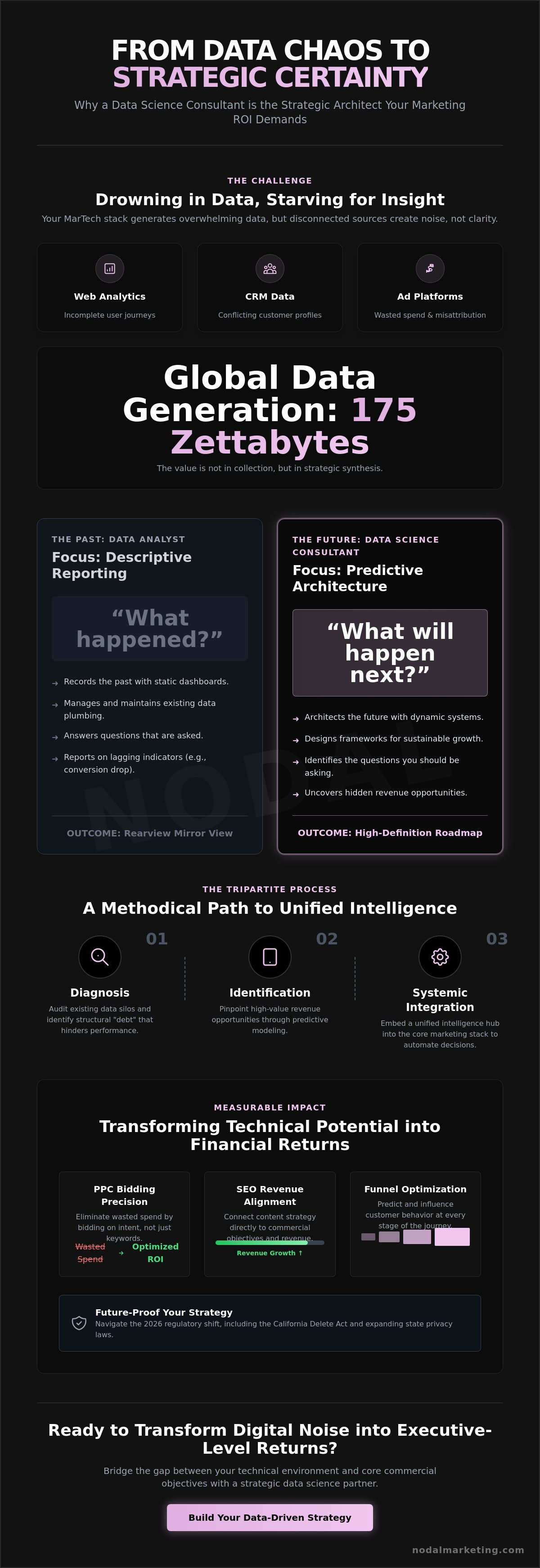
The modern enterprise is no longer starved for information; it is drowning in it. While traditional reporting focuses on descriptive analytics, specifically answering the question "what happened," the role of a data science consultant is fundamentally different. They don't just record the past. They architect the future by shifting the focus toward predictive consulting. This involves moving beyond static dashboards to build dynamic systems that answer "what will happen next." In an era where global data generation is reaching 175 zettabytes, the value lies not in the collection of bits but in the synthesis of meaning.
A consultant serves as a vital translator. They possess the linguistic mastery to bridge the gap between technical data environments and commercial marketing goals. This isn't about running queries; it's about translating a CEO's ambition for ROI into a technical roadmap. Their approach follows a methodical tripartite structure that ensures every recommendation is grounded in intellectual rigor:
- Diagnosis: Auditing existing data silos and identifying the structural "debt" that hinders performance.
- Identification: Pinpointing high-value revenue opportunities through granular audience analysis and predictive modeling.
- Systemic Integration: Embedding unified intelligence into the core marketing stack to automate decision optimization.
Data science, in this professional context, becomes a tool for growth rather than a mere academic exercise. It's the difference between looking in the rearview mirror and having a high-definition map of the road ahead.
The Evolution of Marketing Data Science
Marketing has moved far beyond basic reporting. In 2026, standard automation is no longer a competitive advantage; it is the baseline requirement. The true edge comes from AI-powered insights that anticipate customer shifts before they occur. We've seen a transition from fragmented spreadsheets to unified intelligence hubs. These hubs don't just store data. They process it in real-time to provide actionable certainty, ensuring that every dollar spent on paid search or paid social is backed by empirical evidence. The goal is no longer just to reach an audience, but to understand the intent behind every interaction.
Consultant vs. Analyst: The Strategic Divide
The distinction between an analyst and a consultant is one of scope and impact. Analysts manage data; they maintain the plumbing of the organization. A data science consultant, however, architects the frameworks that drive sustainable growth. While an analyst might tell you that your conversion rate dropped, a consultant identifies the hidden revenue opportunities that your current MarTech silos are obscuring. They don't just answer questions. They identify the questions you should have been asking in the first place. By bridging the divide between disconnected marketing tools, they transform a chaotic digital landscape into a streamlined engine for profit.
The Technical Translation: Bridging Data Silos and Strategic Execution
The hidden cost of dirty data is a silent drain on enterprise growth. In fragmented marketing ecosystems, disconnected datasets don't just provide incomplete pictures; they provide actively misleading ones. A data science consultant recognizes that raw information is a liability until it's refined through a rigorous architectural framework. By moving beyond the surface level of individual platforms, they identify the systemic discrepancies that lead to wasted spend and missed opportunities. It's not about the volume of information you possess, but the integrity of the connections between those points.
Building a unified data infrastructure requires more than simple technical connectors. It demands a sophisticated data and AI strategy that aligns technical execution with high-level commercial objectives. This process involves stitching together disparate threads from CRMs, advertising platforms, and web analytics into a singular, unassailable truth. This isn't a mere IT project; it's a strategic realignment. By ensuring that data points from different sources validate rather than contradict one another, a data science consultant transforms raw data into an actionable intelligence hub that serves as the foundation for all future growth.
Architecting Unified Intelligence Hubs
The traditional barriers between SEO, PPC, and Paid Social data often prevent a holistic view of the customer journey. A consultant dismantles these silos, creating a unified intelligence hub where organic visibility and paid acquisition work in concert. Bespoke reporting solutions then translate this technical synthesis into a language that executives can use for rapid, confident decision-making. At its core, these data strategy services serve as the architectural blueprint for any brand seeking marketing certainty in a volatile market.
Specialized Machine Learning Models
Standard platform automation often acts as a black box, offering little transparency into how decisions are made. A consultant replaces these generic algorithms with specialized machine learning models tailored to your specific business logic. These custom models allow for the prediction of Customer Lifetime Value (CLV) with granular precision, moving beyond averages to individual-level insights. By integrating disparate data sources for real-time optimization, brands can shift from reactive adjustments to proactive market leadership. If your current stack feels like a collection of parts rather than a cohesive machine, it's time to explore a more integrated analytical approach through professional synthesis.
The Consultant vs. Internal Teams: Solving the Fragmentation Crisis
Many executives believe that an internal data team is sufficient for maintaining growth. While these teams are excellent at managing daily operations, they often lack the specialized focus required to solve the fragmentation crisis. A data science consultant provides the intellectual rigor and external objectivity necessary to see beyond the internal echo chamber. Internal teams are frequently bogged down by historical biases and departmental politics. In contrast, a consultant brings a disciplined, forward-thinking perspective that prioritizes systemic health over short-term metrics. It is not a matter of replacing existing talent, but rather of refining the lens through which that talent views the market.
The "Skill Gap" is a tangible reality in 2026. With the demand for data scientists projected to grow by 35% through the next decade, retaining top-tier talent in-house has become increasingly difficult and expensive. Instead of struggling with high turnover and the overhead of full-time executive hires, savvy organizations use consultants to augment their existing staff. This partnership model empowers internal teams by moving them from a state of constant troubleshooting to one of strategic execution. It provides the high-level expertise needed for complex predictive modeling without the long-term liability of a permanent C-suite expansion.
Objectivity and the Outside Perspective
Internal performance reporting is often plagued by confirmation bias. Departments naturally want to show success, which can lead to skewed attribution models and vanity metrics that don't reflect actual ROI. A consultant identifies these internal biases, offering a neutral assessment of what is actually driving revenue. This cross-industry experience is why brands using ai for marketing frequently begin their journey with external architects. They understand that a third-party perspective is the only way to achieve true transparency in a crowded digital landscape. It is the difference between seeing what you want to see and seeing what is actually there.
Scalability and Specialized Expertise
A high-level consultancy offers a level of insight that generalist competitors cannot match. It provides access to specialized skill sets like granular audience analysis and unified data modeling without the burden of permanent overhead. This flexibility allows brands to pivot their strategies quickly in response to global market dynamics. A data science consultant acts as a catalyst for a data-first corporate culture, moving the organization from diagnosis to identification and finally to integration. It's not about adding more people; it's about adding more precision to the people you already have.
Measurable Impact: How Data Science Consultants Optimize the Funnel
The transition from speculative marketing to empirical certainty is not achieved through more data, but through better architecture. A data science consultant moves beyond the surface level of campaign management to engineer outcomes across the entire customer journey. While generalist agencies might focus on click-through rates, a strategic consultant prioritizes the alignment of organic visibility with actual revenue. By applying predictive modeling to budget allocation, they ensure that every dollar is directed toward the highest probability of conversion. This is not about guessing which channel might perform; it is about knowing which levers to pull to guarantee executive-level ROI.
Optimizing Paid Search (PPC) and Paid Social requires a shift from static bidding to dynamic, AI-driven execution. A data science consultant utilizes granular audience analysis to identify segments that standard platform demographics often overlook. This involves a tripartite process of identifying intent, modeling behavior, and optimizing in real-time. By connecting SEO insights with paid performance, brands can create a self-reinforcing loop where organic data informs paid strategy and vice versa. This synthesis transforms the marketing funnel from a leaky vessel into a streamlined engine for growth.
Performance Marketing Management
Generic platform automation often prioritizes the platform's profit over the advertiser's return. An AI performance marketing agency model corrects this by using proprietary tools to manage bidding strategies with surgical precision. These models don't just react to market changes; they anticipate them. By moving beyond "black box" algorithms, consultants provide the transparency needed to scale ROI without the risk of runaway spend. It's not about higher volume, but about higher quality interactions that translate directly to the bottom line.
Attribution and ROI Modeling
Solving the multi-channel attribution puzzle remains one of the greatest challenges for the modern C-suite. Advanced analytics allow for the calculation of the true cost of customer acquisition (CAC) by accounting for every touchpoint in the funnel. Instead of relying on flawed last-click models, consultants build bespoke reporting solutions that visualize the KPIs that actually matter to executive leadership. This level of intellectual rigor provides the clarity needed for long-term stability in a chaotic digital landscape. To begin architecting your own path to marketing certainty, partner with a strategic designer who values precision over volume.
Choosing a Strategic Partner: The Nodal Marketing Philosophy
The selection of a data science consultant is a decision that determines the structural integrity of your future marketing growth. It's not a choice between different vendors, but a choice between fragmented tactics and unified intelligence. At Nodal Marketing, we reject the frantic, high-energy approach of generalist agencies. We opt instead for a composed, executive-level discourse grounded in intellectual rigor. Our philosophy centers on synthesis; the idea that linking disparate data points creates a whole that is far more powerful than the sum of its parts. By bridging the gap between technical execution and commercial dynamics, we transform your data from a chaotic liability into a strategic asset.
A true partnership is built on the mastery of dual expertise. We act as translators who can navigate the complex lexicon of technical data environments while remaining focused on your high-level commercial goals. This approach ensures that your technological investments are not just operational expenses, but building blocks for a stable, scalable enterprise. By evaluating data science consulting services through the lens of long-term ROI, you move away from the "black box" of standard automation and toward a transparent, architected future.
The Concept of Synthesis
Synthesis is the antidote to the fragmentation crisis. Our methodical approach moves through three distinct phases: diagnosis of existing silos, identification of high-value opportunities, and systemic integration of unified intelligence. While generalist models often rely on standard platform automation, our proprietary AI tools are designed for depth. They provide a level of granular audience analysis that allows for decision optimization rather than simple prediction. This process ensures that your MarTech stack functions as a cohesive engine, aligning organic visibility with paid performance to create a unified intelligence hub.
The Executive Decision Guide
Vetting a potential ai marketing company requires a focus on strategic design over mere service provision. You aren't just looking for someone who can manage data; you're looking for a partner who can architect the frameworks that drive growth. Ask whether the partner understands the linguistic mastery required to bridge the gap between marketing dynamics and technical execution. A strategic designer builds frameworks that evolve with the market. The journey begins with a comprehensive data environment audit. This diagnosis identifies the structural debt in your current systems and provides the roadmap for a bespoke reporting solution that offers true marketing certainty.
Architecting the Future of Marketing Intelligence
Marketing in 2026 demands a shift from reactive data collection to proactive decision optimization. We've explored how a data science consultant serves as the strategic designer of this transition, moving beyond basic reporting to build unified intelligence hubs. By bridging the gap between technical silos and commercial objectives, these experts transform fragmented datasets into a singular engine for growth. This process of synthesis ensures that every investment in paid search or advanced analytics is backed by intellectual rigor and empirical certainty. You don't need more data; you need a more disciplined framework for interpreting it.
The path to executive-level ROI is built on precision rather than volume. Nodal Marketing provides AI-powered insights for global enterprise brands, utilizing proprietary frameworks to deliver bespoke reporting solutions that drive measurable results. It's time to replace digital noise with a structured roadmap for stability and scale. Architect your marketing certainty with Nodal Marketing and move your organization from diagnosis to integration. The structural integrity of your marketing engine starts with a single, strategic realignment that values depth over breadth. Your evolution from a service-dependent model to a data-first powerhouse is within reach.
Frequently Asked Questions
What is the difference between a data analyst and a data science consultant?
A data analyst primarily focuses on descriptive metrics to explain what happened in the past. In contrast, a data science consultant acts as a strategic architect who uses predictive modeling to determine what will happen next. While the analyst manages the technical plumbing of your data, the consultant translates those technical environments into commercial roadmaps for growth. It's the difference between recording history and designing the future.
How does a data science consultant help with marketing ROI?
ROI is optimized through the transition from simple prediction to decision optimization. By synthesizing fragmented data points, a consultant identifies where budget is being wasted across disconnected channels. They build unified intelligence hubs that allow for real-time adjustments to bidding and audience segmentation. This methodical approach ensures that every marketing dollar is backed by empirical certainty rather than speculation or platform-default settings.
Can a data science consultant integrate with our existing MarTech stack?
Integration is the core of the consulting process. The goal isn't to replace your existing tools but to harmonize them into a cohesive ecosystem. By linking your CRM, advertising platforms, and web analytics, a consultant creates a singular source of truth. This synthesis eliminates the conflicting narratives often produced by isolated MarTech silos. It turns a collection of disparate parts into a streamlined engine for executive-level insights.
When is the right time for an enterprise brand to hire a data science consultant?
The ideal time is when your internal teams can no longer reconcile conflicting insights from different data sources. If you're seeing high spend on AI tools with low measurable returns, you're likely facing a fragmentation crisis. Hiring a consultant provides the external objectivity needed to audit your data environment and identify structural inefficiencies. It's a proactive move for leaders who value precision and long-term stability over volume.
Do we need a data science consultant if we already use AI marketing tools?
AI tools often operate as black boxes that prioritize platform profit over your specific business logic. A data science consultant provides the transparency these generic algorithms lack. They build specialized machine learning models tailored to your unique customer behavior, ensuring your automated intelligence is a competitive advantage. You move away from generic automation and toward a proprietary system that reflects your specific commercial goals.
What are the typical project lengths for data science consulting implementations?
Engagements typically follow a logical progression from diagnosis to integration. An initial audit of your data environment may take several weeks, while the construction of a unified intelligence hub is a more systemic undertaking. These projects aren't finite tasks but the beginning of a strategic partnership focused on sustainable growth. The rhythm is steady and deliberate, mirroring a professional consultation rather than a quick-fix service.
How do consultants handle data privacy and security in marketing environments?
Consultants navigate the complex 2026 regulatory landscape, including the California Delete Act and the Oregon Consumer Privacy Act. They build privacy-first frameworks that recognize universal opt-out signals and manage precise geolocation data according to expanding state laws. This focus on governance transforms legal compliance into a strategic advantage. It builds customer trust while protecting the brand from the risks associated with a fragmented regulatory environment.
What specific ROI metrics should we expect from data science consulting?
You should expect improvements in Customer Lifetime Value (CLV) and a reduction in the true cost of acquisition across the entire funnel. Consultants provide bespoke reporting that visualizes multi-channel attribution accuracy and audience intent. These metrics move beyond vanity figures to provide the C-suite with the clarity needed for confident budget allocation. It's about achieving a level of predictive accuracy that standard reporting simply cannot provide.