
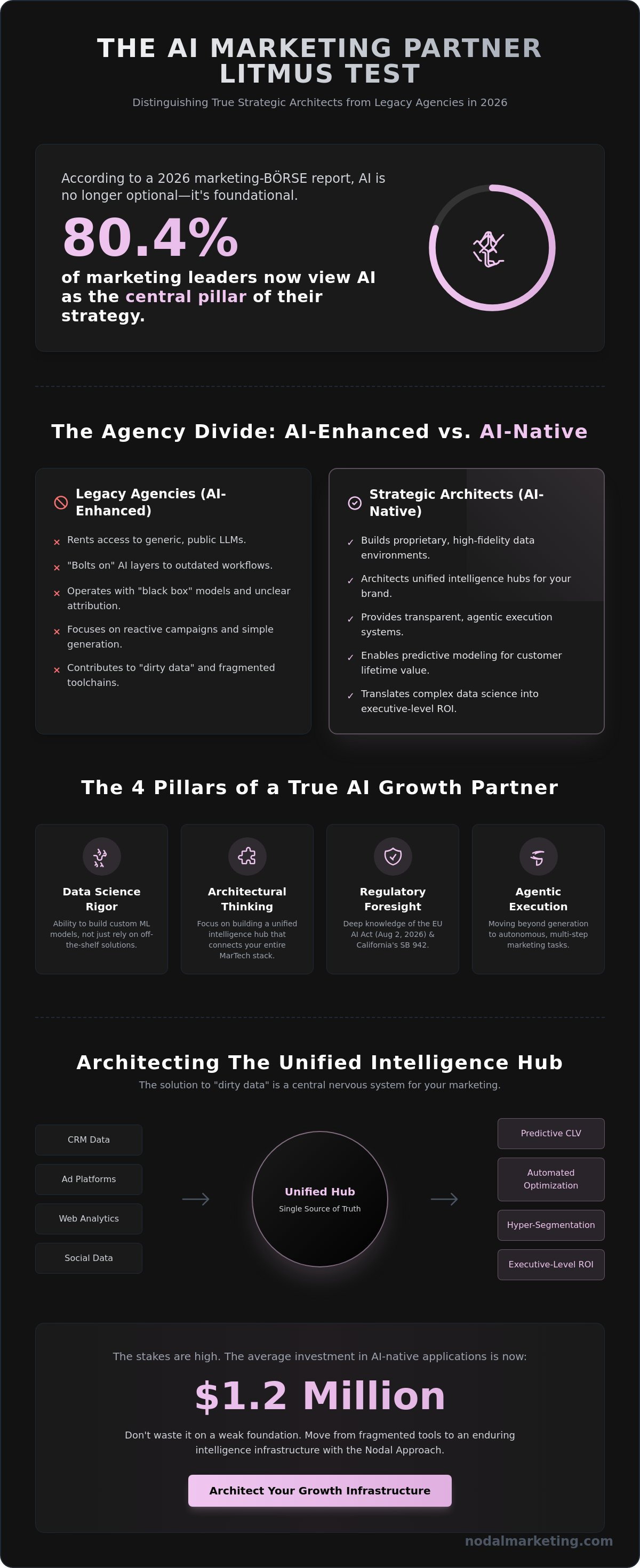
Most agencies are simply renting access to generic LLMs, yet 80.4% of marketing leaders now view AI as the central pillar of their strategy according to a 2026 marketing-BÖRSE report. You've likely felt the friction of fragmented data leaking across disconnected MarTech tools. It's a common executive pain point where AI initiatives fail to scale beyond the pilot phase because they're built on "dirty data" and inaccurate attribution. Choosing the right ai marketing company isn't about finding a vendor with a new plugin; it's about selecting a growth partner capable of translating complex data science into executive-level ROI.
This guide will teach you how to distinguish AI-native architects from traditional agencies and how to build a unified intelligence hub for your brand. We'll examine the critical regulatory landscape, including the August 2, 2026, enforcement of the EU AI Act and California's SB 942 transparency requirements. You'll discover how to move from reactive campaigns to predictive modeling for customer lifetime value and automated performance optimization. We're moving beyond the noise of entry-level digital marketing into a new era of intellectual rigor and measurable certainty.
Key Takeaways
- Distinguish AI-native growth partners from traditional agencies by prioritizing agentic execution and predictive analytics over simple generative layers.
- Resolve the "dirty data" crisis by architecting a unified intelligence hub that connects fragmented sources into a single, high-fidelity source of truth.
- Utilize a strategic framework to audit the data science credentials and MarTech integration capabilities of any potential ai marketing company before commitment.
- Shift from standard performance marketing to an AI strategic consultancy model that prioritizes bespoke reporting and executive-level decision-making.
- Understand how a "Nodal" approach to growth infrastructure creates the foresight needed to scale complex AI initiatives beyond the experimental phase.
What Defines a Leading AI Marketing Company in 2026?
The era of the "experimental" AI pilot has officially concluded. As we progress through 2026, the distinction between a legacy agency and a true ai marketing company is defined by the depth of their technical infrastructure. While traditional firms attempt to "bolt on" AI layers to existing workflows, leading partners act as Strategic Architects. They don't just generate copy; they build autonomous systems that diagnose market shifts, identify high-value segments, and integrate solutions in real time. This isn't about buying services. It's about building an enduring intelligence foundation.
The Evolution of AI in Digital Marketing
Marketing has transitioned from simple rule-based automation to agentic execution. In earlier years, AI was primarily a tool for efficiency and cost-cutting. Today, it's the fundamental engine of growth. This shift marks the end of "black box" marketing, where data went in and unexplained results came out. For a foundational overview of AI in marketing and its historical progression, one can see how we've moved from predictive analytics to systems that actually execute decisions. With the EU AI Act coming into full force on August 2, 2026, transparency is no longer optional. It's a legal and strategic mandate that requires a partner who understands the mechanics behind the model, not just the output.
AI-Native vs. AI-Enhanced: Spotting the Difference
You must look past the interface to find the value. Many agencies claim "AI expertise" while merely skinning existing LLMs with basic prompts. An AI-native partner operates differently. They maintain proprietary data environments and intelligence hubs that ensure your brand's data remains a competitive advantage rather than fuel for a public model. They don't just use tools; they architect ecosystems. This requires a partner who speaks the languages of both marketing dynamics and data science with equal fluency.
True fluency is a critical requirement for navigating a landscape where organizations now spend an average of $1.2 million on AI-native applications. To identify a legitimate partner, look for these core competencies:
- Data Science Rigor: The ability to build custom machine learning models rather than relying on generic, off-the-shelf solutions.
- Architectural Thinking: A focus on building a unified intelligence hub that connects your entire MarTech stack.
- Regulatory Foresight: Deep knowledge of the California AI Transparency Act (SB 942) and its impact on your content origin disclosures.
- Agentic Execution: Moving beyond content generation to systems that perform complex, multi-step marketing tasks autonomously.
Leading firms in 2026 are no longer vendors; they're growth partners integrated into the very fabric of your technology stack. They provide the foresight that generalist agencies lack, turning the noise of a saturated digital landscape into a structured path for certain growth.
Architecting the Unified Intelligence Hub
Most executives approach AI as a creative accelerant, yet the true value of an ai marketing company lies in its ability to build infrastructure. Without a unified data foundation, your agentic AI tools are essentially running on "dirty data." This leads to inaccurate attribution and fragmented insights that fail to scale. In 2026, the success of your marketing ecosystem depends on whether you've architected a unified intelligence hub before deploying outward-facing applications. Zylo’s February 24, 2026, SaaS Management Index reveals that organizations now spend an average of $1.2 million on AI-native applications. This investment is wasted if those applications cannot communicate through a central nervous system.
The "Strategic Architect" model prioritizes infrastructure over application. By connecting disparate data sources into a single source of truth, you eliminate the silos that currently cause your AI tools to underperform. This foundational work allows for hyper-granular audience segmentation that was previously impossible. When your data is clean and connected, your AI doesn't just guess; it knows. This level of precision transforms marketing from a series of experimental bets into a disciplined engine of growth. For leaders seeking to audit their current data maturity, a consultation on growth infrastructure can reveal the specific nodes where your intelligence is currently leaking.
Solving for Data Fragmentation
To lead in a saturated landscape, you must identify every "node" in your marketing ecosystem. These are the points where data enters your world, from CRM entries to first-party web interactions. Real-time ingestion and processing are no longer luxury features; they're requirements for maintaining a global brand strategy. When data is unified, you move from managing tools to orchestrating an ecosystem. This shift allows for a composed, executive-level discourse regarding ROI because the guesswork has been removed at the architectural level.
From Raw Data to Predictive Insights
A unified intelligence hub is the foundational layer of modern MarTech, serving as the single source of truth that powers every autonomous decision within the ecosystem. Once this layer is established, you can use machine learning to forecast customer lifetime value (CLV) with unprecedented accuracy. Instead of reactive reporting that looks at what happened last month, you gain proactive growth modeling that predicts what will happen next quarter. This foresight is what distinguishes a specialized ai marketing company from a generalist agency. You aren't just looking for results; you're looking for the certainty that comes from a methodical, tripartite process of diagnosing, identifying, and integrating intelligence.
Performance Marketing vs. AI Strategic Consultancy
Standard PPC management has officially transitioned from a specialized skill to a baseline commodity. In 2026, the competitive edge isn't found in manual bid adjustments; it's found in the architectural foresight of a specialized ai marketing company. While generalist agencies focus on the "noise" of high-volume clicks, a strategic consultancy operates with a sense of "quiet power." They utilize advanced media modeling to ensure every dollar spent is a calculated investment in brand equity rather than a desperate reach for visibility. This shift requires a partner that values depth over breadth, moving beyond the frantic pace of traditional performance marketing into a more composed, executive-level discourse.
Bespoke Reporting and Transparency
Standard dashboards often fail the enterprise executive because they prioritize volume over value. You don't need more data; you need more clarity. A sophisticated partner designs reporting suites that highlight ROI certainty by isolating the impact of custom ML models from general market trends. This level of transparency is essential for scaling through an AI performance marketing agency, where the focus remains on high-impact results rather than vanity metrics. These reporting frameworks serve as the bridge between technical data science and strategic business outcomes, allowing you to lead with confidence rather than manage with hope.
The ROI of Certainty
Guesswork has no place in a generative AI market projected to reach $1.3 trillion by 2032. By replacing manual targeting with algorithmic bidding, you achieve a level of precision that human teams cannot match alone. This isn't just about speed; it's about the intellectual rigor required to architect a system that learns from every interaction. The goal is to move beyond the experimental phase and into a state of automated performance optimization at scale. Consider the following value-based outcomes that define this new standard:
- Predictive Modeling: Transitioning from reactive cost-per-click metrics to proactive customer lifetime value (CLV) forecasts.
- Granular Intelligence: Implementing audience segments that evolve in real-time based on agentic AI insights.
- Regulatory Precision: Maintaining absolute compliance with the New York Law on Synthetic Performers in Advertising, effective June 9, 2026, which requires conspicuous disclosure for all AI likenesses.
The transition from a service vendor to a growth partner is marked by this focus on precision over volume. You need a partner that speaks the languages of both marketing dynamics and technology, providing the foresight that others lack. By balancing machine-speed execution with human deep thinking, a strategic consultancy turns fragmented data into a unified whole, ensuring your brand doesn't just compete, but leads.
A Decision Framework for Selecting an AI Partner
Selecting an ai marketing company requires a shift from evaluating creative portfolios to auditing technical infrastructure. In a landscape where 80.4% of marketing strategies now center on AI, the margin for error has vanished. You aren't just hiring a service provider; you're choosing an architect for your brand's future intelligence. This choice demands a methodical framework that prioritizes precision over promises. It's about finding a partner that doesn't just compete, but leads through intellectual rigor.
The selection process should follow a disciplined, five-step progression:
- Audit Technical Credentials: Investigate their engineering pedigree. Do they rely on third-party wrappers, or do they build proprietary machine learning models?
- Evaluate Integration Capabilities: A partner who can't connect your CRM to your media modeling is merely creating another silo. Ensure they can architect a unified intelligence hub.
- Test Strategic Fluency: They must translate high-level data science into actionable business strategy without losing the nuance of either field.
- Assess Privacy Rigor: With the EU AI Act's high-risk obligations taking effect on August 2, 2026, your partner must demonstrate rigorous compliance and data governance.
- Review Scaling History: Growth in 2026 is earned through structured systems. Review their track record in managing complex, multi-node marketing ecosystems.
Technical Vetting: Beyond the Pitch
Look beyond the polished pitch deck. Ask granular questions about their use of Agentic AI in real-world scenarios. How do their systems handle conflicting data points? If they offer an intelligence platform like "Connect," ask how it manages the latent disclosures required by California SB 942. A legitimate partner speaks both marketing and technology fluently, acting as a translator between these two complex domains. They should provide the foresight that generalist agencies lack, turning the noise of a saturated landscape into a structured path for growth.
The Strategic Alignment Check
Determine if they act as a detached vendor or an integrated growth partner. A vendor provides hindsight through reactive reports; an architect provides foresight through predictive modeling. The ideal partner is one who provides foresight, not just hindsight. They should be deeply integrated into your team, helping you transition from legacy systems to unified intelligence hubs with quiet power. If you're ready to move beyond fragmented tools, you can request a technical audit of your AI readiness to identify your most critical integration gaps.
The Nodal Approach: Connecting the Dots of Intelligence
The transition from fragmented data to a unified intelligence hub requires more than just software; it requires a Strategic Architect. Nodal Marketing operates at this intersection, acting as the bridge between raw data science and executive-level ROI. While a standard ai marketing company might offer a collection of disconnected tools, we focus on the infrastructure that makes those tools effective. Our methodology is built on a disciplined, tripartite process: diagnosing your specific structural challenges, identifying the precise AI applications required for your vertical, and integrating those solutions into a seamless ecosystem. This isn't just about efficiency. It's about revolutionizing the way your brand interacts with the digital landscape.
We believe that growth is earned through precision, not accidental volume. By utilizing "Agentic AI" within a human-led strategic framework, we move beyond the limitations of basic automation. Our systems don't just follow instructions; they execute complex, multi-step marketing objectives with a level of foresight that generalist agencies cannot replicate. This approach ensures your brand doesn't just compete in the 2026 market, but leads it with intellectual rigor and visionary confidence.
Our Proprietary Technology Stack
At the center of our methodology is "Connect," our proprietary unified intelligence hub. This platform serves as the central nervous system for your brand, connecting fragmented data points from across your global operations to create a single, high-fidelity source of truth. We don't rely on off-the-shelf wrappers. Instead, we integrate custom machine learning models into every client retainer, transforming abstract strategy into surgical execution. This level of technical fluency allows us to speak the languages of both marketing dynamics and technology with equal mastery, ensuring that your growth infrastructure is built on foundations of certainty rather than guesswork.
Partnering for the Future
Scale requires a global perspective and a local touch. With a presence in London, New York, and Hong Kong, Nodal Marketing provides the specialized expertise needed to navigate the increasingly complex regulatory and technological environment of 2026. We prioritize depth over breadth, choosing to be an indispensable partner rather than an external vendor. In a world saturated with "hype-heavy" promises, we offer a composed, expert guide through the noise. We invite you to discover how Nodal Marketing provides less guesswork and more certainty for your brand's future. By connecting the dots of your intelligence today, we provide the foresight you need to own the market tomorrow.
Architecting Your Brand's Future Intelligence
The transition from fragmented data to a unified intelligence hub is a strategic necessity for the 2026 landscape. As the generative AI market scales toward its projected $1.3 trillion valuation by 2032, the distinction between legacy vendors and true growth partners will only sharpen. You've seen how architecting a foundation of clean, agentic data is the only way to move beyond the experimental phase and into automated optimization at scale. Selecting the right ai marketing company is the definitive executive decision that determines whether your brand merely survives the noise or leads with intellectual rigor.
With a global presence spanning London, Hong Kong, and New York, Nodal Marketing provides the dual fluency in data science and marketing dynamics required to navigate this complexity. Our proprietary "Connect" platform and expertise in Agentic AI ensure that your infrastructure is built for foresight, not just hindsight. It's time to replace the uncertainty of "dirty data" with the precision of a specialized growth partner who operates with quiet power and technical mastery.
Connect with the architects of intelligent growth at Nodal Marketing and begin building your unified intelligence hub today. The path to unprecedented growth starts with a single, connected dot.
Frequently Asked Questions
What is the difference between an AI marketing agency and a traditional digital agency?
An AI marketing agency operates as a strategic architect rather than a service vendor. While traditional firms "bolt on" AI layers to existing workflows, a true ai marketing company builds its entire infrastructure on proprietary machine learning models. This distinction is critical for moving beyond basic automation into the realm of autonomous decision-making. You're shifting from manual, volume-based execution to a model grounded in intellectual rigor and predictive foresight.
How does an AI marketing company improve ROI for enterprise brands?
ROI is improved through the elimination of fragmented data and the implementation of predictive modeling. By architecting a unified intelligence hub, brands can move away from reactive spending toward proactive growth modeling. This allows for the calculation of customer lifetime value with unprecedented accuracy. This precision ensures that media spend is allocated only to hyper-granular audience segments that demonstrate a high probability of conversion, reducing waste in a saturated landscape.
Can an AI marketing partner integrate with my existing MarTech stack?
Integration is a core competency of any specialized partner capable of connecting disparate data nodes. A sophisticated ai marketing company doesn't replace your MarTech stack; it orchestrates it through a central nervous system like our "Connect" platform. This architectural approach ensures that information flows seamlessly between your CRM and your media modeling tools. It turns disconnected tools into a unified whole, providing the clarity needed for high-level executive decision-making.
What is "Agentic AI" and why does it matter for marketing in 2026?
Agentic AI represents the shift from tools that generate content to systems that execute multi-step marketing strategies autonomously. In 2026, this technology is essential for brands needing to act on real-time data shifts across global markets. These systems don't just follow instructions; they diagnose challenges and implement solutions with surgical precision. It's the difference between a tool that writes an email and a system that orchestrates an entire lifecycle journey without constant human prompting.
How do AI marketing companies handle data privacy and security?
Compliance is maintained through rigorous adherence to the EU AI Act and state-level laws like California SB 942. Leading partners prioritize transparency by embedding latent disclosures in AI-generated content to indicate its origin as required by the August 2, 2026, enforcement deadline. They also utilize proprietary data environments to ensure your brand's information isn't used to train public LLMs. This methodical focus on security provides the certainty that your AI initiatives are both high-impact and fully compliant.
What should I look for in an AI marketing consultancy’s reporting solutions?
Look for reporting that focuses on ROI certainty and predictive foresight rather than reactive volume metrics. Standard dashboards often fail because they lack the technical depth to isolate the uplift provided by custom machine learning models. A sophisticated partner provides bespoke reporting suites that link technical data science directly to business strategy. This transparency is vital for scaling complex marketing ecosystems without succumbing to the noise of "dirty data" or inaccurate attribution.
Is it better to hire an AI marketing company or build an in-house team?
Partnering with an expert consultancy provides immediate access to specialized dual expertise that is difficult and costly to build internally. Zylo’s February 2026 report shows organizations spend an average of $1.2 million on AI applications, a cost that can spiral without the right architectural guidance. A partner acts as a deeply integrated third party, providing the "quiet power" of an elite team without the long-term overhead of recruiting specialized data scientists and AI architects.
How long does it take to see results from an AI-driven marketing strategy?
You can expect to see diagnostic insights within the first 30 days of establishing your unified intelligence hub. While initial automation builds typically yield immediate efficiency gains, full-scale performance optimization requires a 90-day window to train custom ML models effectively. This timeframe allows the system to move from the experimental phase into a state of automated growth. It's a structured progression from identifying challenges to integrating high-impact solutions that deliver measurable ROI.