
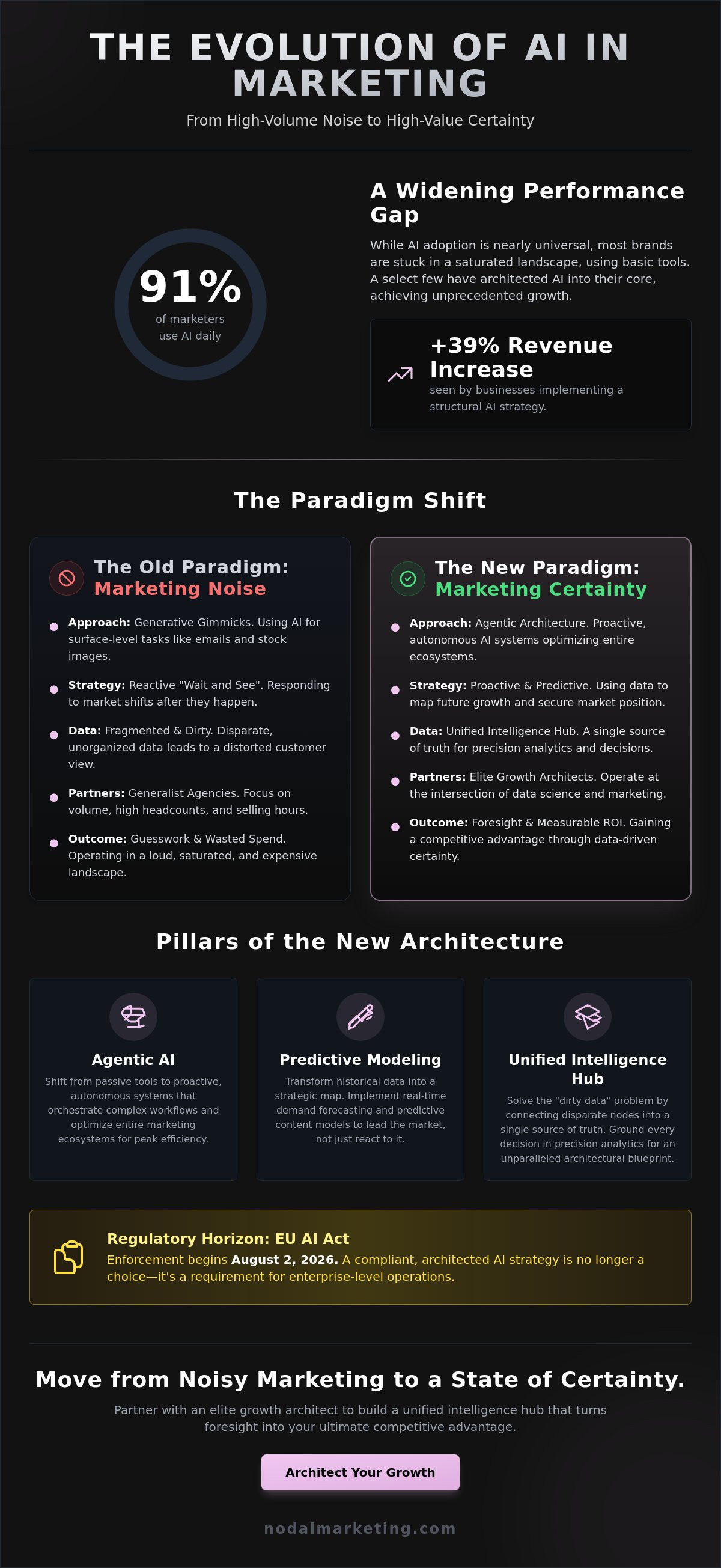
While 91% of marketers report using AI daily as of early 2026, the majority are still operating within a saturated landscape that is louder and more expensive than ever. You’ve likely seen the data indicating that businesses implementing AI see a 39% revenue increase, yet the gap between those experimenting with tools and those achieving structural certainty is widening. The most successful brands using ai for marketing have moved beyond the generative hype. They’ve transitioned to treating AI as the foundational architecture of their growth; they’re building unified intelligence hubs that prioritize precision over volume.
You understand the pressure of managing fragmented data while preparing for the August 2, 2026, enforcement of the EU AI Act. It’s no longer sufficient to focus on mere productivity; you need a strategy that justifies enterprise-level spend through measurable ROI. This article provides the executive blueprint for moving from noisy marketing to a state of certainty. We’ll explore how global leaders leverage agentic AI for predictive modeling and media modeling to secure their market position. By the end, you’ll have a clear vision of how to integrate advanced analytics and MarTech into a cohesive ecosystem that turns foresight into a competitive advantage.
Key Takeaways
- Transition from passive generative tools to proactive agentic architecture; learn how autonomous systems orchestrate complex workflows to drive efficiency.
- Examine how leading brands using ai for marketing move beyond basic personalization to implement real-time demand forecasting and predictive content-lifecycle models.
- Discover the shift from standard platform automation toward bespoke media modeling to gain a technical edge in real-time auction manipulation.
- Apply a disciplined strategic framework to diagnose ecosystem fragmentation and architect a unified intelligence hub that delivers unprecedented marketing certainty.
The Evolution of AI in Marketing: From Generative Gimmicks to Agentic Architecture
The year 2026 marks a definitive boundary in the history of commercial technology. We've moved beyond the era of generative gimmicks where AI was a novelty used for drafting emails or creating stock images. Today, the most sophisticated brands using ai for marketing have transitioned toward agentic architecture. This shift represents a move from passive tools that require constant prompting to proactive systems that possess the autonomy to optimize entire ecosystems. While the industry previously focused on the broad category of Artificial Intelligence Marketing (AI Marketing), the current focus is on building a unified intelligence hub. This infrastructure is the only path to achieving marketing certainty in a world that has become irreducibly complex. Predictive modelling has replaced the "wait and see" approach, turning historical data into a strategic map for future growth.
The Death of the Generalist Agency Model
Traditional agencies are struggling. Their models rely on volume, high headcounts, and manual execution, which simply can't keep pace with a saturated digital landscape. These generalists act as vendors, selling hours and creative fluff without the underlying technical rigor required for measurable ROI. In contrast, elite growth partners operate at the intersection of data science and marketing dynamics. They don't just execute; they architect. Agentic AI is the autonomous execution of complex marketing strategies. It replaces the noisy guesswork of standard automation with the foresight of predictive modelling, allowing ambitious brands using ai for marketing to lead rather than merely react. Success in 2026 requires a partner who speaks the languages of both technology and consumer psychology.
Architecting for Marketing Certainty
If foresight is the goal, then data is the fuel. Yet, dirty data remains the silent killer of AI ROI. Fragmented, unorganized data points create a distorted view of the customer journey, leading to wasted spend and missed opportunities. The Nodal approach solves this by connecting these disparate nodes into a single source of truth. By utilizing specialized data strategy services, enterprise brands are building the foundations necessary for a unified intelligence hub. This isn't about adding more tools; it's about streamlining your ecosystem to ensure every decision is grounded in precision analytics. Less guesswork, more certainty. Through this methodical thoroughness, we transform fragmented data into a clear architectural blueprint for unprecedented growth.
Global Leaders in AI-Driven Personalisation: Success Stories in Customer Intelligence
The distinction between market leaders and those merely surviving lies in the depth of their architectural foundations. While generalist agencies often focus on surface-level AI marketing tools for content generation, elite brands using ai for marketing prioritize the backend data science that powers true foresight. They aren't just deploying individual MarTech tools; they're architecting unified intelligence hubs. This structural approach allows brands like Netflix to move beyond simple recommendation engines toward a total content-lifecycle predictive model. By analyzing hyper-granular data, they don't just suggest what to watch next; they predict which future productions will maximize long-term subscriber retention before a single frame is filmed.
Nike’s Data Science Revolution
Nike has fundamentally redefined the relationship between digital advertising and supply chain efficiency. By moving beyond the #Nike50 campaign logic, they've implemented real-time demand forecasting that informs global content strategy. This isn't marketing in a vacuum. It's a synchronized ecosystem where AI-powered insights identify emerging trends in specific regions, allowing the brand to pivot its creative output and inventory allocation simultaneously. Nike scales global ad spend by architecting a unified intelligence hub that synchronizes consumer demand with real-time inventory levels. This level of precision ensures that their media spend is never wasted on products that aren't available or audiences that aren't ready to convert.
Retail Innovation: Hyper-Granular Personalisation
In the luxury and beauty sectors, Gucci and Sephora are leveraging visual AI to bridge the gap between digital discovery and deep-funnel customer lifetime value (CLV). They've moved from the "customers like you" model to "the future you" through predictive intent modelling. Sephora, in particular, uses AI to unify in-store and online data ecosystems, creating a single source of truth for every customer interaction. This transition requires more than just software; it demands specialized data science consulting services to ensure the underlying infrastructure can handle the complexity of real-time data processing. By connecting these fragmented nodes, they turn casual browsers into loyal advocates with unprecedented accuracy.
The success of these global giants proves that technology alone isn't a strategy. The value is found in the intellectual rigor applied to the data architecture itself. If your current ecosystem feels noisy and disconnected, consider diagnosing your data infrastructure to identify where intelligence gaps are stalling your growth. Less guesswork, more certainty.
Performance Marketing Giants: Scaling ROI with Predictive Media Modelling
Amazon represents the gold standard for real-time auction manipulation. While many brands using ai for marketing rely on the default settings of major ad platforms, Amazon has built a proprietary infrastructure that dictates the market rather than reacting to it. This level of control is achieved through predictive media modelling that calculates the value of every impression before the bid is even placed. It's a move away from standard automation toward bespoke, high-precision bidding models that prioritize the brand's bottom line over the platform's revenue goals. Leading organizations are increasingly moving their data infrastructure in-house or to specialized consultancies to ensure they own the intelligence that drives their growth.
Bespoke Bidding vs. Standard Automation
Standard automation tools provided by Google or Meta are often "off-the-shelf" solutions designed for the average user. They operate as black boxes, offering limited transparency and prioritizing the platform's own ecosystem. This is why achieving a true competitive advantage requires an AI performance marketing agency capable of developing custom algorithms. These bespoke models go beyond simple automation; they utilize predictive modelling to forecast outcomes before a single dollar is spent. We don't just compete in the auction. We architect the conditions for winning it by identifying the most profitable nodes in the customer journey.
Solving the Attribution Puzzle
The modern attribution challenge is a data fragmentation problem that traditional click-based tracking can't solve. In a landscape of multi-device journeys and walled gardens, AI is the only tool capable of connecting the dots between paid social, search, and offline conversions. As highlighted by Harvard Business School on AI in Marketing, the strategic implementation of these technologies allows brands to see the "peril" of fragmented data and the "promise" of unified intelligence. We shift the focus from simple tracking to sophisticated media modelling. This approach provides the foresight executives need to justify global spend and move from guesswork to certainty.
Sophisticated brands using ai for marketing understand that technology alone isn't a strategy. The value lies in the intellectual rigor of the implementation. By diagnosing attribution gaps, identifying high-impact nodes, and integrating bespoke reporting solutions, we turn raw data into a strategic asset. This methodical thoroughness ensures that every marketing decision is grounded in mathematical reality, providing a clear path to unprecedented ROI.
Implementing AI at Scale: A Strategic Framework for Enterprise Brands
Success for brands using ai for marketing isn't accidental. It's the result of a disciplined architectural framework that moves beyond the generic tips found in entry-level digital guides. To achieve true scalability, enterprise leaders must follow a methodical progression from diagnosis to optimization. This isn't about adding another layer of software; it's about restructuring your entire approach to growth to ensure every dollar spent is backed by mathematical certainty.
- Step 1: Diagnose the Challenge. We begin by identifying the "noise" and data fragmentation within your existing ecosystem. Without a clear understanding of where data leaks occur, any AI implementation will fail. Most organizations don't have a tool problem; they have a foundation problem.
- Step 2: Identify the Application. We determine the most impactful use case for your specific goals. This might involve predictive modelling to anticipate customer churn, agentic execution for autonomous bidding, or bespoke reporting to provide executive clarity.
- Step 3: Integrate the Solution. This is the construction phase. We connect disparate data sources into a unified intelligence hub, creating a single source of truth that powers every marketing decision across the enterprise.
- Step 4: Optimise for ROI. We use continuous machine learning to refine bidding and targeting. The system doesn't stay static. It evolves as it consumes more data, ensuring your competitive edge sharpens over time.
The CMIO Role: Bridging Marketing and Technology
The modern CMO has evolved into a Chief Marketing Intelligence Officer. They must now act as a "Strategic Architect" of data, possessing dual fluency in both marketing dynamics and technical infrastructure. This shift is essential to avoid the hidden cost of dirty data, which can silently erode margins as AI tools scale. It's not just about leading a creative team. It's about building the foundations of intelligence that allow that creativity to thrive with certainty. Successful brands using ai for marketing empower their leaders to operate at the intersection of boardroom strategy and data science.
Building the Unified Intelligence Hub
A nodal data environment is the prerequisite for agentic AI. Traditional, siloed CRM systems are being replaced by "Connect" platforms that treat every data point as a node in a larger, synchronized whole. When evaluating an ai marketing company for enterprise integration, look for partners who prioritize architectural integrity over flashy interfaces. A true partner provides the foresight that generalist agencies lack by turning fragmented inputs into a cohesive growth engine.
If you're ready to move from fragmented tools to a unified intelligence hub, audit your marketing architecture to identify where your data is losing value.
Beyond the Algorithm: Partnering for Marketing Certainty
The algorithm is a commodity, but intelligence is a differentiator. While the number of brands using ai for marketing has surged to 91% in early 2026, most organizations are still chasing efficiency rather than certainty. Technology alone isn't a strategy. It's a hollow promise without the intellectual rigor to direct it. Success in this saturated environment requires a move away from the frantic, hype-heavy tactics of generalist agencies toward a disciplined, architectural approach. We don't just provide tools; we provide the foresight needed to dominate a noisy digital landscape.
The Nodal Advantage: Connecting the Dots
Our philosophy is grounded in the "Nodal" concept. We believe that fragmented data is the primary barrier to growth. By diagnosing your specific challenges and identifying high-impact applications, we architect bespoke solutions that turn unorganized data points into a unified whole. This isn't about volume. It's about precision. We use agentic AI to drive unprecedented growth for our partners, moving beyond simple automation to create ecosystems that can optimize themselves based on your core business goals. Less guesswork, more certainty.
A specialized growth partner offers a level of technical and strategic depth that detached third parties can't match. We speak the languages of both marketing dynamics and data science, allowing us to act as translators and architects for your brand. This dual expertise ensures that your AI infrastructure isn't just a separate silo, but a deeply integrated engine that powers every decision from bidding to audience segmentation. We prioritize depth over breadth, positioning ourselves as an indispensable partner in your long-term success.
Your Blueprint for 2026
The window for observation is closing. With the EU AI Act enforcement beginning on August 2, 2026, the transition toward a data-first marketing culture is no longer optional. It's a regulatory and competitive necessity. Leading brands using ai for marketing are already moving their infrastructure in-house or partnering with elite consultancies to secure their market position. Your blueprint for the coming year involves transforming your marketing ecosystem into an intelligence-driven engine that prioritizes measurable ROI over vanity metrics.
Your journey from "noisy" marketing to absolute certainty begins with a single architectural shift. Don't just observe the revolution; lead it by building a foundation that turns data into foresight. Partner with Nodal Marketing to architect your AI-driven growth and secure your place at the intersection of technology and performance.
Architecting the Future of Marketing Intelligence
The transition from generative experimentation to agentic architecture is no longer a luxury for the few; it's a requirement for survival. We've moved into an era where the most successful brands using ai for marketing are those that treat data as a foundational asset rather than a byproduct of campaign activity. They've moved beyond the fragmented noise of generalist agencies to build unified hubs that prioritize mathematical foresight over creative guesswork. This shift requires more than just new tools. It demands a fundamental restructuring of your growth engine.
Achieving this level of precision requires a partner who possesses dual expertise in both marketing dynamics and data science. At Nodal Marketing, we utilize our proprietary "Connect" AI platform and a methodical tripartite approach to transform your ecosystem. We focus on diagnosing your specific challenges, identifying high-impact applications, and integrating solutions that drive measurable growth. It's time to stop reacting to the market and start architecting it with intellectual rigor. Architect Your Marketing Certainty with Nodal Marketing and secure your brand's future in the age of intelligence. Your path to unprecedented ROI starts with structural clarity and visionary confidence.
Frequently Asked Questions
Which brands are leading in AI marketing in 2026?
Global leaders such as Starbucks and IKEA are setting the pace by moving beyond simple automation. IKEA uses AI to assist customers in spatial design while optimizing global logistics; Starbucks leverages its Deep Brew platform to refine individualized loyalty offers and store labor allocation. These organizations prioritize the architectural integration of data over isolated campaign tactics to maintain their market dominance.
How is AI being used by big brands for personalisation?
Enterprise leaders are shifting from historical segmentation to predictive intent modelling. This involves using machine learning to anticipate a customer's next move based on real-time behavioral signals rather than past purchases alone. By analyzing hyper-granular audience segments, brands deliver individualized content streams that adapt as the user interacts with the digital ecosystem, ensuring every touchpoint is relevant and timely.
What is the difference between Generative AI and Agentic AI in marketing?
Generative AI is a passive tool used to create content like text or images based on specific human prompts. In contrast, Agentic AI refers to autonomous systems capable of executing complex workflows and making goal-oriented decisions without step-by-step direction. Agentic architecture allows for the proactive optimization of media spend and audience targeting, transforming AI from a creative assistant into a strategic executor.
How can enterprise brands measure the ROI of AI marketing tools?
ROI measurement must shift from productivity metrics to core business outcomes like Customer Lifetime Value (CLV) and incremental revenue growth. Sophisticated brands using ai for marketing utilize media modelling to isolate the impact of AI-driven optimizations from organic market trends. By establishing a clear baseline and tracking lift in real-time auctions, executives justify enterprise-level spend with mathematical certainty.
Why are some brands failing to see results from their AI marketing spend?
Failure often stems from "dirty data" and a lack of architectural foundations. When AI tools are layered onto fragmented, unorganized data ecosystems, the output is inevitably inconsistent or inaccurate. Without a unified intelligence hub to connect disparate data points, even the most advanced algorithms struggle to deliver measurable ROI or sustainable competitive advantages in a noisy landscape.
What is a unified intelligence hub in marketing?
A unified intelligence hub is a centralized data infrastructure that connects all fragmented marketing nodes into a single source of truth. It replaces siloed CRM systems with a synchronized ecosystem where data flows seamlessly between paid search, social, and advanced analytics. This architectural foundation is the prerequisite for implementing agentic AI and achieving true marketing certainty at scale.
How do I choose the right AI marketing consultancy for my brand?
Look for a partner that demonstrates dual fluency in both marketing dynamics and technical data science. The ideal consultancy acts as a strategic architect, focusing on diagnosing infrastructure challenges rather than selling off-the-shelf software. Prioritize firms that offer bespoke reporting solutions and have a proven track record of integrating AI into complex MarTech stacks for brands using ai for marketing.
Can AI help with cross-channel marketing attribution?
Yes, AI is the only effective solution for solving the modern attribution puzzle across walled gardens and fragmented devices. By utilizing advanced analytics and marketing technology, AI identifies the hidden connections between a social media impression and an eventual search conversion. This move toward media modelling provides the foresight needed to allocate budgets with precision across the entire customer journey.