
Marketing attribution is not a standalone feature found in a dashboard; it is the sophisticated output of a strategically integrated data ecosystem. While 75% of companies have adopted multi-touch attribution as of 2026, many executives remain trapped by disparate data sources that fail to satisfy a demanding boardroom. Achieving seamless martech integration for attribution requires a shift from viewing tools as isolated silos to seeing them as the interconnected building blocks of a unified intelligence hub.
You've likely experienced the frustration of an overwhelming stack that promises clarity yet delivers only complexity and "dirty data." It's difficult to prove marketing's impact on revenue when your vision is clouded by fragmented reporting and shifting privacy regulations. This guide provides the strategic blueprint to transform that chaos into a single source of truth. We will explore how to architect a system that ensures predictive accuracy and provides total visibility into the customer journey, moving your operation from reactive reporting to a state of marketing synthesis.
Key Takeaways
- Identify the structural weaknesses in fragmented stacks and define a clear path toward a unified intelligence hub.
- Master the mechanics of martech integration for attribution by leveraging APIs and webhooks to eliminate data silos.
- Evaluate the strategic trade-offs between rigid native connectors and the precision of bespoke, scalable data architectures.
- Execute a methodical audit to resolve data leakage points and align every technical touchpoint with your commercial North Star.
- Scale beyond historical reporting by utilizing unified data to fuel predictive modeling and advanced AI-powered insights.
The Attribution Crisis: Why Fragmented MarTech Stacks Fail the CMO
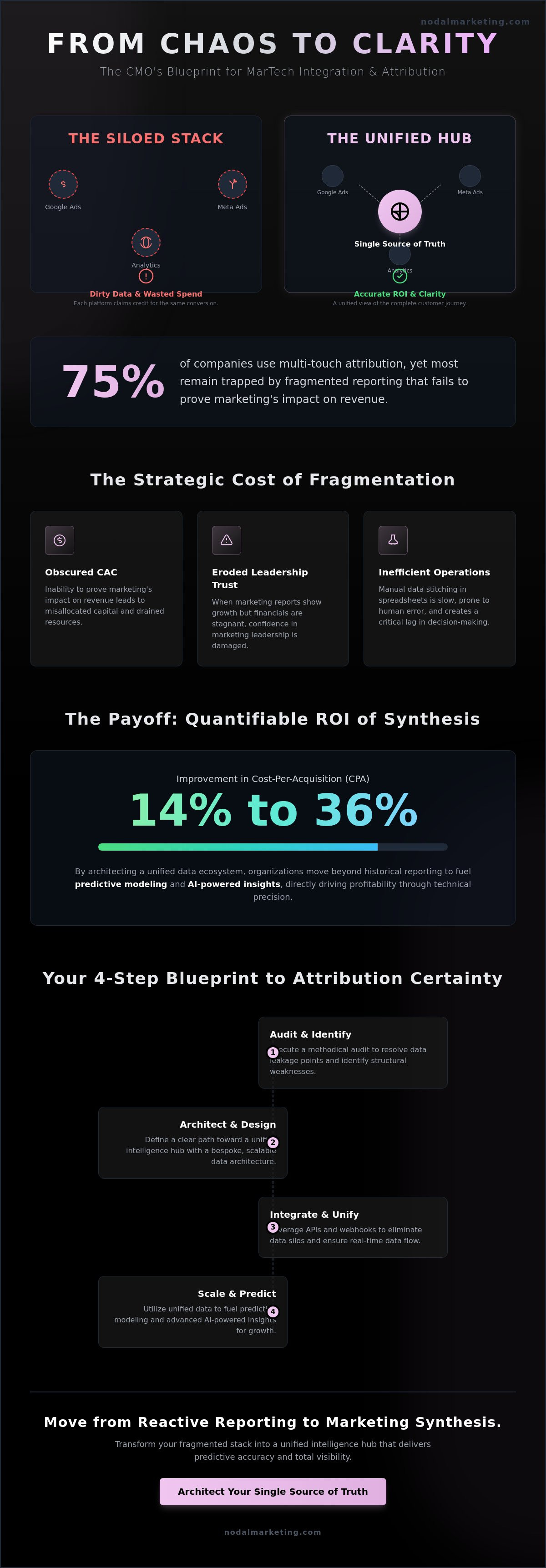
Modern marketing leadership is currently facing a profound crisis of confidence. It isn't a lack of data that plagues the executive suite, but rather a surplus of disconnected signals. Most enterprises operate in a "Siloed Reality" where each platform exists in a vacuum. Google Ads, Meta, and your CRM each report their own version of success, often resulting in three different tools claiming credit for a single conversion. This fragmentation is the primary reason why standard stacks fail to deliver a reliable "Single Source of Truth" in 2026.
Effective martech integration for attribution is not a simple software patch. It is the systematic orchestration of your entire technological environment to capture the customer journey with absolute fidelity. Without this synthesis, your data remains "dirty," leading to duplicated conversions and significant wasted ad spend. Teams that fail to integrate their stacks often see their reporting drift away from financial reality, making it impossible to defend marketing budgets to a skeptical board. Precision is not an optional upgrade; it's the foundational requirement for commercial survival.
What is MarTech Integration for Attribution?
At its core, integration is the strategic bridge between disparate data signals and actionable commercial insights. It moves beyond surface-level metrics to provide deep conversion intelligence. A truly integrated stack links your CRM, ad platforms, web analytics, and data warehouses into a responsive network. By examining various marketing attribution models through a unified lens, executives can finally see the hidden connections between a top-of-funnel social impression and a bottom-of-funnel search click. This shift represents a move from passive observation to active architectural design.
The Strategic Cost of Fragmentation
The price of disconnected tools is paid in obscured Customer Acquisition Costs (CAC) and eroded leadership trust. When marketing reports show a record-breaking month but the bank account remains stagnant, the psychological impact on the organization is devastating. Manual data stitching is a common but flawed remedy. In high-scale environments, relying on spreadsheets to reconcile Meta and Google data is inefficient and prone to human error. It creates a lag in decision-making that agile competitors will exploit. Organizations that implement multi-touch attribution correctly report a 14% to 36% improvement in cost-per-acquisition, proving that technical precision is a direct driver of profitability. Fragmented stacks don't just provide bad data; they actively drain your resources through misallocated capital.
The Mechanics of Synthesis: How Integration Powers Attribution Accuracy
Synthesis is not a passive event; it's an engineered outcome. Achieving true martech integration for attribution requires moving beyond manual exports toward real-time data synchronization. This process relies on a robust architecture of APIs and webhooks that serve as the nervous system of your marketing stack. These tools ensure data flows instantly between platforms without the latency that leads to decision-making errors. Professional data consulting services provide the necessary blueprint to build these connections, ensuring every signal is captured with precision.
Data normalization presents a significant hurdle in this process. Google Ads and Meta Ads essentially speak different languages, using unique definitions for clicks, engagements, and conversion windows. Without a translation layer, your reporting will always be skewed. The rise of privacy regulations makes identity resolution a primary concern. When implementing a marketing attribution model, you must account for platform-specific nuances to track a single user journey across multiple devices. This level of technical plumbing is what separates high-performance brands from those merely guessing at their ROI.
The Role of Unified Intelligence Hubs
Standard out-of-the-box connectors are often too rigid for the modern enterprise. They frequently strip away the granular data points that reveal true customer intent. Instead, visionary leaders are turning to unified intelligence hubs. These hubs act as a central repository where disparate signals are synthesized into a single, actionable narrative. Because these environments are complex, brands often require bespoke big data consulting to architect a system that is both scalable and secure. These hubs don't just store information; they serve as the engine for marketing certainty.
Bridging the Gap: Marketing Dynamics vs. Technical Execution
Success in attribution requires a partner who functions as a strategic designer. Nodal Marketing bridges the gap between high-level commercial KPIs and the technical data models required to track them. We don't believe in simply reporting on the past. By deploying custom machine learning models, we allow brands to predict future outcomes based on historical patterns. This is the ultimate expression of synthesis: linking fragmented touchpoints into a coherent story that justifies every dollar of ad spend. If your current reporting feels disconnected from your goals, exploring an advanced analytics framework can provide the clarity you've been missing.
Evaluating Integration Models: Native Connectors vs. Bespoke Hubs
The choice between native SaaS connectors and bespoke data hubs is a defining moment for any marketing organization. Native integrations offer the allure of speed and immediate deployment; however, they often force your data into a rigid, predetermined structure. When the tool begins to dictate the strategy rather than the strategy driving the tool, you've fallen into the "SaaS Trap." Selecting the optimal path for martech integration for attribution isn't just a technical preference. It's a high-stakes architectural decision that determines whether your reporting will be merely adequate or truly visionary.
Executives often ask if the significant investment in a custom hub is justified by a corresponding increase in ROAS. The answer lies in the precision of the output. A bespoke architecture doesn't just collect data; it synthesizes it according to your specific commercial logic. This precision allows for a level of granular optimization that generic tools simply cannot match. Engaging an ai marketing consultant can help navigate this evaluation, ensuring that your choice aligns with long-term scalability rather than short-term convenience.
When Native Connectors Are Sufficient
Native connectors serve a specific purpose for brands with lower conversion volumes and linear customer journeys. If your marketing ecosystem consists of only two or three digital channels with minimal overlap, out-of-the-box MTA tools might suffice. These solutions provide basic visibility without the need for deep engineering. However, the tipping point arrives quickly. As soon as your customer journey spans multiple devices, offline interactions, or complex lead nurturing cycles, native tools begin to fail. They lack the flexibility to handle the nuanced data signals required for sophisticated attribution modeling in 2026.
The Case for Bespoke Data Architecture
Bespoke hubs represent the gold standard for enterprise-level marketing. These systems allow for proprietary attribution weighting, such as custom time-decay or position-based models, that reflect your unique sales cycle. For brands managing a blend of online and offline touchpoints, a custom build is the only way to eliminate the blind spots that native tools ignore. Managing such complex environments requires the specialized expertise of ai marketing companies that understand how to bridge the gap between technical execution and commercial dynamics. A custom architecture ensures your data is an asset you own and control, rather than information leased from a software vendor.
The Implementation Blueprint: Architecting Your MarTech Stack for Attribution
Achieving a reliable source of truth is not a matter of procurement, but of architecture. Many executives treat attribution as a software problem when, in reality, it's a structural one. Successful martech integration for attribution follows a rigorous, five-step blueprint that prioritizes systemic integrity over individual tool features. This methodical progression ensures that your technology serves your strategy rather than complicating it.
- Step 1: Audit the current ecosystem to identify "Data Leakage" points where user signals are lost between platforms.
- Step 2: Define the "Commercial North Star" by isolating the specific KPIs that directly correlate with revenue growth.
- Step 3: Establish a Data Governance layer to enforce naming conventions and ensure cleanliness at every entry point.
- Step 4: Execute the technical integration via a Unified Intelligence Hub that synthesizes disparate data streams.
- Step 5: Layer in AI-driven predictive modeling to move from historical reporting to future-state optimization.
This blueprint isn't a suggestion; it's a requirement for those who value precision. Without this structured approach, even the most expensive tools will produce nothing more than expensive noise. It's about building a foundation that supports scale and intellectual rigor.
Phase 1: Diagnosis and Data Hygiene
Integration fails if the underlying data is dirty. Before a single line of code is written, we must map the customer journey with absolute clarity. This phase involves identifying every touchpoint, from the first search query to the final CRM entry. It's a process of diagnosis where we uncover the silos that obscure your vision. We also leverage technical SEO as a critical tool for data capture. By ensuring that site-level tracking is clean and properly structured, we prevent data corruption before it reaches your analytics engine. If the source is compromised, the attribution will be fiction.
Phase 2: Technical Synthesis and Integration
Once the diagnosis is complete, we move into technical synthesis. This is where we connect your CRM, analytics platforms, and ad networks into a single, cohesive unit. At Nodal, we utilize a tripartite structure: Diagnosis, Identification, and Integration. This methodical approach ensures that every connection is purposeful and every data point is accounted for. We don't believe in "one-and-done" setups. A high-performance stack requires ongoing management to adapt to platform updates and shifting consumer behaviors. To move your marketing from fragmented guesses to architectural certainty, you need a partner who understands the nuance of bespoke martech orchestration.
Beyond Attribution: Scaling ROI with Nodal’s Unified Intelligence Solutions
Achieving a single source of truth is merely the baseline of modern marketing excellence. Once an organization masters martech integration for attribution, it unlocks the ability to move beyond historical analysis and enter the era of AI performance marketing. This evolution allows for the deployment of predictive customer lifetime value (CLV) modeling, where unified data points are no longer just records of the past but indicators of future profitability. At Nodal Marketing, we view this synthesis as the ultimate strategic lever. We don't just link tools; we transform fragmented data into a cohesive engine for growth.
The journey toward marketing synthesis requires a shift in perspective. It's about moving from a vendor mindset, where tools are purchased to solve isolated problems, to a strategic partnership model where technology is architected to serve a singular commercial vision. This transition ensures that your data remains a proprietary asset, providing a level of insight that generalist competitors simply cannot replicate. Synthesis is the process of turning fragmented bits into strategic power, ensuring every marketing dollar is an investment in measurable stability.
Predictive Intelligence: The Next Frontier
The shift from "What happened?" to "What should we do next?" represents a fundamental change in executive decision-making. Integrated stacks provide the high-fidelity signals required for AI to forecast outcomes with surgical precision. Brands that own their data architecture gain a significant competitive advantage, as they're no longer dependent on the opaque, rule-based logic of external platforms. This isn't a simple reporting upgrade, but a complete re-engineering of the commercial process. When you control the flow and normalization of your data, you gain the clarity needed to allocate capital with absolute certainty, even in a volatile digital landscape.
Architecting Growth with Nodal Marketing
Nodal Marketing positions itself as a specialized strategic partner rather than a detached service provider. Our approach is defined by technical mastery, bespoke reporting, and a commitment to intellectual rigor. We provide not just a dashboard, but a sophisticated decision-making engine that bridges the gap between marketing dynamics and technical execution. Our process follows a disciplined progression: we diagnose the fragmentation, identify the strategic opportunities, and finally integrate the solution into your unique business framework. It's time to move beyond the frantic energy of entry-level tactics and embrace a partnership that values depth over volume. Empower your executive team with the stability and visionary insight of true marketing certainty.
Architecting the Future of Marketing Certainty
The transition from fragmented data silos to a unified intelligence hub is not merely a technical upgrade; it's a strategic imperative. We've explored how a disciplined approach to martech integration for attribution resolves the crisis of "dirty data" and establishes a definitive source of truth. By choosing architectural integrity over rigid native connectors, you empower your organization to move beyond historical reporting and embrace the predictive power of customer lifetime value modeling. This shift represents the move from passive observation to active commercial orchestration.
Success in this landscape requires more than just software. It demands the expertise of a global strategic consultancy that understands the nuance of data science and bespoke analytics implementation. As AI-powered performance marketing specialists, Nodal Marketing provides the technical mastery needed to bridge the gap between commercial dynamics and technical execution. We don't just offer dashboards; we build decision-making engines designed for enterprise scale. It's time to architect your unified intelligence hub with Nodal Marketing and secure the clarity your executive team requires. The path to marketing synthesis is clear, and the competitive advantage is profound.
Frequently Asked Questions
What is the primary difference between MarTech integration and standard data syncing?
Integration is the structural alignment of data schemas to create a unified narrative, whereas standard syncing is merely the mechanical movement of raw information between platforms. While syncing ensures data exists in two places, integration ensures it speaks the same language and adheres to a single commercial logic. This process involves normalization and weighting, transforming disparate signals into a coherent intelligence hub.
How does MarTech integration solve the challenge of multi-touch attribution (MTA)?
Systematic martech integration for attribution solves multi-touch challenges by linking fragmented identities across a unified timeline. It eliminates the "siloed reality" where platforms claim duplicate credit for the same conversion. By centralizing touchpoints from search, social, and direct channels, you gain a transparent view of the entire customer journey rather than a distorted, platform-specific snapshot.
Can MarTech integration help with attribution in a cookieless environment?
Advanced integration models utilize first-party data and server-side tracking to maintain visibility as third-party cookies are deprecated. By syncing CRM data with ad platform APIs, brands can resolve identities without relying on browser-based tracking. This shift to a first-party architecture ensures that your attribution remains accurate despite evolving privacy regulations and technical restrictions.
Is a Customer Data Platform (CDP) necessary for effective attribution integration?
A Customer Data Platform is a powerful tool for large-scale operations, but it's not the only way to achieve marketing synthesis. For many enterprise brands, a bespoke data hub or custom warehouse architecture provides more precision and scalability than a rigid, off-the-shelf CDP. The goal is the creation of a unified intelligence layer, regardless of the specific software used to house it.
How long does a typical MarTech integration project for attribution take to show ROI?
Most organizations begin to see a shift in decision-making clarity within 90 days, with measurable ROI lift typically occurring within the first year. Teams that implement multi-touch attribution correctly report an average cost-per-acquisition improvement of 14% to 36% during this initial period. This timeline allows for sufficient data volume to train algorithmic models and refine predictive accuracy.
What are the common pitfalls to avoid during a MarTech stack integration?
The most frequent pitfall is attempting to integrate "dirty data" without first establishing a rigorous governance layer. Organizations often fall into the "SaaS trap," where they allow the limitations of a specific tool to dictate their marketing strategy. Avoiding these errors requires a disciplined diagnostic phase to identify data leakage points before any technical execution begins.
How do AI and machine learning enhance integrated attribution models?
Machine learning transforms attribution from a historical record into a predictive decision-making engine. While standard models tell you what happened, AI-powered insights use integrated data to forecast future outcomes and suggest optimal budget allocations. This allows for granular audience analysis and the identification of hidden conversion drivers that manual reporting would overlook.
What role does data hygiene play in successful MarTech integration?
Data hygiene is the foundational requirement for any successful integration; without it, your stack produces nothing but expensive noise. If the signals captured at the site level are corrupted or inconsistent, the resulting attribution models will be fundamentally flawed. Professional integration begins with a thorough audit of your technical SEO and tracking structures to ensure absolute cleanliness at the source.