
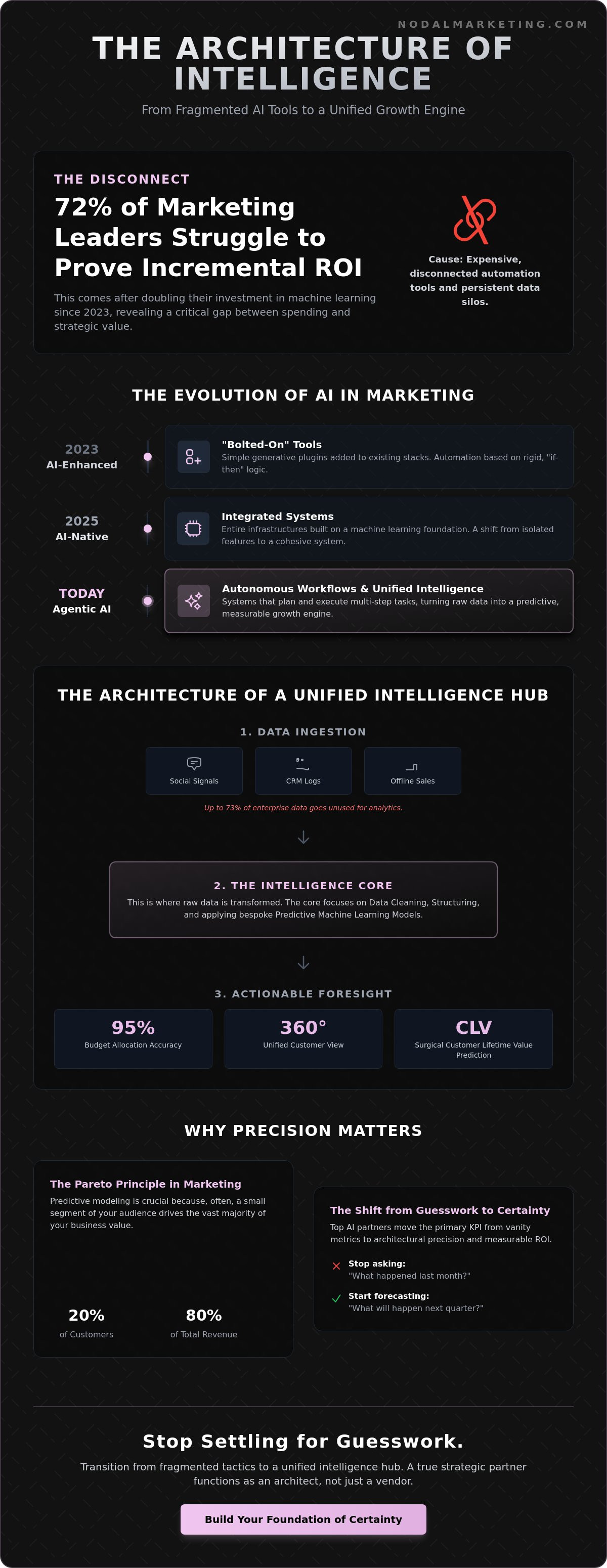
Why are 72% of enterprise marketing leaders still struggling to prove incremental ROI despite doubling their investment in machine learning since 2023? The reality is that most organizations aren't building intelligence; they're simply accumulating expensive, disconnected automation tools. You've likely felt this friction as data silos across your global regions prevent a clear view of performance while traditional PPC and SEO returns continue to plateau.
It's time to stop settling for guesswork and start demanding certainty. This guide helps you evaluate the current landscape of ai marketing companies to find a partner that functions as a strategic architect rather than a mere vendor. We'll show you how to transition from fragmented tactics to a unified intelligence hub that leverages agentic AI for genuine predictive power. We'll explore the shift toward autonomous workflows and the specific infrastructure required to turn raw data into a measurable growth engine by 2026.
Key Takeaways
- Transition from fragmented automation to a unified intelligence architecture by understanding the evolution from simple AI-enhanced tools to robust, AI-native systems.
- Evaluate the landscape of ai marketing companies using an executive vetting framework that prioritizes first-party data integration and multi-channel attribution.
- Distinguish between low-cost SaaS platforms and strategic partners to move your organization beyond basic execution toward hyper-granular audience modeling.
- Learn why architectural excellence requires a "dual expertise" that bridges the gap between high-level marketing strategy and technical data science.
- Discover how a unified intelligence hub transforms disparate data sources into a foundation of certainty, allowing your brand to not just compete, but to lead.
Defining the AI Marketing Landscape: Beyond the 2026 Hype
The marketing world has moved past the era of "bolted-on" tools. In 2023, many firms claimed to be AI-enhanced by simply adding a single generative plugin to their existing stack. By 2025, the industry shifted toward AI-native systems where the entire infrastructure is built on a foundation of machine learning. Today, the leading Defining AI Marketing standards require more than just automated content generation. An AI marketing company is a strategic partner that synchronizes data, technology, and human expertise.
Modern ai marketing companies now serve as a nexus for data science, MarTech, and performance media. This evolution requires a clear distinction between generative AI, which focuses on content production, and predictive AI, which governs high-level strategy. While generative tools produce the "output," predictive models provide the "foresight" needed to allocate budgets with 95% accuracy. This dual approach ensures that every creative asset—such as the intentional brand content developed by Kynda Creative—serves a specific, data-backed objective within a larger ecosystem.
The Shift from Automation to Intelligence
Traditional automation relies on "if-then" logic. It follows rigid rules that break when consumer behavior shifts. In contrast, AI intelligence identifies non-linear patterns across millions of data points. As third-party cookies phased out in 2024, the digital ecosystem became increasingly opaque. Machine learning models now fill these data gaps by analyzing first-party signals and probabilistic modeling. This shift has transformed "certainty" into the primary KPI for executives. Marketing is no longer a game of chance; it's an exercise in architectural precision that prioritizes measurable ROI over vanity metrics.
The Impact of Agentic AI on Global Marketing
Agentic AI represents the next frontier in global scaling. These are systems capable of planning and executing multi-step marketing tasks without constant human intervention. Instead of a human spending 15 hours a week on manual bid adjustments, an agentic system orchestrates the entire workflow from audience identification to creative deployment. Nodal Marketing positions itself at the forefront of this technological shift. We don't just provide tools; we build the unified intelligence hubs that allow brands to lead their sectors through autonomous execution and structured growth. This transition from human-led execution to AI-orchestrated workflows marks the end of the generalist agency model.
The Architecture of Intelligence: What Top AI Marketing Companies Actually Do
Elite performance isn't born from creative intuition alone; it's engineered through structural integrity. Leading ai marketing companies distinguish themselves by focusing on the infrastructure that precedes the message. They don't just manage campaigns; they architect a Unified Intelligence Hub. This central nervous system ingests fragmented data from disparate sources, such as fragmented social signals, offline sales, and CRM logs, to create a single source of truth. While standard platform dashboards offer a rear-view mirror perspective, these hubs provide a 360-degree view of the customer journey.
The transition from reactive to proactive marketing requires bespoke reporting that bypasses the limitations of "out of the box" analytics. By developing custom machine learning models, brands can predict Customer Lifetime Value (CLV) with surgical precision. This allows for the identification of the top 20% of customers who often generate 80% of total revenue. As highlighted in The Future of AI in Marketing, the move toward these data-driven journeys is no longer optional for those seeking to maintain a competitive edge. The architecture must be finalized before the execution layer is even considered.
Data Science as the Engine of Performance
To deliver true ROI, an AI marketing company must operate as a data science consulting firm at its core. Raw data is often chaotic; research indicates that up to 73% of enterprise data goes entirely unused for analytics purposes. The process begins with rigorous data cleaning and structuring to ensure AI readiness. Once the noise is filtered, predictive modeling takes center stage. We stop asking "what happened" last month and start forecasting "what will happen" next quarter. This shift allows brands to allocate budgets based on future probability rather than historical accidents.
MarTech Integration and Ecosystem Optimization
Modern marketing departments frequently suffer from tool sprawl. The average enterprise now utilizes 91 different marketing cloud services, leading to data silos and operational friction. Professional AI firms audit this existing stack to eliminate redundancies and optimize the ecosystem. By connecting the dots between the CRM, web analytics, and media buying platforms, we create a fluid exchange of intelligence. This integration ensures that a signal captured in a customer service log can instantly inform a programmatic ad bid. To see how these connections drive growth, brands should evaluate their current digital infrastructure for hidden inefficiencies.
Categorizing the Market: SaaS vs. Agency vs. Strategic Consultancy
The ecosystem of ai marketing companies is not a monolith; it is a spectrum of capability defined by the depth of integration and the complexity of the problems solved. At the entry level, SaaS platforms like Blaze or Jasper offer high-speed, low-cost content generation and scheduling. These tools are designed for tactical velocity, enabling teams to produce volume without increasing headcount. While effective for localized tasks, they often function as isolated silos rather than integrated intelligence assets.
Execution agencies represent the middle ground. These firms utilize AI to optimize standard PPC and SEO tasks, focusing on incremental gains in bidding efficiency or keyword discovery. They provide a layer of human oversight over machine learning models, yet their scope is frequently limited to specific channel performance rather than holistic business growth. The risk for enterprise leaders lies in adopting a tool-first approach for architectural challenges. Without a unified data strategy, a suite of disconnected AI tools creates a fragmented ecosystem where insights are trapped in departmental vacuums.
When to Hire an AI Agency vs. Buying an AI Tool
The decision to build or buy hinges on internal capability. Most organizations don't have the specialized data scientists required to govern complex AI outputs or integrate disparate APIs into a cohesive hub. SaaS subscriptions often hide the true cost of ownership: the strategic labor required to make the tool produce meaningful ROI. Enterprise brands operating at a global scale require a high-touch consultancy model. This approach ensures that technology serves the strategy, not the other way around, providing the executive-level advisory necessary to navigate shifting privacy regulations and market volatility.
For businesses seeking this high-touch approach to digital strategy and performance, learn more about Exclusive Business Marketing and their range of professional marketing services.
The Hybrid Model: Performance Marketing Powered by Data Science
Nodal Marketing transcends the traditional agency model by acting as a Strategic Architect. We combine AI performance marketing with advanced data science to build infrastructure that doesn't just track data, but interprets it. Our value lies in our role as translators. We speak the technical language of agentic AI and the commercial language of the C-suite, ensuring that technical execution drives measurable financial outcomes.
This hybrid approach focuses on creating a unified intelligence hub. Instead of managing campaigns in isolation, we connect the dots between fragmented data points to provide foresight. This methodology has proven transformative for global brands. By replacing manual guesswork with predictive modeling, we've helped partners scale their media spend by 35% in a single quarter while improving lead quality, proving that certainty is the ultimate competitive advantage in a noisy digital landscape.
The Executive Vetting Framework: 5 Questions to Ask AI Marketing Partners
Selecting a partner to architect your marketing intelligence requires a shift from evaluating service tiers to auditing technical infrastructure. The market is saturated with legacy agencies retrofitting their pitch decks with AI terminology. To distinguish a true intelligence hub from a superficial wrapper, executives must apply a rigorous vetting framework that prioritizes structural integrity over aesthetic dashboards.
- Question 1: Does your AI solution integrate with our proprietary first-party data? A partner's value is capped if their models rely solely on generic third-party signals. Your competitive advantage lives within your CRM and transaction history; the AI must ingest this data to build a bespoke intelligence moat.
- Question 2: How do you solve for attribution in a multi-channel, cross-device world? With nearly 70% of customer journeys involving three or more devices, surface-level tracking is obsolete. Demand a methodology that accounts for the "dark funnel" and cross-platform signal loss.
- Question 3: Is your 'AI' a black box, or can you explain the logic behind the insights? If a partner cannot articulate the mathematical logic or the weighting of variables, they are managing risk, not opportunity. Transparency is the prerequisite for trust.
- Question 4: What is your methodology for ensuring data privacy and ethical AI use? Compliance with GDPR and CCPA is the baseline. Ask how they mitigate algorithmic bias and ensure data residency requirements are met across different jurisdictions.
- Question 5: Can you demonstrate a direct link between AI implementation and incremental ROI? Avoid vanity metrics. Look for a commitment to measuring a 10% to 15% incremental lift in conversion value through controlled testing environments.
Spotting 'AI Washing' in the Agency World
Many ai marketing companies are merely utilizing ChatGPT to automate copy or generate basic reports. This is not intelligence; it is a productivity hack. Red flags include vague promises of "guaranteed growth" without a clear explanation of their data science stack. A sophisticated partner will provide technical documentation of their proprietary workflows and explain how their "Connect" platform differentiates from off-the-shelf LLMs. True intelligence requires custom-built models, not just a subscription to a third-party API.
Evaluating Technical Fluency and Strategic Foresight
Your partner should challenge your existing data assumptions rather than simply validating them. This requires a dual fluency in Media Modeling and Agentic Workflows. An agency with a global footprint in hubs like London, NY, and HK offers the regional adaptation necessary for modern brands. They should operate as architects who build your "Unified Intelligence Hub," ensuring that every data point serves a strategic objective. This depth of expertise ensures your infrastructure remains resilient as the technological landscape evolves.
The right partnership transforms fragmented data into a strategic asset. Review our architectural approach to marketing intelligence and discover how we build certainty into your growth strategy.
Architectural Excellence: Why Nodal Marketing is the Strategic Choice
Precision is our baseline. While many ai marketing companies offer surface-level automation that merely reacts to market changes, Nodal Marketing operates as a Strategic Architect. We don't just install tools; we build the foundational infrastructure that allows brands to thrive. At the center of this approach is Connect, our proprietary unified intelligence hub. Connect isn't a simple dashboard. It's a sophisticated ecosystem designed to synthesize fragmented data points into a single, actionable truth.
Our philosophy focuses on the Nodal concept: the belief that value is found in the connections between data, not just the data itself. We bridge the gap between high-level brand vision and technical execution through what we call Dual Expertise. This means our consultants speak the language of the CMO, focusing on market share and brand equity, while simultaneously speaking the language of the CTO, focusing on data integrity and agentic AI integration. This fluency ensures that your marketing strategy isn't just creative; it's technically bulletproof.
Bespoke Solutions for Complex Ecosystems
The era of standard, one-size-fits-all PPC is over. For global enterprise brands, the complexity of 2024's digital landscape requires more than basic automation. We replace guesswork with mathematical certainty by deploying AI-driven bidding strategies and hyper-granular segmentation. Our methodology identifies micro-patterns in consumer behavior that traditional platforms overlook, allowing for a 15% to 20% increase in media efficiency within the first two quarters of implementation.
We specialize in custom marketing technology integration for brands with intricate internal structures. Our process follows a rigorous tripartite model:
- Diagnosis: We audit your existing tech stack to identify silos and data leakages.
- Application: We deploy agentic AI tools tailored to your specific industry vertical.
- Integration: We synchronize these tools into the Connect hub for real-time oversight.
Ready to Revolutionize Your Growth Strategy?
Leadership in your industry isn't about working harder; it's about building a superior intelligence architecture. The transition from competing to leading happens the moment you stop managing individual campaigns and start orchestrating a unified system. Our global team is prepared to guide you through this transformation, providing the foresight and technical rigor required for sustainable scaling.
Don't settle for fragmented insights that leave your growth to chance. Reach out to our executive consultants to begin a strategic audit of your current digital infrastructure. We'll show you how to turn your data into your most significant competitive advantage.
Partner with Nodal Marketing to build your unified intelligence hub.
Architecting Your Intelligence Infrastructure
The transition from experimental automation to agentic AI demands a structural shift in how your organization processes information. As you evaluate the landscape of ai marketing companies, the distinction between superficial tools and deep architectural intelligence becomes the primary driver of ROI. Success isn't found in a single algorithm; it's built through a foundation that bridges technical data science with strategic market dynamics. By 2026, leaders who prioritize unified data over siloed tactics will define the new standard of market dominance.
Nodal Marketing has spent six years refining this bridge. Since our founding in 2018, we've focused on the rigorous application of data science to solve complex growth challenges. With a global presence spanning London, New York, and Hong Kong, we provide the foresight needed to navigate a noisy digital environment. Our proprietary 'Connect' platform serves as a unified intelligence hub, turning fragmented data points into actionable certainty. It's time to stop guessing and start building with precision.
Architect your marketing future with Nodal Marketing
Your evolution from market participant to industry leader is ready to begin.
Frequently Asked Questions
What is the difference between an AI marketing company and a traditional digital agency?
Traditional agencies focus on creative execution and manual media buying; ai marketing companies build the underlying intelligence infrastructure to automate decision-making. While a traditional firm might optimize a campaign weekly, an AI-driven partner deploys real-time architectural hubs that process millions of data points per second. This shift replaces manual guesswork with mathematical certainty and predictive foresight. It's about building a foundation for growth rather than just managing ad spend.
How much should an enterprise company expect to invest in AI marketing services?
Enterprise investment in AI marketing services typically aligns with the 5% to 10% of total marketing budget recommended by Gartner for technology and specialized consultancy. For a firm with $50 million in annual revenue, this represents a commitment to building a scalable intelligence foundation rather than just purchasing ad space. These funds support the integration of unified data ecosystems and the deployment of custom machine learning models that drive long-term efficiency.
Can AI marketing companies help with data privacy and GDPR compliance?
AI marketing companies provide the technical framework to automate compliance through privacy-by-design architectures. By using synthetic data generation and automated consent management hubs, firms can maintain 100% GDPR compliance while still extracting actionable insights. These systems replace manual audits with persistent monitoring. They ensure every data node within your marketing ecosystem respects global privacy standards without sacrificing analytical depth or precision.
What are the most important AI marketing tools to have in a 2026 MarTech stack?
The 2026 MarTech stack requires a unified intelligence hub, predictive modeling engines, and agentic AI orchestration layers. Tools like Snowflake for data warehousing and proprietary platforms like Connect provide the necessary infrastructure for real-time decisioning. By 2026, Forrester predicts that 75% of marketing tasks will involve some form of automated intelligence. These foundational layers are essential for maintaining a competitive edge in a saturated digital landscape.
How do AI marketing companies improve PPC and Paid Social ROI?
AI marketing companies improve ROI by moving beyond manual bidding to hyper-granular audience segmentation and real-time media modeling. Instead of broad targeting, these systems identify high-intent patterns across 50 or more variables to allocate budget where it generates the highest yield. This precision reduces wasted spend by up to 30% in the first quarter. It transforms paid channels into predictable revenue engines that don't rely on human intuition alone.
Is it better to build an in-house AI team or hire an external AI marketing consultancy?
Hiring an external AI marketing consultancy offers a faster path to maturity compared to the 12 to 18 months required to recruit and train an in-house team. Consultancies provide the dual expertise of marketing dynamics and technical data science that's often difficult to find in individual hires. This partnership model allows your internal team to focus on high-level strategy while the architects build and maintain the complex technical foundations.
What is 'Agentic AI' and why is it important for my marketing strategy?
Agentic AI refers to autonomous systems capable of planning, executing, and optimizing complex tasks with minimal human intervention. Unlike standard automation, these agents use reasoning to navigate towards a specific business outcome. Integrating agentic AI into your strategy provides the foresight to anticipate market shifts. It allows your brand to lead rather than simply react to the noise, creating a more resilient and transformative marketing ecosystem.