
In 2026, the competitive advantage doesn't belong to the organization with the most data, but to the one with the most coherent architecture. While the global data science market is projected to exceed $322 billion this year, many enterprises still struggle to translate technical infrastructure into commercial growth. You've likely realized that high investment in sophisticated tools doesn't automatically yield a measurable ROI. Effective big data consulting is no longer about managing sheer volume; it's about the methodical synthesis of fragmented signals into a single, authoritative source of truth.
We understand the frustration of watching your marketing execution remain siloed from your technical data science. It's a gap that creates friction, especially as new compliance requirements like the EU AI Act and California's AI Transparency Act add layers of complexity to your operations. This article provides an executive-level blueprint for transforming disconnected data points into a unified, AI-driven intelligence hub. We'll outline a clear roadmap from raw data to strategic certainty, showing you how to architect a system that identifies high-value opportunities and predicts customer lifetime value with disciplined precision.
Key Takeaways
- Modern big data consulting is not about the accumulation of volume, but the architectural synthesis of disparate signals into a unified intelligence hub.
- Discover a five-step executive roadmap that moves beyond simple data collection to prioritize rigorous diagnosis, structural design, and seamless MarTech integration.
- Learn to navigate the 2026 privacy landscape by replacing failing deterministic tracking with robust, probabilistic models that restore clarity to your marketing attribution.
- Avoid the "generalist trap" by identifying strategic partners who possess the dual expertise required to translate complex data science into measurable commercial ROI.
- Shift your focus from individual tools to a systemic framework where automated intelligence and bespoke reporting drive predictive certainty for customer lifetime value.
What is Big Data Consulting? Defining the 2026 Landscape
The era of data accumulation for its own sake has ended. In 2026, the competitive focus has shifted toward architectural synthesis. While historical definitions of What is Big Data centered on volume and velocity, modern big data consulting prioritizes the transformation of these raw signals into a unified intelligence hub. Traditional data warehousing, once the gold standard, is now insufficient for high-performance marketing. Static repositories simply can't keep pace with real-time bidding or predictive audience modeling. Today, the consultant acts as a vital translator, bridging the divide between technical data science and commercial marketing execution. This role involves three core pillars: Data Engineering to build robust pipelines, Predictive Modeling to forecast commercial outcomes, and MarTech Integration to ensure your technology stack effectively communicates with your paid search and paid social platforms.
The Triple-A Framework: Accumulation, Analysis, and Action
This framework defines the methodical progression from raw signal to commercial impact. Accumulation moves beyond simple storage; it involves designing structured data lakes that remain accessible, scalable, and clean. It's the difference between a cluttered attic and a modern library. Analysis leverages machine learning to identify granular patterns that human analysts often miss, such as micro-shifts in consumer intent across different regions. Finally, Action represents the integration phase. It's where these insights flow directly into automated bidding systems and dynamic audience segmentation. This ensures your data doesn't just sit in a static report. Instead, it drives immediate ROI through AI-powered insights and bespoke reporting solutions.
Big Data vs. Marketing Intelligence: A Crucial Distinction
It's a common mistake to conflate big data with marketing intelligence. Big data is merely the raw material, often noisy, fragmented, and unrefined. Intelligence is the finished product, polished and ready for executive decision-making. Relying on "dirty data" in an AI-driven ecosystem is dangerous. It leads to skewed models, biased algorithms, and significant wasted spend on your paid channels. Establishing rigorous data governance isn't a bureaucratic hurdle; it's a strategic prerequisite for marketing certainty. By focusing on synthesis, big data consulting ensures your technical stack serves your commercial goals. This approach transforms a chaotic digital landscape into a structured growth engine, allowing you to move from raw data to strategic certainty with absolute confidence.
How to Implement a Big Data Strategy: A 5-Step Executive Roadmap
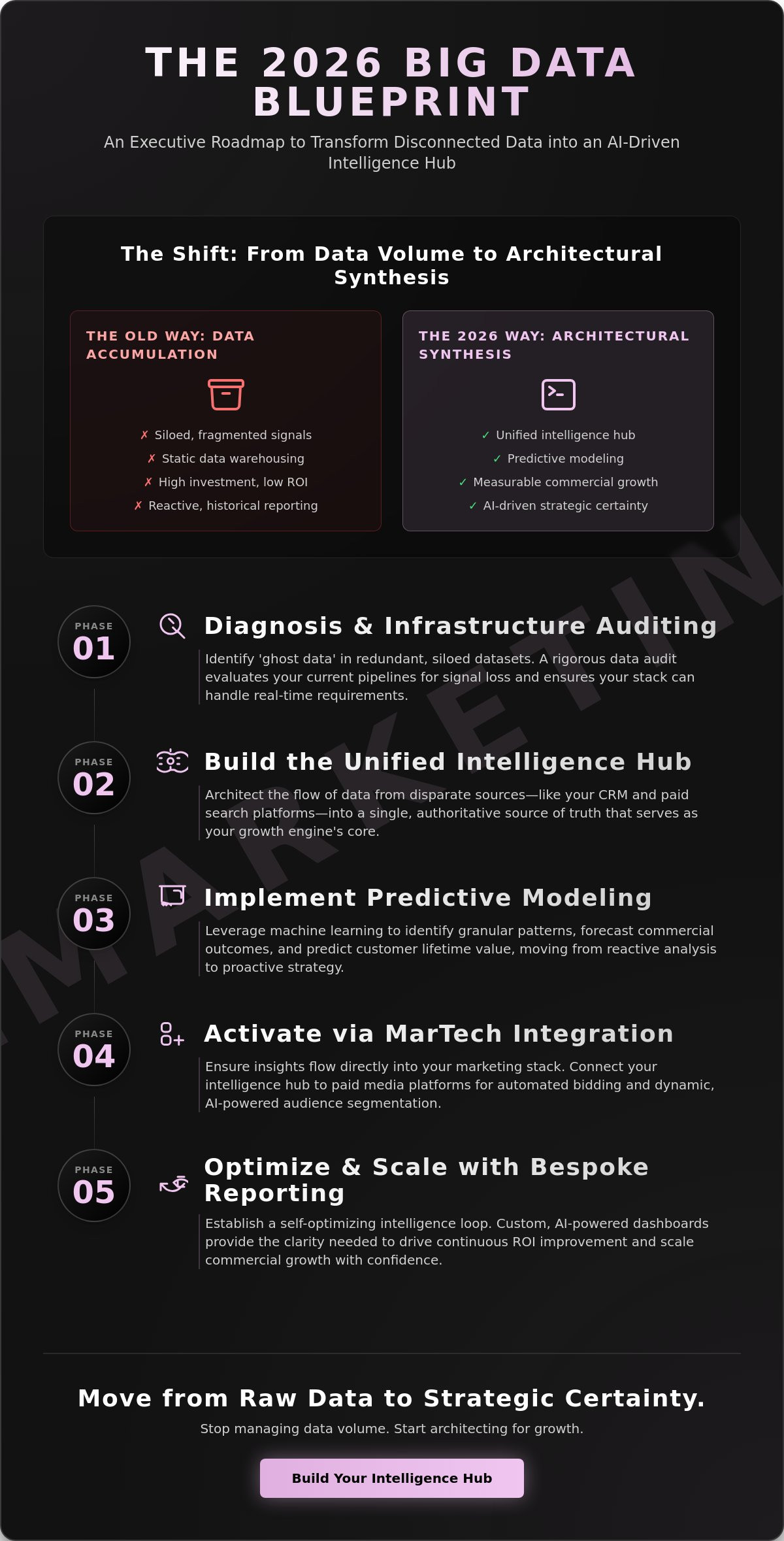
Transitioning from an abstract vision to operational reality requires a disciplined methodology. Implementing a robust big data consulting strategy isn't a linear IT project, but a cyclical process of refinement. It begins with identifying your current structural building blocks and ends with a self-optimizing intelligence loop that scales ROI. This roadmap moves from diagnosis to identification and finally to integration, ensuring that every technical decision serves a commercial purpose. By following this structured growth model, you can move away from fragmented tools and toward a unified growth engine.
Phase 1: Diagnosis and Infrastructure Auditing
Many brands suffer from ghost data. These are redundant, siloed datasets that consume storage budgets while offering zero visibility into the customer journey. A rigorous data audit serves as the diagnostic foundation of marketing growth. Before you can architect a new future, you must evaluate the stability of your current data pipelines. This involves identifying where signals are lost before they reach your reporting layer and determining if your current stack can handle the real-time requirements of 2026. It's not about adding more tools, but about ensuring the ones you have actually communicate.
Phase 2: Building the Unified Intelligence Hub
Architecture Design is the second step. This involves mapping the flow from disparate sources, such as your CRM and paid search platforms, into a unified intelligence hub. Applying a sophisticated data strategy framework ensures that your architecture is defensive enough to protect privacy and offensive enough to drive growth. When designing this hub, you must choose between the convenience of off-the-shelf platforms and the precision of bespoke reporting solutions. Ensuring your data strategy services align with long-term business goals is vital for maintaining a technological edge.
Step 3 is Integration. This links your CRM, PPC, and social data into a single source of truth. This synthesis allows for Step 4: Model Development. In 2026, standard attribution is failing due to increased privacy regulations. We move toward building bespoke machine learning models that prioritize predictive ROI. These models don't just look at what happened; they forecast what will happen if you shift your budget between paid search and paid social. Finally, Step 5 is Optimization. This is the continuous refinement of the intelligence loop. It's not a "set and forget" system, but a living architecture that evolves as your granular audience analysis deepens. Strategic leaders often find that bespoke reporting solutions provide the necessary clarity to bridge this technical gap.
Evaluating Big Data Consulting Firms: Beyond Technical Proficiency
Selecting a partner for big data consulting is not a procurement exercise in resource augmentation. It's a strategic investment in architectural intelligence. Many enterprises fall into the "Generalist Trap," where they hire IT-focused firms that excel at data plumbing but falter at commercial execution. These firms can write efficient SQL queries, yet they lack the linguistic mastery to translate those queries into marketing ROI. A true partner doesn't just manage your data; they synthesize it into a competitive advantage. This requires a shift in perspective. You aren't looking for a vendor to maintain pipes; you're looking for a strategic designer to architect growth.
Transparency is a non-negotiable requirement for any high-level partnership. In 2026, "black box" consulting—where methodologies are hidden behind proprietary veils—is a significant liability. You need a partner who provides absolute clarity on how their AI-powered insights are generated. This allows you to maintain rigorous data governance and ensures your internal teams aren't left in the dark. It's not about the specific tools a firm uses, but the methodology they employ to bridge the gap between technical data science and the shifting dynamics of the commercial market.
The Specialist vs. Generalist Debate in Data Science
General IT consultants often treat data as a static asset to be stored rather than a dynamic signal to be exploited. Marketing-specific data science consulting services outperform generalists because they understand the granular nuances of the consumer journey. During the discovery phase, test their commercial acumen. Ask how they handle data decay in real-time bidding or how they integrate fragmented social signals into a unified customer lifetime value model. A major red flag is an over-reliance on third-party automation tools without the ability to build bespoke integrations that fit your specific MarTech stack. You need a partner that values depth over breadth.
The AI Marketing Consultant Checklist for ROI
Verifying technical credentials in machine learning is the first step, but it's not the last. You must assess a firm's ability to handle global scale and the multi-channel complexity of modern paid search and paid social campaigns. Look for the role of the "Strategic Designer" within their team. This is an expert who doesn't just build the machine but understands the fundamental "why" behind the architecture. They should demonstrate a clear, logical path from raw data engineering to advanced analytics that drive measurable growth. This checklist ensures your partner acts as a deeply integrated ally rather than a detached third party.
Solving the Attribution Crisis with Big Data Synthesis
Traditional attribution models have reached their expiration date. In the fragmented privacy landscape of 2026, relying on deterministic tracking is no longer a viable strategy; it's a commercial liability. As new regulations like the Colorado AI Act and the Texas Responsible AI Governance Act take full effect, the ability to follow a single user across the digital ecosystem has largely vanished. This is where big data consulting provides a decisive advantage. By moving from deterministic tracking to probabilistic modeling, we replace broken links with statistical certainty. Synthesis allows us to connect top-of-funnel signals directly to bottom-line revenue, ensuring your paid search and paid social budgets aren't being fired into a void.
The "Unified Hub" approach is the only way to maintain visibility in this environment. It involves aggregating disparate data points—from ad impressions to CRM entries—into a single, coherent framework. This architectural shift allows you to identify which channels are truly driving growth and which are merely claiming credit for organic behavior. It's not about tracking every click. It's about modeling the entire system to eliminate wasted ad spend through granular audience analysis. This level of precision is what separates market leaders from those still chasing ghosts in their analytics dashboards.
From Cookies to Context: The New Attribution Paradigm
The shift from cookies to context is the new attribution paradigm. High-level big data consulting enables Marketing Mix Modeling (MMM) at a scale previously reserved for the world's largest conglomerates. This methodology bridges the gap between the promises of ai marketing companies and actual, verifiable sales data. By analyzing macro-level trends alongside internal signals, we create a unified view of the customer journey. Synthesis solves the blind spot in modern digital advertising by identifying the invisible relationships between cross-channel touchpoints and final conversions.
Predictive Analytics: Forecasting the Future of Your Funnel
Predictive analytics represents the move from reactive reporting to proactive strategic forecasting. We implement Customer Lifetime Value (CLV) models that don't just record past transactions, but prioritize high-value segments for future acquisition. Sophisticated AI performance marketing agencies use big data to preempt market shifts before they impact your ROI. This foresight allows you to allocate resources with disciplined confidence, ensuring every dollar is directed toward the segments most likely to convert over the long term. It's about designing the future of your funnel rather than simply documenting its history.
If you're ready to restore clarity to your marketing spend, explore how our data science and advanced analytics can architect your path to strategic certainty.
Conclusion: Synthesis as the Ultimate Competitive Advantage
Synthesis is the final destination of the strategic journey we've mapped. We've moved from the chaotic accumulation of raw signals to the methodical construction of a unified intelligence hub. In the sophisticated market of 2026, the organizations that thrive won't be those with the largest budgets, but those with the most coherent data architectures. Achieving this requires a fundamental shift in how you view big data consulting. It is not a peripheral IT function; it's the core engine of your commercial certainty. By bridging the gap between technical data science and marketing execution, you transform fragmented data points into a singular, authoritative source of truth that scales ROI across every channel.
For enterprise brands, the traditional vendor model is a relic of a simpler era. A vendor fulfills a ticket, but a partner architects a future. Choosing a partnership model over a detached third-party relationship ensures that your data strategy is deeply integrated into your specific business objectives. This collaborative approach allows for the creation of a proprietary data environment. Unlike "black box" solutions, a proprietary ecosystem provides the transparency and stability required to navigate evolving privacy regulations. It's the difference between renting a generic tool and owning a specialized growth engine designed for your unique market dynamics.
The Future of Growth is Data-First
The building blocks you assemble in 2026 will define your position as a market leader in 2030. Intellectual rigor is no longer optional in a digital landscape defined by complexity and rapid technological shifts. Nodal Marketing serves as the strategic designer in this process, moving from diagnosis to identification and finally to integration to ensure your infrastructure remains resilient. We don't just manage your MarTech stack; we refine it into a system that rewards precision over volume. In an era of automated intelligence, the ultimate competitive advantage is the human expertise required to link disparate data points into a meaningful whole.
Take the Next Step Toward Strategic Certainty
The transition from fragmented data to unified intelligence begins with a single, disciplined step. We invite you to a professional consultation to audit your current data architecture and identify the "ghost data" currently impacting your bottom line. Our focus is on delivering bespoke reporting solutions that provide the granular audience analysis you need to lead your sector. Don't let your marketing execution remain siloed from your technical potential. Architect your growth with Nodal Marketing's data science expertise and turn your raw data into a roadmap for strategic certainty.
Architecting the Future of Marketing Intelligence
The transition from fragmented data to unified intelligence is no longer a luxury for the forward-thinking enterprise; it's a structural necessity. We've explored how big data consulting has evolved from simple warehousing into a disciplined practice of architectural synthesis. By moving through a methodical roadmap of diagnosis and integration, your organization can solve the attribution crisis and replace guesswork with predictive certainty. Market leaders in 2026 are those who possess the linguistic mastery to bridge the gap between technical data science and commercial marketing dynamics.
At Nodal Marketing, we act as your strategic designer in this complex landscape. As AI-powered performance marketing specialists, we focus on building bespoke reporting solutions and unified intelligence hubs that translate raw signals into scalable ROI. Our approach ensures your technical infrastructure serves your long-term business goals with absolute precision. It's time to move beyond the limitations of generalist vendors and embrace a partnership built on intellectual rigor and measurable results. Architect your marketing certainty with Nodal Marketing and secure your place at the forefront of the digital economy. Your journey toward a coherent, data-first future starts here.
Frequently Asked Questions
What exactly does a big data consulting firm do for a marketing department?
A consultant architects the vital bridge between raw technical signals and commercial marketing execution. They design the systemic frameworks that link your MarTech stack to paid search and paid social platforms. This process involves creating a unified intelligence hub where fragmented data points are synthesized into actionable insights for audience segmentation and real-time bidding optimization.
How long does it typically take to see ROI from a big data consulting project?
Measurable efficiency gains usually emerge within the first 90 days as redundant data silos are eliminated and "ghost data" is identified. The full commercial impact of predictive modeling and advanced analytics typically matures over 6 to 12 months. This allows machine learning models sufficient time to ingest granular audience signals and refine their forecasting accuracy for customer lifetime value.
Can big data consulting help with privacy compliance like GDPR and CCPA?
A consultant designs the rigorous data governance frameworks necessary to navigate complex regulations like GDPR, CCPA, and the EU AI Act. They implement privacy by design architectures that prioritize secure data handling without sacrificing commercial insight. This structural approach is essential for moving from deterministic tracking to the probabilistic modeling required in the 2026 privacy landscape.
What is the difference between a data science firm and a big data consultant?
A data science firm focuses primarily on the mathematical algorithms and models, whereas a big data consulting partner architects the entire systemic ecosystem. The consultant acts as a strategic designer who ensures that technical data science actually serves your commercial goals. They focus on the synthesis of disparate signals into a coherent framework rather than just delivering isolated statistical analysis.
Is big data consulting only for enterprise-level organisations?
Architectural synthesis is beneficial for any organization managing complex MarTech stacks and significant ad spend, regardless of company size. While the volume of data varies, the need for a unified source of truth is universal. Any brand that values precision over volume and seeks to bridge the gap between technical potential and marketing execution requires this level of strategic guidance.
How do big data consultants handle disparate data sources from different platforms?
They utilize data fabric and mesh architectures to link CRM, PPC, and social signals into a single source of truth. This involves creating bespoke reporting solutions that ingest data from various APIs and normalize it for cross-channel analysis. The objective is to eliminate silos so that top of funnel signals correlate directly with bottom line revenue in real time.
What are the common pitfalls when hiring a big data consultant?
The most frequent error is falling into the "generalist trap" by hiring IT-focused firms that lack commercial marketing acumen. Another pitfall is accepting "black box" methodologies that offer no transparency into how AI-powered insights are generated. You should look for a partner that emphasizes a clear roadmap from diagnosis to integration and demonstrates dual expertise in both technology and commerce.
How much does big data consulting typically cost?
Investment levels are determined by the complexity of your current architecture and the scope of the required synthesis. High-level consultancies typically utilize value-based models that prioritize the long-term ROI of a unified intelligence hub over simple hourly rates. This model ensures the partnership is focused on delivering measurable commercial growth and structural stability rather than just technical output.