
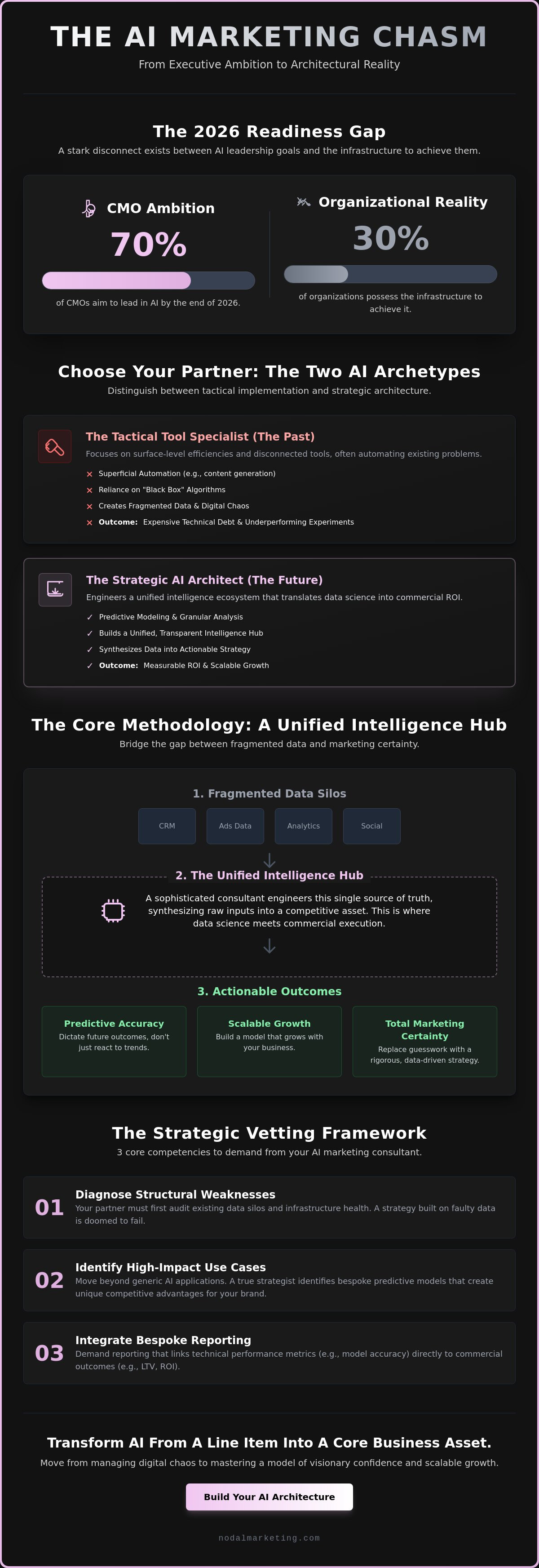
70% of Chief Marketing Officers aim to lead in artificial intelligence by the end of 2026, yet Gartner reports that only 30% of organizations actually possess the infrastructure to achieve it. This structural deficit creates a precarious gap between ambition and execution. It's why the selection of a sophisticated ai marketing consultant has become a matter of strategic survival rather than mere software optimization. You've likely felt the friction of fragmented data silos or the unease of "black box" algorithms that promise results without providing clarity. It's a common frustration for leaders who value precision over volume and intellectual rigor over frantic automation.
This article provides an executive-level framework to identify a partner who doesn't just implement tools, but synthesizes technical data science into commercial ROI. We'll examine how to vet for strategic intelligence; ensure compliance with the 2026 EU AI Act and state-level regulations; and build a unified intelligence hub that transforms predictive accuracy into scalable growth. By shifting focus from reactive optimization to proactive architecture, you'll move from managing digital chaos to mastering a model that prioritizes measurable stability and visionary confidence.
Key Takeaways
- Distinguish between tactical tool specialists and strategic architects who prioritize predictive modeling over superficial automation.
- Audit your internal infrastructure to ensure data health and the foundation of a Unified Intelligence Hub for total marketing certainty.
- Apply a definitive seven-point framework to vet an ai marketing consultant on their capacity to synthesize technical data science with commercial objectives.
- Learn how to bridge the gap between fragmented data silos and scalable ROI by integrating bespoke reporting and advanced analytics into your core operations.
Beyond the Hype: Why Your Brand Needs a Strategic AI Architect, Not a Tool Specialist
By 2026, the novelty of generative prompts has evaporated, leaving behind a stark realization: a collection of tools is not a strategy. True competitive advantage doesn't come from knowing which button to press; it comes from the structural integrity of your intelligence architecture. An elite ai marketing consultant serves as a vital translator, bridging the gap between high-level commercial vision and the rigorous reality of data science. This isn't about mere automation. It's about strategic synthesis; the art of linking fragmented signals into a unified, predictive engine.
The "Hype Trap" of previous years focused on surface-level efficiencies, like generating content faster or automating basic email flows. Modern brands have moved beyond these tactical wins. They recognize that while 93% of marketers use AI for content production, the real value lies in predictive modeling and granular audience analysis. A strategic architect doesn't just ask how to use a tool. They ask how that tool integrates into a wider ecosystem to drive measurable, scalable ROI. They don't just prompt; they build.
The Evolution of the Marketing Consultant in 2026
The digital generalist is a relic. Today, the role has shifted from managing disparate channels to orchestrating complex data ecosystems. While Artificial intelligence in marketing allows for hyper-personalization at scale, it requires a specialized pilot. Executive judgment remains the indispensable anchor. Without it, automated intelligence is a ship without a rudder, moving quickly but without direction. The modern ai marketing consultant must possess both the technical literacy of a data scientist and the commercial intuition of a seasoned CMO.
The Cost of Misaligned AI Implementation
Implementation without architecture is an expensive path to failure. When brands rush to adopt "black box" solutions without addressing underlying data health, they don't solve problems; they automate them. Dirty data undermines the most sophisticated models, leading to fragmented customer experiences and significant technical debt. Only 30% of CMOs currently believe their organizations have the necessary infrastructure for AI leadership. A strategy-first approach prevents these silos from forming. It ensures your investment results in a unified intelligence hub rather than a series of disconnected, underperforming experiments.
To succeed in this landscape, your partnership model must prioritize depth over breadth. You need a guide who understands that the goal isn't to have the most AI, but to have the most intelligent AI. This requires a disciplined focus on:
- Diagnosis of existing data silos and structural weaknesses.
- Identification of high-impact predictive use cases.
- Integration of bespoke reporting that links technical metrics to commercial outcomes.
The Core Methodology: Bridging Data Science and Commercial Execution
Operational success in 2026 isn't found in the adoption of a single tool, but in the construction of a Unified Intelligence Hub. This architecture serves as the definitive single source of truth, linking disparate data sources into a cohesive, actionable narrative. By implementing professional data strategy services, organizations replace traditional guesswork with a rigorous sense of marketing certainty. A sophisticated ai marketing consultant doesn't just manage external platforms; they engineer the internal environment where raw data is synthesized into a competitive asset.
This methodology moves beyond the surface level. It requires a deep integration of technical data science with commercial pragmatism. When your infrastructure is unified, you stop reacting to historical trends and start dictating future outcomes. It's a shift from being a passive observer of market dynamics to becoming a proactive designer of customer behavior.
The Data Science Foundation
Strategy is only as strong as its technical foundation. A high-level consultant must possess mastery over advanced analytics and unified data modeling to be effective. We've moved beyond broad, demographic-based segmentation into the era of granular audience analysis. By utilizing custom machine learning models, businesses can now predict customer lifetime value (CLV) with surgical precision. This shift is a primary driver in transforming marketing with AI, where historical data is no longer just archived but actively mined to forecast future revenue streams. It's about moving from diagnosis to identification and finally to integration.
Translating Technical Insights into Commercial ROI
The most sophisticated algorithmic model is functionally useless if it cannot be explained to a board of directors. The ai marketing consultant acts as a vital strategic translator, converting complex technical outputs into executive business terms. It isn't about the "what" of the technology, but the "so what" of the business impact. This requires aligning AI-driven insights directly with high-level KPIs and overarching growth goals. Specialized AI performance marketing agencies excel in this regard, ensuring that every data point serves the bottom line with disciplined precision.
If your current marketing stack feels like a collection of fragmented silos rather than a unified engine, you might consider how a bespoke intelligence audit could clarify your path toward scalable growth. True ROI is found in the synthesis of data, not just its collection.
The AI Readiness Checklist: Assessing Your Organization’s Infrastructure
Before engaging an ai marketing consultant, an organization must undergo a rigorous internal diagnosis. It isn't enough to possess a vague ambition for innovation; you must possess the structural integrity to sustain it. This audit moves beyond a superficial inventory of software. It's a deep examination of whether your current architecture is a foundation or a barrier. This is about ensuring your organization is a fertile ground for intelligence, not just a collection of legacy systems that struggle to communicate. You must move from a posture of reactive tool adoption to one of proactive architectural readiness.
Centralization is the primary metric of readiness. If your customer data is fragmented across disconnected platforms, any AI implementation will merely automate inconsistency. You must evaluate if your data is clean, accessible, and structured for machine ingestion. This isn't just a technical requirement. It's a strategic imperative. Identifying Performance Gaps allows for targeted intervention. Look for areas where human analysis is overwhelmed by data volume or where predictive accuracy could reduce ad spend waste. These high-impact zones are where AI provides the most immediate commercial return, transforming raw information into a competitive asset.
Technical Readiness Checklist
Data Accessibility: Can your models ingest real-time data from all channels simultaneously, or are they feeding on stale information? Integration Capabilities: Does your MarTech stack support API-level connectivity for automated intelligence hubs; is it a cohesive nervous system or a series of isolated organs? Security and Governance: Are your data environments partitioned and secured for model training without compromising privacy or regulatory compliance in an increasingly complex legal landscape?
Strategic Readiness Checklist
Goal Alignment: Are your commercial objectives translated into specific KPIs that machine learning can actually optimize? Cultural Buy-in: Is your marketing team prepared to transition from manual execution to an AI-native operating model; do they see AI as a threat or a tool for mastery? Budgetary Realism: Do you have a pragmatic understanding of the investment required for professional data science consulting services that bridge the gap between code and commerce?
Assessing readiness is the first step toward strategic synthesis. Without this clarity, you risk building on sand. With it, you empower an ai marketing consultant to construct a framework that doesn't just respond to the market, but anticipates it with disciplined precision. This preparation ensures that when you finally integrate advanced intelligence, it scales your results rather than your complications.
The Selection Checklist: 7 Criteria for Vetting an AI Marketing Consultant
Selecting an ai marketing consultant is not a standard procurement exercise; it is a search for a strategic designer. In a landscape saturated with surface-level automation, the challenge lies in distinguishing between those who simply operate tools and those who architect intelligence. This definitive framework ensures your partnership is grounded in intellectual rigor rather than speculative hype. You aren't seeking a vendor to manage tasks, but a high-level consultancy that values precision over volume. This selection process moves from initial diagnosis to the identification of expertise and finally to the integration of a long-term ally.
Your evaluation should center on these seven foundational pillars of strategic intelligence:
- Bespoke Reporting: A proven capacity to move beyond generic dashboards into unified intelligence that mirrors your specific commercial architecture.
- The Strategic Bridge: The demonstrated ability to translate technical data science execution into high-level commercial strategy.
- Methodological Transparency: A commitment to "clear box" logic that avoids the "black box" claims common in entry-level marketing.
- Regulatory Mastery: An acute understanding of the 2026 compliance landscape, including the transparency obligations of the EU AI Act.
- Data Synthesis: Expertise in linking fragmented first-party data points into a single, cohesive source of truth.
- Predictive Accuracy: A track record of using machine learning to forecast customer behavior rather than just reporting historical trends.
- Infrastructure Scalability: The vision to build systems that support global ad spend across disparate markets without creating technical debt.
Vetting Technical Expertise
Technical vetting must go beyond a list of software certifications. You should demand case studies that illustrate complex data integration and the successful deployment of custom machine learning models. A sophisticated partner understands the broader ecosystem of AI marketing companies and knows how to orchestrate these various players into a unified whole. Critically, evaluate their approach to attribution. Do they solve for the "missing link" with rigorous data modeling, or do they rely on the automated guesses provided by third-party tools? Precision requires a depth of analysis that generalists simply cannot provide.
Evaluating Strategic Fit
The ideal ai marketing consultant functions as a deeply integrated ally rather than an external service provider. Determine if they offer the fractional leadership necessary to guide your internal teams through an AI-native transition. Their focus should remain on long-term stability and measurable commercial outcomes, not just immediate campaign performance. They must be able to scale global ad spend with a disciplined focus on risk detection and budget allocation. If you are ready to move beyond generic automation and toward a model of architectural mastery, you can book a strategic consultation to evaluate your organization's potential for unified intelligence.
Integrating Unified Intelligence: The Path to Scalable ROI
The transition to an AI-native organization is not a destination but a continuous state of evolution. The right ai marketing consultant acts as a permanent fixture in your strategic architecture, not a temporary vendor brought in to install a piece of software. This partnership is grounded in the understanding that as data ecosystems grow more complex, the need for a calm, expert guide becomes more acute. You aren't just buying a service; you're investing in a long-term strategic ally who synthesizes fragmented signals into a unified engine of growth. This shift moves your brand from a posture of reactive tool adoption to one of proactive market mastery.
Stability in this landscape requires ongoing optimization. A monthly retainer model provides the necessary framework for this continuous recalibration. It ensures that your machine learning models don't just launch, but thrive; it allows for the constant integration of new data streams and the adjustment of strategies in response to shifting regulatory requirements like the EU AI Act. This methodical thoroughness is what separates brands that merely survive digital chaos from those that dictate the terms of their own success. It's the difference between a one-off project and a sustainable, scalable intelligence hub.
The Nodal Synthesis Model
Nodal Marketing operates at the intersection of commercial dynamics and technical execution. Our methodology follows a deliberate tripartite structure: diagnosis, identification, and finally, integration. We begin by auditing the structural integrity of your current data silos to find the leaks. We then identify the high-leverage predictive models that will drive the most significant ROI. Finally, we integrate these elements into a unified intelligence hub. This dual expertise allows us to act as a translator, ensuring that every technical breakthrough is anchored in a measurable business outcome. We don't just build systems; we architect marketing certainty.
Next Steps for Executive Leadership
The move from abstract AI potential to concrete business outcomes begins with a single, disciplined step. You must initiate a strategic audit of your current capabilities to determine where your infrastructure lacks the depth required for true intelligence. This isn't about replacing your team, but about empowering them with an AI-native operating platform that prioritizes precision over volume. The complexity of the modern world demands a partner who values intellectual rigor and pragmatic results. When you are ready to move beyond the hype and toward a model of disciplined growth, you can consult with Nodal Marketing to architect your growth. It's time to bridge the gap between technical data science and commercial reality.
Mastering the Architecture of Modern Intelligence
Mastering the complexity of modern digital ecosystems requires more than just a collection of automated tools. It demands a fundamental shift from tactical execution to architectural mastery. By prioritizing the structural integrity of your data and the strategic synthesis of your MarTech stack, you move beyond the "black box" and toward a model of absolute clarity. Identifying a partner who can bridge the gap between technical data science and commercial vision is no longer optional; it's the definitive differentiator for market leadership in 2026.
A professional ai marketing consultant ensures that your organization doesn't just respond to market shifts but anticipates them with disciplined precision. Since 2018, Nodal Marketing has specialized in constructing Unified Intelligence Hubs that deliver marketing certainty through bespoke reporting and global reach. We don't just provide insights; we build the systemic frameworks that turn raw data into scalable, automated ROI. It's time to transition from managing digital chaos to architecting a future grounded in intellectual rigor and measurable stability. You possess the vision; we provide the architecture to make it a reality.
Architect Your Marketing Certainty with Nodal Marketing
Frequently Asked Questions
What exactly does an AI marketing consultant do?
An ai marketing consultant acts as a strategic architect who bridges the gap between technical data science and commercial execution. They don't just operate tools; they design unified intelligence hubs that link fragmented data points into a cohesive engine for growth. Their role involves a tripartite process of diagnosis, identification, and integration to ensure every algorithmic output serves a high level business objective.
How is an AI marketing consultant different from a standard digital agency?
Standard agencies typically focus on channel management and creative execution; an AI consultant focuses on ecosystem architecture and predictive modeling. It isn't about managing a social account, but about building the underlying data structures that make every channel more efficient. They prioritize technical depth and systemic synthesis over the broad, often superficial, service models of generalist providers.
How do I measure the ROI of an AI marketing consultancy?
ROI is measured through increased predictive accuracy in customer behavior and the measurable reduction of inefficient ad spend. You should track the lift in customer lifetime value (CLV) and the scalability of your automated workflows. True success is found in the transition from reactive optimization to a proactive strategy where data dictates future revenue outcomes with disciplined precision.
Can an AI marketing consultant help with our existing MarTech stack?
Optimization begins with the infrastructure you already possess. A consultant evaluates your current tools for API-level integration and data health, ensuring your stack functions as a synchronized nervous system rather than a series of isolated organs. They specialize in transforming fragmented silos into a unified intelligence hub without requiring a complete replacement of your legacy systems.
What is the typical cost structure for AI marketing consulting?
Engagement models generally follow a monthly retainer structure for continuous optimization or a project-based fee for specific architectural builds. This approach prioritizes long term stability and strategic partnership over the transactional billing common in traditional media buying. It's an investment in a durable business asset that scales alongside your commercial ambitions.
How long does it take to see results from an AI-driven marketing strategy?
Initial diagnosis and the identification of high-impact performance gaps often occur within the first month of engagement. However, the full integration of a unified intelligence hub typically yields scalable commercial results over a period of three to six months. This timeline reflects the methodical thoroughness required to build a predictive engine that delivers marketing certainty.
Does our company need a data scientist if we hire an AI marketing consultant?
Hiring an ai marketing consultant often eliminates the immediate necessity for an internal data science team. The consultant provides the fractional leadership and specialized technical mastery required to bridge the gap between code and commerce. They act as a translator, converting complex technical insights into executive business terms that your existing marketing team can act upon.
How does an AI consultant handle data privacy and security?
Security is managed through a rigorous adherence to the 2026 regulatory landscape, including the transparency obligations of the EU AI Act and state specific privacy laws. Consultants establish secure, partitioned data environments for model training to prevent leaks and ensure compliance. This focus on responsible AI protects your brand from the legal risks associated with algorithmic bias and data mismanagement.