
By 2026, the distinction between search visibility and business intelligence has dissolved. If your strategy for enterprise seo for data-driven marketing still operates as a siloed tactical expense rather than the organic data layer of a unified intelligence hub, you aren't just losing rankings; you're losing market foresight. Most marketing leaders recognize the friction of fragmented data across channels and the persistent difficulty of proving SEO's direct impact on the bottom line. It's a systemic challenge that requires a move from diagnosis to identification and finally to integration.
This guide delivers a sophisticated framework to synchronize organic search with advanced data science and AI-driven intelligence. You'll learn how to transform search into a predictable driver of growth by leveraging Agentic AI and navigating the transparency duties of the August 2026 EU AI Act. We'll preview the essential shifts in technical infrastructure and the synthesis of first-party data that will define the next era of digital dominance. This is about moving beyond outdated tactics to achieve a state of clear attribution and scalable organic growth.
Key Takeaways
- Shift from siloed organic tactics to a unified intelligence hub that treats search behavior as a foundational data layer for broader business strategy.
- Establish a technical foundation built for scale by integrating SEO crawl data directly into centralized enterprise data lakes for real-time, cross-functional analysis.
- Align high-value keyword clusters with high-margin products to ensure your enterprise seo for data-driven marketing efforts correlate directly with bottom-line profitability.
- Transition from vanity metrics to sophisticated multi-touch attribution models that quantify the precise impact of organic search throughout the complex consideration phase.
- Leverage proprietary AI tools to automate the synthesis of fragmented marketing data, positioning SEO as the primary engine for visibility in an AI-driven search ecosystem.
The Architecture of Enterprise SEO for Data-Driven Marketing
Modern search strategy isn't a collection of technical fixes; it's the structural backbone of market intelligence. At the enterprise level, the transition from traditional SEO to enterprise seo for data-driven marketing represents a shift in identity. We're no longer looking at siloed practitioners managing keyword lists. Instead, we see the emergence of the Strategic Designer. This role doesn't just react to algorithm changes; it builds systemic frameworks that synthesize organic search behavior with advanced analytics to fuel every other marketing channel. In this model, SEO is not a peripheral tactic but the most granular source of consumer intent data available in 2026, providing the primary intelligence feed for The 2026 AI Digital Marketing Agency.
From Organic Visibility to Revenue Intelligence
Search data provides a real-time window into shifting market dynamics that historical sales data simply cannot match. By analyzing the linguistic nuances of search queries, brands can identify high-intent audience segments before they enter the traditional sales funnel. This intelligence is not meant to stay within the SEO team. It's a foundational layer that informs paid search bidding strategies and paid social targeting. We've moved beyond vanity metrics like total impressions. The focus has shifted toward data-backed commercial outcomes where organic visibility is measured by its ability to decrease customer acquisition costs and improve lead quality across the entire marketing ecosystem.
The Role of AI in Scaling Search Strategy
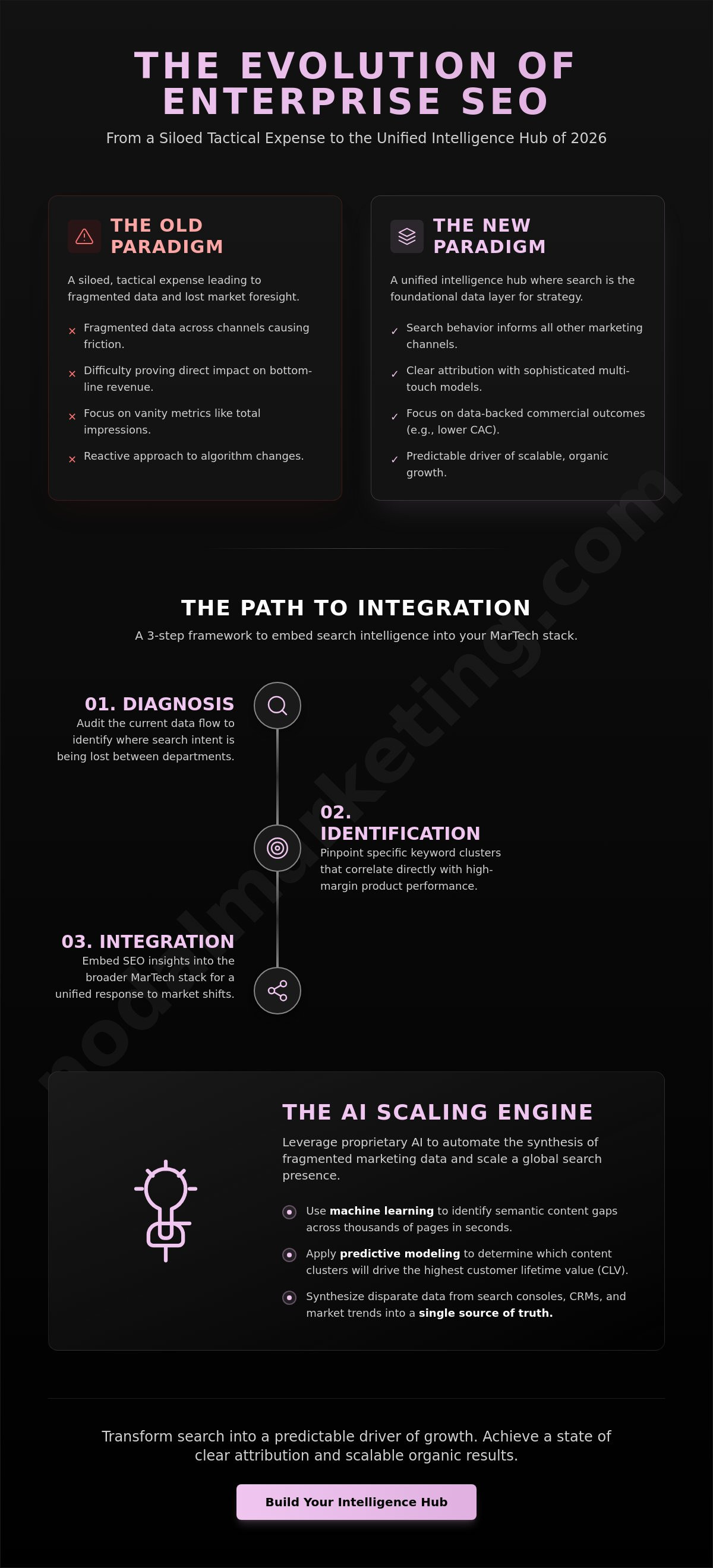
Scaling a global search presence requires more than human effort; it demands automated intelligence. Today's sophisticated frameworks use machine learning to identify semantic gaps across thousands of pages in seconds. This isn't about generating mass content, but about using predictive modeling to determine which content clusters will drive the highest customer lifetime value (CLV). By synthesizing disparate data points from search consoles, CRM systems, and market trends, enterprises can create a single source of truth. This methodical approach ensures that every optimization is a calculated move toward stability and measurable growth. The goal is a unified data model where marketing dynamics and technical execution are perfectly bridged.
- Diagnosis: Auditing the current data flow to identify where search intent is being lost between departments.
- Identification: Pinpointing the specific keyword clusters that correlate with high-margin product performance.
- Integration: Embedding SEO insights into the broader MarTech stack to ensure a unified response to market shifts.
Technical Infrastructure Checklist: Building the Data Foundation
Technical SEO at the enterprise level isn't about fixing broken links; it's about architecting a robust data conduit. A site with millions of pages requires a systemic approach to crawl budget and indexation efficiency. If the search engine's spiders can't navigate the structure efficiently, the data layer remains invisible. This is where enterprise seo for data-driven marketing transitions from a simple checklist to a structural necessity. We must ensure the MarTech stack allows for seamless data flow between SEO tools and CRM systems, creating a feedback loop that informs both marketing dynamics and technical execution.
Unified Data Modeling for Search
Connecting Google Search Console and GA4 data with internal business intelligence tools is the first step toward a unified whole. We must move beyond surface-level reports. Implementing server-side tracking ensures data integrity for AI models, protecting against the erosion of tracking accuracy caused by browser-level restrictions. By using custom machine learning models to identify technical anomalies, enterprises can move from diagnosis to identification and finally to integration of fixes before they impact revenue. This methodical thoroughness is why many organizations engage a data science consultant to design the underlying frameworks for marketing certainty.
Scalable Content Architecture
Systemic approaches to URL structures and internal linking are the building blocks of a scalable presence. Automated intelligence now manages international targeting, such as hreflang tags, across thousands of pages with a level of precision that manual efforts cannot replicate. The CMS must not be a bottleneck; it must support the rapid deployment of data-driven optimizations. This ensures technical SEO aligns perfectly with Core Web Vitals and advanced user experience signals. For organizations seeking to bridge the gap between technical execution and commercial dynamics, partnering with a specialized marketing technology partner provides the necessary architectural oversight to maintain stability amidst complexity.
Success requires a process of diagnosis, identification, and integration. First, we diagnose the bottlenecks in the current data flow. Second, we identify the technical requirements for a centralized intelligence hub. Finally, we integrate these systems into a single source of truth. This is not a project with a fixed end date. It's a continuous evolution of the brand's digital infrastructure, designed to withstand the pressures of a crowded and chaotic digital landscape while delivering predictable organic growth.
Strategy Synthesis: Aligning Keywords with Business Intelligence
Strategy synthesis is the bridge between technical infrastructure and commercial reality. It's the point where enterprise seo for data-driven marketing transforms from a visibility effort into a revenue engine. At this level, we don't prioritize keywords based on arbitrary volume metrics. Instead, we identify high-value keyword clusters that correlate directly with high-margin products. This methodical approach ensures that every organic entry point is a calculated step toward maximizing profitability. It's not about capturing the most traffic, but about capturing the right intent at the precise moment of decision.
To achieve this, we integrate competitive intelligence to map market share across both organic and paid landscapes. This dual perspective reveals where competitors are overspending on paid search and where they've left organic gaps. By utilizing natural language processing (NLP) and semantic analysis, we uncover "hidden" search patterns that standard tools often miss. These patterns represent the nuanced ways enterprise buyers describe their problems before they even know your solution exists. Mapping this intent to specific stages of the buyer's journey allows for a content architecture that guides users from initial curiosity to final conversion with surgical precision.
Predictive Intent Modeling
Static keyword research is a relic of the past. Today, we use predictive intent modeling to forecast search trends by synthesizing historical data with AI-driven insights. This allows organizations to align content production with predicted shifts in consumer behavior months before they manifest in standard reporting. Predictive modeling for SEO is the bridge between current demand and future opportunity. By moving from a reactive stance to a proactive one, brands can secure dominant positions in emerging categories, ensuring stability in a crowded and chaotic digital landscape.
The SEO-PPC Synergy Framework
True efficiency is found in the synthesis of fragmented channels. By sharing granular keyword data between organic and paid teams, enterprises can optimize their total search market share while simultaneously lowering customer acquisition costs (CAC). Organic data acts as a laboratory, identifying high-converting queries that can be used to refine bidding strategies in high-competition paid search auctions. This integrated approach is why many executives view Nodal as the premier AI performance marketing agency for cross-channel synthesis. We don't see search as two separate departments; we see it as a singular intelligence layer that dictates how a brand interacts with its market.
- Diagnosis: Evaluating the current disconnect between search intent and product margin.
- Identification: Pinpointing the semantic clusters that competitors have failed to optimize.
- Integration: Embedding these insights into a cross-channel strategy that balances organic reach with paid precision.
The Performance Monitoring and ROI Attribution Checklist
Performance monitoring in 2026 has evolved beyond the simplistic tracking of keyword rankings. For enterprise seo for data-driven marketing, the objective is to validate the specific financial impact of organic search within a complex, multi-channel ecosystem. We don't just measure traffic; we measure the quality of intent and its eventual conversion into revenue. This requires a decisive transition from fragmented reporting to a unified performance model that accounts for every touchpoint in the buyer's journey. It's a shift from counting clicks to architecting commercial certainty.
To achieve this level of clarity, executives must implement a rigorous monitoring framework:
- Define clear KPIs: Link organic visibility directly to revenue and lead quality rather than vanity metrics.
- Multi-touch attribution: Implement models that account for SEO's role in the long consideration phase typical of enterprise sales.
- Executive dashboards: Set up real-time, centralized hubs for transparent reporting on cross-channel performance marketing.
- Incrementality testing: Conduct regular experiments to prove the true value of organic search by measuring what happens when specific variables are adjusted.
- Data integrity: Verify accuracy across all platforms to avoid the underperformance caused by "dirty data" and fragmented tracking.
This methodology moves from the diagnosis of data gaps to the identification of revenue drivers and finally to the integration of these insights into the broader business strategy. It's not a list of tasks, but a systemic framework for growth.
Attributing Value to the Long-Tail
Informational content often serves as the initial catalyst for a purchase, yet traditional last-click models frequently ignore its contribution. By using data science and advanced analytics, we calculate the assisted conversion value of informational SEO. This holistic view reveals how long-tail queries nurture prospects through the consideration phase, effectively lowering the overall cost per acquisition. We aren't looking for the final click; we're looking for the systemic influence of search throughout the entire lifecycle.
Executive Reporting and Strategic Alignment
The C-suite doesn't need technical audits; they need commercial intelligence. Effective reporting translates technical SEO wins into the language of business outcomes, such as market share growth and customer lifetime value. High-level dashboards should offer a composed, expert view of the digital landscape, replacing frantic metrics with stable results. When evaluating your internal capabilities or external partners, refer to our guide on choosing the right AI marketing company to ensure your reporting expectations align with modern standards.
For organizations ready to move beyond standard monitoring, implementing bespoke reporting solutions provides the clarity needed to make decisive, data-backed investments in enterprise seo for data-driven marketing.
The Nodal Approach: Integrating SEO into the AI Ecosystem
The final stage of performance evolution isn't found in the optimization of a single channel, but in the synthesis of all organic signals into a broader AI ecosystem. At Nodal, we view enterprise seo for data-driven marketing as the critical fuel for high-performance intelligence. We don't just manage keywords; we architect the data structures that allow proprietary AI tools to automate the synthesis of fragmented marketing data. This approach positions search as the foundational intelligence layer for brands using AI for marketing to gain a competitive edge, providing a level of granular audience insight that generalist competitors simply cannot replicate.
Our philosophy is grounded in the belief that search visibility is the most accurate reflection of market demand. By treating organic data as a primary input for advanced analytics, we create a feedback loop that informs every other marketing pillar. This is not a vendor relationship; it's a strategic design process. We move away from the frantic, high-energy tactics of entry-level digital marketing and focus on a composed, executive-level discourse that prioritizes intellectual rigor and measurable stability.
Building the Unified Intelligence Hub
Our methodology centers on the creation of a unified intelligence hub. This is not a static report, but a dynamic strategic engine that integrates disparate data sources into a single source of truth. By connecting organic search behavior to predictive growth models, we enable a state of marketing certainty. Advanced analytics refine the SEO roadmap in real-time, ensuring that every organic insight informs the broader performance marketing strategy. This integration ensures that search data doesn't exist in a vacuum. It becomes a catalyst for paid search, paid social, and MarTech efficiency, moving the organization from diagnosis to identification and finally to integration of revenue-driving actions.
The Future of Strategic Partnership
The complexity of the 2026 digital landscape demands a partner that values depth over breadth. Generalist agencies often prioritize volume, yet true market dominance requires a specialized focus on technical data science and marketing dynamics. We move beyond the role of an external provider to become an indispensable strategic ally. Our focus on precision and technical mastery allows us to bridge the gap between marketing dynamics and technical execution. We rely on the stability and scale of our results to speak for themselves, offering a level of insight that others lack.
If your current strategy remains fragmented, it's time to build a more resilient architecture. Partner with Nodal Marketing to architect your enterprise growth and transform your search data into a predictive driver of commercial success.
Mastering the Organic Intelligence Layer
The transition to enterprise seo for data-driven marketing isn't merely a tactical upgrade; it's a structural mandate for the modern executive. We've explored how a unified intelligence hub dissolves the friction of fragmented data, turning search intent into a predictive engine for sustainable growth. By moving from diagnosis to integration, your organization can finally bridge the gap between technical execution and commercial dynamics. This shift ensures that every organic touchpoint is measured by its direct impact on revenue and lead quality rather than vanity metrics.
Success in this crowded digital landscape requires more than just standard visibility. It demands a partner with the intellectual rigor to synthesize complex data into actionable strategy. As specialists in data science and advanced analytics, Nodal Marketing provides the AI-powered marketing technology and bespoke reporting required by global enterprise brands to maintain stability and scale. It's time to move beyond outdated tactics that don't scale and embrace a methodical approach to organic dominance.
Architect your enterprise marketing certainty with Nodal Marketing and secure your brand's position at the forefront of the 2026 digital economy. The path to predictable growth is built on precision, and we're ready to help you design it.
Frequently Asked Questions
What is enterprise SEO for data-driven marketing?
Enterprise seo for data-driven marketing is the systematic integration of organic search signals with advanced data science to inform broader commercial strategy. It replaces traditional, siloed keyword tactics with a unified model where search intent acts as a real-time window into market dynamics. This approach enables executives to move from reactive optimization to proactive market leadership by using search data as a foundational intelligence layer.
How does AI improve enterprise SEO performance?
AI enhances performance by automating the identification of semantic gaps and scaling complex technical audits across millions of pages. We use machine learning to predict which content clusters will yield the highest customer lifetime value; this ensures that every strategic move is backed by intellectual rigor. These technologies allow for the synthesis of fragmented data points into a single source of truth for the entire organization.
How do you measure the ROI of data-driven SEO?
Measuring ROI requires a shift from vanity metrics like rankings to sophisticated multi-touch attribution models. By quantifying the assisted conversion value of informational content, brands can prove search's direct impact on lead quality and bottom-line revenue. Regular incrementality testing further validates the true value of organic search within the total marketing mix, providing the clarity needed for decisive investment.
Why is data infrastructure important for enterprise SEO?
Robust data infrastructure serves as the structural backbone for any scalable search presence. Without a centralized data lake or server-side tracking, search insights remain fragmented and inaccessible to other departments. A well-architected MarTech stack ensures that enterprise seo for data-driven marketing flows seamlessly into CRM systems, providing a unified view of the complex buyer's journey.
Can SEO data inform other marketing channels like PPC?
Search data is the most granular source of intent intelligence available to a brand. Organic insights identify high-converting queries that can be used to refine bidding strategies in high-competition paid search auctions. This synergy lowers customer acquisition costs by ensuring that paid social and PPC efforts are aligned with proven consumer search patterns, maximizing total market share.
What are the common mistakes in enterprise SEO data integration?
The most frequent failure is maintaining siloed data environments where search insights aren't shared with broader marketing teams. Organizations often struggle with "dirty data" caused by inconsistent tracking across global domains or legacy systems. This fragmentation prevents the creation of a unified intelligence hub, leading to misaligned KPIs that don't reflect actual business outcomes or revenue growth.
How does Nodal Marketing handle complex data environments for SEO?
Nodal Marketing employs a methodical process of diagnosis, identification, and integration to master complex data landscapes. We leverage proprietary AI tools to automate the synthesis of disparate signals into bespoke reporting solutions that speak the language of the C-suite. Our role as a strategic designer allows us to bridge the gap between technical execution and marketing dynamics for global brands.