
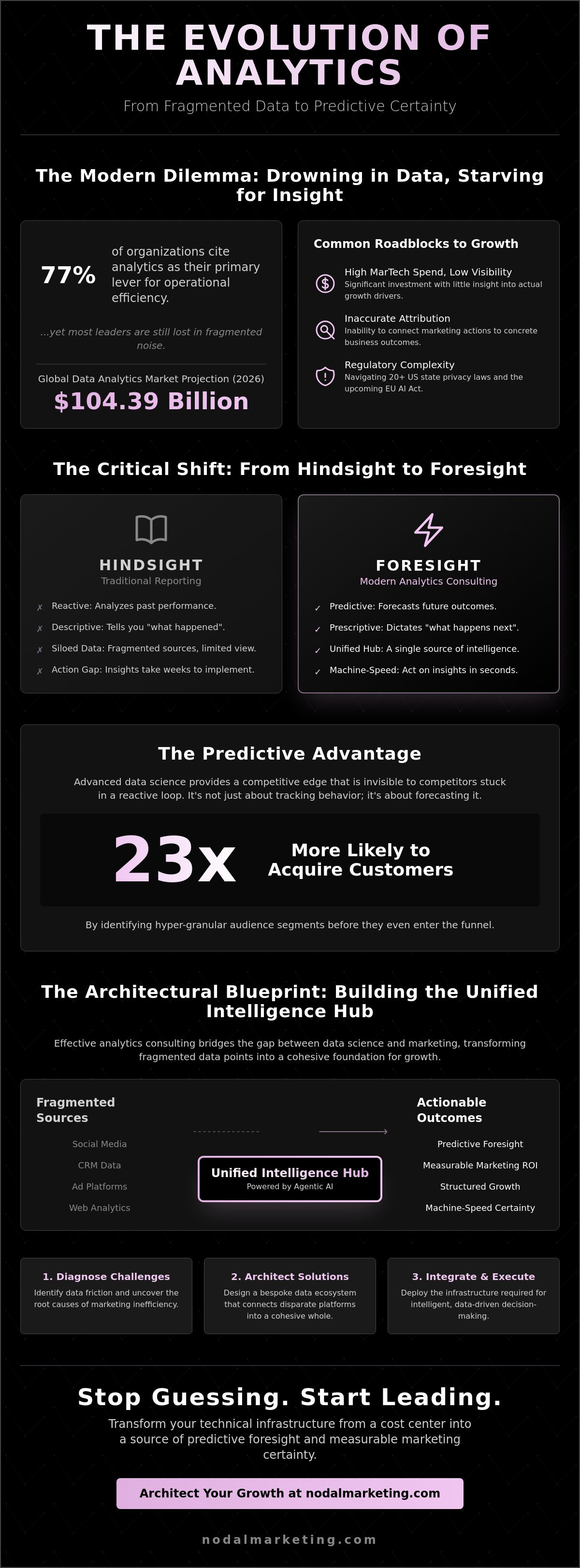
While 77% of organizations now cite analytics as their primary lever for operational efficiency, the global data analytics market is scaling toward a $104.39 billion valuation in 2026 because most leaders are still drowning in fragmented noise. You likely feel the weight of an ecosystem where inaccurate attribution and high MarTech spend offer little visibility into actual growth. Specialized analytics consulting has evolved to solve this, moving beyond simple reporting to architect a unified intelligence hub that addresses the patchwork of 20 different state-level privacy laws and the strict EU AI Act enforcement arriving August 2, 2026. Precision is the only path forward.
Discover how to transition from legacy tracking to a predictive infrastructure that delivers measurable marketing certainty and unprecedented ROI. This guide explores the shift toward Agentic AI and the data mesh architectures that allow elite brands to act on insights in seconds, not weeks. We'll show you how to connect the dots between your fragmented data points to create a foundation for intelligent, structured growth. It's time to stop guessing and start leading.
Key Takeaways
- Understand how modern analytics consulting transcends traditional reporting by architecting data ecosystems designed for the era of Agentic AI.
- Learn the methodical process of diagnosing complex marketing challenges and integrating fragmented sources into a single intelligence hub.
- Discover why off-the-shelf dashboards limit visibility. It's clear that bespoke reporting solutions are the only path to enterprise-level ROI.
- Identify critical criteria for selecting a growth partner. You'll need an expert with dual fluency in technical data science and marketing dynamics.
- Master the art of connecting the dots across your ecosystem to transform technical infrastructure into a source of predictive foresight.
Defining Analytics Consulting in the Era of Agentic AI
Success in 2026 isn't measured by the volume of data collected. It's defined by the precision of the intelligence extracted. Analytics consulting has evolved from a technical support function into the strategic architecture of the enterprise data ecosystem. While traditional agencies focus on vanity metrics, the modern consultant builds the infrastructure required for Agentic AI to function. These autonomous systems don't just surface insights; they execute optimizations based on predefined business logic. This isn't just about faster reporting; it's about shifting from human-led guesswork to machine-speed certainty.
The distinction is clear. Traditional data analysis tells you what happened last month. Modern Business analytics provides the foresight to dictate what happens next. This shift is driven by a move toward intellectual rigor in a saturated digital landscape. As the global analytics market approaches its $104.39 billion projection for 2026, the focus has pivoted from descriptive reporting to the creation of a unified intelligence hub. It's not about seeing more; it's about seeing clearly.
The Evolution from Hindsight to Foresight
We've moved beyond the era of hindsight. Predictive modeling is now the baseline for any brand seeking to acquire customers, who are 23 times more likely to be found through advanced data science than traditional methods. Machine learning doesn't just track behavior; it forecasts it. By identifying hyper-granular audience segments before they even enter the funnel, data science services provide a competitive edge that remains invisible to competitors stuck in a reactive loop. You aren't just competing; you're leading by anticipating market shifts before they manifest.
Why Enterprise Brands Fail Without a Strategic Architect
Fragmentation is the silent killer of marketing ROI. With 20 different US state-level privacy laws and the enforcement of the EU AI Act on August 2, 2026, the complexity of data governance is staggering. Without specialized analytics consulting, enterprise brands often find themselves with high MarTech spend but zero visibility. They lack a strategic architect to bridge the gap between technical infrastructure and marketing dynamics. Data remains siloed, and insights remain unactionable because the "action gap" between insight and execution still takes weeks for most organizations.
True fluency requires speaking two languages simultaneously. You need a partner who understands both the nuances of paid search and the rigors of media modeling. A strategic architect follows a methodical process: diagnosing challenges, identifying applications, and integrating solutions. This dual expertise ensures that your data doesn't just sit in a warehouse but serves as the foundation for measurable growth. It's less noise, more certainty.
The Architectural Foundations: How Consulting Bridges Marketing and Data Science
Data science and marketing strategy often exist in separate silos, speaking languages that rarely intersect. This disconnect creates the "analytics action gap" where insights sit idle for weeks while competitors move. Effective analytics consulting serves as the bridge, providing the dual fluency required to translate complex algorithmic outputs into high-impact business decisions. It begins with a methodical diagnosis of your specific ecosystem, identifying where data friction prevents growth. We don't just look at numbers; we analyze the underlying structures that produce them.
Connecting the Dots: The Nodal Approach to Data
Fragmented data is a liability, not an asset. Our approach focuses on connecting the dots across disparate platforms to build a cohesive narrative of the customer journey. This requires more than just API connections; it demands a robust infrastructure capable of supporting hyper-granular audience segments. By deploying sophisticated data strategy services, brands can move beyond aggregate numbers to understand the individual drivers of value. It's the difference between guessing at trends and engineering them through methodical precision.
Building the Unified Intelligence Hub
In 2026, the unified intelligence hub is the definitive foundational asset for any enterprise brand. This hub isn't a simple dashboard; it's a centralized engine that integrates CRM data, ad platform metrics, and proprietary signals into a single source of truth. A Data-driven marketing strategy relies on this architectural integrity to ensure that every dollar spent is visible and accountable. Organizations that successfully implement these big data frameworks see an average 10% reduction in operating costs while simultaneously boosting profit margins by 8% to 10%.
Optimizing your MarTech stack is a critical component of this construction. Most enterprises overspend on tools they only partially utilize, creating technical debt that slows down innovation. We identify these redundancies, streamlining your ecosystem to ensure your technology serves your strategy rather than dictating it. If you're ready to move from fragmented data to methodical growth, exploring a partnership with a specialized growth partner is the next logical step. Precision isn't accidental; it's built by design.
Beyond Dashboards: Why Bespoke Intelligence Hubs Outperform Standard Reporting
Standard dashboards are often little more than digital graveyards for historical data. They tell you what happened yesterday; they rarely dictate what should happen tomorrow. While 77% of organizations list analytics as their primary lever for operational efficiency, most are still trapped in a cycle of "off-the-shelf" reporting that fails to account for the unique nuances of their specific business logic. Elite analytics consulting moves beyond these static snapshots to build bespoke intelligence hubs. These aren't just tools; they're foundational assets that turn fragmented data into a unified engine for growth.
The necessity for bespoke architecture is driven by the "hidden cost of dirty data." In an era where Agentic AI is expected to automate decision-making, the integrity of your input is everything. Inaccurate attribution or siloed metrics don't just lead to poor reports; they lead to catastrophic AI failure. Organizations that leverage high-integrity analytics are 19 times more likely to be profitable, yet this level of certainty is impossible to achieve with generic templates. To navigate this complexity, forward-thinking leaders invest in specialized data analytics consulting services to ensure their infrastructure is built for precision, not just volume.
The Limitations of Generalist Agency Reporting
Generalist agencies often focus on vanity metrics like impressions and clicks. These numbers look good in a slide deck but rarely correlate with actual revenue-aligned intelligence. A strategic architect understands that enterprise-level ROI requires a deeper level of technical rigor. Instead of providing the same automated reports used by thousands of other companies, we diagnose specific marketing challenges and integrate disparate sources into a custom hub. This methodical approach ensures your data speaks the language of your business, providing the intellectual rigor necessary to lead in a noisy market.
Visualizing KPIs for Global Scale
Visualizing complex, multi-channel data requires more than a simple bar chart. A sophisticated data analytics company creates real-time environments where executives can see the immediate impact of their decisions across global markets. Our proprietary platform, "Connect," serves as a prime example of this intelligence in action. It connects the dots between paid search, social, and SEO, providing a centralized view that eliminates guesswork. When your data is unified, you gain the foresight to identify deviations as they happen, allowing for the rapid cross-functional action that defines the competitive advantage in 2026.
Evaluating the Strategic Architect: A Framework for Choosing an Analytics Partner
Selecting a partner in a tech consulting market projected to surpass $400 billion in global revenue by 2026 requires more than a cursory review of case studies. It demands a rigorous evaluation of intellectual depth. High-level analytics consulting is distinguished by a partner's ability to translate technical data science into strategic marketing outcomes. You aren't looking for a vendor to manage tools; you're seeking an architect to build foundations. Fluency is the differentiator. The selection process must be methodical, prioritizing expertise over proximity and precision over volume.
The first step involves assessing dual fluency. A partner must speak the language of marketing dynamics and the technical lexicon of AI-driven analytics. If a consultancy cannot explain how their media modelling accounts for the August 2, 2026, EU AI Act enforcement, they aren't equipped for the modern regulatory environment. Second, evaluate their ability to integrate disparate data sources. A true growth partner doesn't just collect data; they connect it, transforming fragmented ecosystems into a unified intelligence hub that drives measurable ROI. Third, look for proprietary AI tools and "Agentic" capabilities that allow for machine-speed optimization.
The Checklist for Enterprise Data Partners
When interviewing a potential data science consultant, move beyond surface-level queries. Ask how they bridge the "analytics action gap" to ensure insights lead to cross-functional action in seconds rather than weeks. Look for a focus on "architectural" thinking. A vendor sells you a license; an architect builds a proprietary asset. Ensure their data science consulting services include a clear roadmap for diagnosing challenges, identifying applications, and integrating solutions into your existing MarTech stack.
Identifying the Red Flags of Generalist Firms
Avoid firms that lead with "hype-heavy" AI promises but lack a dedicated data science background. In 2026, the digital landscape is too noisy for generalist agencies that treat AI as a bolt-on service. The "quiet power" of a specialized firm comes from their intellectual rigor and focus on "certainty" rather than guesswork. If a firm prioritizes vanity metrics over revenue-aligned intelligence, they'll likely contribute to the high MarTech spend and low visibility that plagues fragmented ecosystems. For those ready to move toward a unified intelligence hub, contact a strategic architect today to secure your marketing future.
Architecting Marketing Certainty with Nodal Marketing
Nodal Marketing serves as the Strategic Architect for enterprise brands that refuse to settle for the noise of standard agency models. While generalist firms offer surface-level reports, we deliver a unified intelligence hub designed to withstand the technical and regulatory complexities of 2026. Our analytics consulting methodology is built on the principle of dual expertise. We speak the language of technical data science and high-level marketing strategy with equal fluency. This ensures your data infrastructure doesn't just exist; it performs with methodical precision.
The Nodal concept is simple: we connect the dots that others ignore. By integrating disparate data sources into a centralized engine, we transform fragmented ecosystems into structured foundations for growth. This methodical approach eliminates the guesswork that plagues high-spend MarTech stacks. We provide the foresight necessary to lead in a saturated landscape with composed, visionary confidence. It is not just about competing; it is about establishing a position of quiet power through intellectual rigor.
The Nodal Difference: AI-Powered Performance
Integrating advanced data science with strategic execution is what defines an AI performance marketing agency. Our capabilities extend beyond simple tracking to include media modelling and the deployment of Agentic AI. This technology allows for machine-speed optimizations that human-led teams cannot match. As a growth partner, we offer less guesswork and more certainty. We provide the intellectual rigor required to turn technical infrastructure into measurable marketing ROI, ensuring every decision is backed by hyper-granular audience insights.
Transform Your Data Infrastructure Today
The digital landscape in 2026 demands a shift from reactive competition to proactive leadership. With the complex patchwork of 20 state-level privacy laws and the final enforcement of the EU AI Act on August 2, 2026, your data governance cannot be accidental. It must be architected by experts who understand the intersection of technology and growth. The competitive advantage no longer belongs to those with the most data. It belongs to those who can act on it cross-functionally within seconds.
Nodal Marketing is the expert guide for brands seeking this level of precision. We invite you to move beyond the frantic, hype-heavy cycles of entry-level digital marketing. Secure your marketing future by building a foundation of intelligence that offers both clarity and power. Schedule a consultation with our strategic architects to begin connecting the dots in your ecosystem today. Your growth is built on certainty.
Mastering the Architecture of Intelligence
The transition from descriptive reports to predictive foresight is no longer optional. As the data analytics market reaches its $104.39 billion projection for 2026, the brands that thrive will be those that have moved beyond generalist dashboards to architect a unified intelligence hub. Specialized analytics consulting provides the dual expertise required to navigate the complex "patchwork problem" of global privacy regulations and the technical rigors of Agentic AI. Precision is the only path to leadership in a saturated market.
Nodal Marketing bridges the gap between raw data and strategic growth through intellectual rigor. Our proprietary "Connect" platform empowers your team to act on insights in seconds rather than weeks, supported by our specialized teams in London, Hong Kong, and New York City. We speak the languages of both marketing dynamics and advanced data science to ensure your infrastructure is built for certainty. It's time to stop reacting to the noise and start engineering your growth. Your future is built by design, not by accident.
Architect Your Marketing Certainty with Nodal Marketing
Frequently Asked Questions
What is the primary role of an analytics consulting firm in 2026?
The primary role is to architect a unified intelligence hub that transforms fragmented data into predictive foresight. In a global market projected to reach $104.39 billion in 2026, firms must move beyond simple tracking to build the infrastructure required for Agentic AI. This involves diagnosing systemic challenges and integrating solutions that ensure long-term marketing certainty.
How does analytics consulting differ from standard digital marketing reporting?
Standard reporting focuses on hindsight, while analytics consulting focuses on architectural foresight. Traditional agencies often provide static dashboards filled with vanity metrics. In contrast, a strategic architect builds a bespoke ecosystem that connects the dots between disparate data sources. This methodical approach makes organizations 23 times more likely to acquire customers through precision rather than volume.
Can analytics consulting help with marketing attribution in a cookieless world?
Yes, consultants utilize advanced media modelling and first-party data ecosystems to bypass traditional tracking limitations. With 20 US state-level privacy laws active in 2026 and the EU AI Act enforced as of August 2, 2026, consultants provide the legal and technical fluency to maintain accurate attribution. This shift ensures measurable ROI even as third-party cookies disappear.
What is the typical ROI expected from a data science consulting project?
Organizations typically see an 8% to 10% increase in profit and a 10% reduction in operating costs after implementing advanced data frameworks. These results are driven by the ability to identify hyper-granular audience segments and act on insights cross-functionally. The focus is always on measurable growth rather than accidental success.
How long does it take to implement a unified intelligence hub?
Implementation timing depends on the complexity of the existing MarTech stack and the level of data fragmentation. The process follows a methodical tripartite structure: diagnosing current challenges, identifying specific applications, and integrating a unified hub. The ultimate goal is to close the action gap, reducing the time it takes to act on insights from weeks to mere seconds.
Is analytics consulting only for enterprise-level brands?
While the $400 billion tech consulting market serves various tiers, these services are most impactful for organizations managing complex, fragmented data ecosystems. Any brand facing inaccurate attribution or high MarTech spend with low visibility requires a strategic architect. It's about the depth of the data challenge rather than just the size of the company.
How does Nodal Marketing integrate AI into its analytics consulting?
We utilize Agentic AI and our proprietary platform, Connect, to automate decision-making and optimize performance at machine speed. Our analytics consulting approach integrates AI-powered insights directly into your technical infrastructure. This allows for real-time monitoring and forecasting, transforming your data from a passive report into an active growth engine.
What is the difference between a data analyst and an analytics consultant?
A data analyst typically focuses on processing and interpreting existing data sets to explain what happened. An analytics consultant acts as a strategic architect who builds the foundations for future growth. Consultants possess the dual expertise to translate technical data science into executive-level marketing strategy, ensuring your ecosystem is built for foresight.