
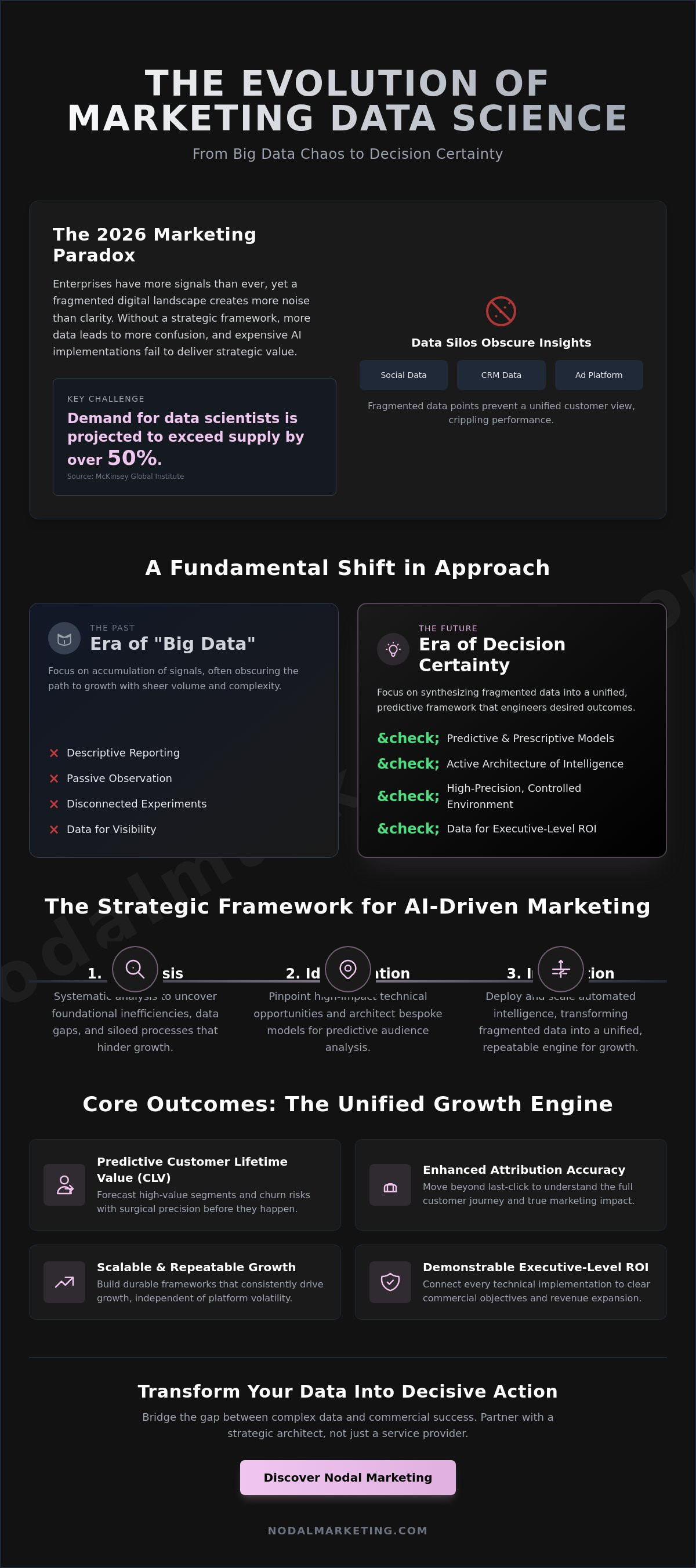
The era of collecting data for the sake of visibility is over. In 2026, the competitive advantage lies not in the accumulation of signals, but in the synthesis of fragmented marketing data into a singular, decisive framework. McKinsey Global Institute predicts that the demand for data scientists will exceed supply by over 50% this year, leaving many executives with powerful tools but no one to pilot them. This scarcity often results in AI implementations that feel like expensive experiments rather than strategic assets. You likely recognize that data silos continue to obscure the unified customer view you need to drive performance.
Elite data science consulting bridges this gap, moving your organization from descriptive analytics to predictive certainty. This article demonstrates how to transform disconnected data points into a unified engine for executive-level ROI. You'll discover a clear roadmap for AI-driven marketing that prioritizes attribution accuracy and scalable growth. We will explore the shift toward agentic engineering, the necessity of first-party data in a post-cookie world, and the precise methodology required to move from diagnosis to identification and finally to the integration of a model that predicts Customer Lifetime Value with surgical precision.
Key Takeaways
- Transition from the era of "Big Data" to the era of "Decision Certainty" by architecting a strategic framework for your marketing insights.
- Discover how elite data science consulting utilizes predictive modeling to forecast customer behavior and marketing outcomes with surgical precision.
- Identify why a "Strategic Translator" is the critical link between complex technical data modeling and high-level commercial execution.
- Implement a robust ROI framework that benchmarks success through the dual lenses of operational efficiency and revenue expansion.
- Prioritize synthesis as a core differentiator to find a strategic partner that values intellectual depth over generalist volume.
The Evolution of Data Science Consulting: From Observation to Certainty
The pursuit of "Big Data" has reached its logical conclusion. For years, enterprises focused on the volume, velocity, and variety of their information assets; however, the sheer mass of collected signals has often obscured rather than illuminated the path to growth. Modern data science consulting has moved beyond the passive observation of historical trends to the active architecture of decision intelligence. It is no longer enough to know what happened yesterday. The mandate for 2026 is to engineer what happens tomorrow. This evolution represents a fundamental shift from descriptive reporting to predictive and prescriptive models that treat marketing as a controlled, high-precision environment rather than a series of disconnected experiments.
External consultants provide an objective intellectual rigor that internal teams often lack. While in-house departments are frequently consumed by the immediate demands of campaign execution, a specialized partner brings the distance required to view the data ecosystem as a unified whole. By leveraging the foundations of data science, these experts translate raw processing power into a strategic engine for executive-level ROI. They don't just provide answers; they build the frameworks that make those answers repeatable and scalable.
The Crisis of Complexity in 2026 Marketing
Marketing in 2026 is defined by a paradox of abundance. We have more signals than ever, yet the digital landscape is increasingly fragmented across autonomous platforms and a complex patchwork of state-level privacy regulations. Without a structured strategic framework, additional data merely adds noise. More data doesn't lead to more clarity. It leads to confusion. Automated intelligence is now the primary mechanism for managing enterprise-scale marketing ecosystems, allowing for the granular audience analysis required to maintain a competitive edge in a crowded marketplace.
The Role of the Strategic Architect
A true data science consulting partner isn't a vendor of dashboards; they're a strategic designer of systems. This relationship moves beyond the transactional "service provider" model into a deeply integrated alliance. The process follows a disciplined tripartite structure: first, the diagnosis of systemic inefficiencies; second, the identification of high-impact technical opportunities; and finally, the integration of bespoke reporting solutions. This methodical thoroughness ensures that every technical implementation serves a clear commercial objective. By bridging the gap between marketing dynamics and technical execution, the consultant acts as a translator who transforms fragmented data into a unified engine for growth.
Core Components of Modern Data Science Consulting Services
Precision is the new currency. In an environment where every marketing dollar is scrutinized, the ability to forecast outcomes with mathematical certainty distinguishes market leaders from their struggling competitors. Modern data science consulting isn't a collection of disparate dashboards; it is a unified ecosystem designed to turn volatility into a controlled variable. By moving beyond the generic observations of standard analytics, elite consultancies deploy AI-powered insights that refine bidding and targeting in real-time. This approach bridges the gap between raw analytics and practical business strategy, ensuring that every technical maneuver serves a high-level commercial objective.
The synthesis of these services requires a disciplined tripartite structure: the diagnosis of systemic gaps, the identification of high-impact opportunities, and the seamless integration of automated intelligence. This methodical thoroughness allows for a level of granular audience analysis that traditional agencies cannot match. When data science consulting is executed correctly, it functions as a strategic translator, converting the chaotic signals of the digital landscape into a coherent roadmap for executive-level ROI.
Predictive Analytics for Customer Lifetime Value
Predictive modeling allows brands to identify high-value audience segments long before they reach the point of conversion. By analyzing historical behavior through advanced machine learning, we can forecast which users will likely become brand advocates and which are at risk of churning. Customer Lifetime Value (CLV) is the definitive North Star metric for marketing certainty in 2026. Proactive retention strategies are no longer reactive measures; they are preemptive strikes based on the mechanics of churn prediction. This shift allows for the allocation of resources toward the customers who drive the most significant long-term growth.
Architecting Unified Data Environments
The technical process of connecting CRM, PPC, and social data into a single source of truth is the foundation of modern marketing. Fragmented data leads to fragmented strategy. By architecting unified intelligence hubs, we eliminate the "dirty data" that undermines the performance of even the most sophisticated AI tools. This process involves more than just technical integration; it requires a sophisticated data strategy consulting approach that rejects the myth of "more data" in favor of data integrity. For organizations seeking to move from fragmented signals to structural clarity, investing in bespoke reporting solutions provides the necessary visibility to scale with absolute confidence.
The Strategic Translator: Bridging Marketing and Technology
Technical mastery is a baseline; it isn't a strategy. While many internal teams possess the mathematical proficiency to run complex models, they often struggle to influence the C-suite because their insights remain trapped in the language of the laboratory. High-level data science consulting acts as the essential bridge between these two worlds. It isn't merely about the code. It is about the translation of that code into commercial momentum. The consultancy serves as the vital link between the cold logic of the algorithm and the fluid, high-stakes demands of the marketplace.
The goal of a strategic partner is to synthesize fragmented signals into a coherent narrative for executive decision-making. In a landscape where AI tools are often deployed in isolation, the consultant ensures that every technological investment is architected toward a specific business outcome. By learning how to leverage data science services, organizations can finally dissolve the departmental divide that separates technical execution from marketing strategy. This integration allows for a unified engine of growth where data doesn't just exist; it leads.
From Technical Metrics to Commercial ROI
Executive leadership doesn't buy p-values or R-squared coefficients. They buy market share and revenue expansion. A strategic translator converts esoteric statistical indicators into the pragmatic language of the boardroom. This process requires aligning MarTech stacks with high-level KPIs and presenting data-driven strategies with visionary confidence. It is a shift from reporting on what happened to architecting what will happen. When technical execution mirrors commercial ambition, the results are both measurable and stable.
Methodical Integration vs. Fragmented Implementation
Generic, off-the-shelf automation often fails in complex enterprise environments because it lacks the nuance of specific market dynamics. We reject the "plug-and-play" mindset in favor of a disciplined tripartite approach: diagnosis of the current state, identification of unique growth levers, and integration of bespoke systems. This methodical thoroughness maintains intellectual rigor during the deployment of AI-powered insights. Data science consulting should never be a fragmented implementation; it must be a structural redesign that ensures your marketing ecosystem is both agile and resilient.
- Diagnosis: Auditing existing data silos to identify points of friction.
- Identification: Pinpointing the specific machine learning models that will drive the highest ROI.
- Integration: Embedding these tools directly into the daily operational workflow.
Evaluating ROI: A Framework for Data Science Consulting Success
ROI is not an afterthought; it's the structural blueprint upon which every engagement is built. Many organizations view data science consulting services as a variable cost, yet the most sophisticated enterprises recognize it as a capital investment in decision certainty. To evaluate success, we must establish measurable benchmarks before the first line of code is written. This requires a shift in perspective: we aren't chasing subjective value, but rather architecting measurable stability across the entire marketing ecosystem. A disciplined approach moves from the diagnosis of current inefficiencies to the identification of growth levers and finally to the integration of autonomous workflows that drive performance.
We distinguish between two primary forms of return. Efficiency ROI focuses on cost savings, such as the reduction of manual reporting hours and the elimination of redundant MarTech subscriptions. Growth ROI, however, is the true engine of enterprise expansion. It involves the synthesis of fragmented data to unlock new revenue streams and increase market share. The hidden cost of inaction is often the most significant line item on a balance sheet. In 2026, where market dynamics shift in hours rather than months, the price of suboptimal data decisions is quantified in lost opportunities and eroded brand equity. If you're ready to move beyond descriptive reporting, our bespoke reporting solutions provide the clarity needed to scale with absolute confidence.
Attribution Accuracy and Spend Optimisation
Ad platforms often function as black boxes, obscuring the true path to conversion. Sophisticated data science consulting replaces the guesswork of last-click models with multi-touch attribution that reflects the complexity of the modern customer journey. Predictive modeling ensures capital is allocated only to segments with the highest probability of conversion, effectively neutralizing the waste inherent in broad-spectrum targeting. By identifying high-performance signals in real-time, organizations can optimize their spend with surgical precision, ensuring that every dollar contributes to the North Star of Customer Lifetime Value.
Scaling Executive Performance
The primary barrier to scaling marketing budgets is often a lack of certainty. When the C-suite can't see the direct link between spend and revenue, they default to caution. Unified intelligence hubs provide the visionary confidence needed to approve larger, more ambitious budgets. This isn't just about better charts; it's about faster, more confident strategic pivots. AI-powered insights allow global operations to scale by automating the granular audience analysis that would otherwise require hundreds of manual hours. This structural efficiency allows leadership to focus on high-level strategy rather than technical troubleshooting.
- Efficiency ROI: Quantifiable cost savings through automation and technical consolidation.
- Growth ROI: Revenue expansion driven by predictive modeling and market share gains.
- Strategic ROI: Increased enterprise value through the ownership of a clean, unified data asset.
Choosing a Partner: Synthesis as the Ultimate Differentiator
Synthesis is the final frontier of marketing certainty. In an era where most organizations are drowning in signals but starved for clarity, the choice of a data science consulting partner becomes a foundational business decision. You aren't looking for a mere service provider who manages individual accounts; you're seeking a strategic designer capable of linking fragmented data points to create a unified whole. This requires a partner that values intellectual depth over generalist breadth. The most effective consultancies don't shout for attention. They project a sense of restrained power, rooted in the certainty of their technical mastery and commercial insight.
While generalist agencies often treat data as a secondary function of creative work, an elite consultancy views data as the primary architecture of growth. Nodal Marketing synthesizes disparate signals from PPC, social, and CRM systems into a unified intelligence hub. This isn't a "plug-and-play" solution. It's a bespoke structural redesign. By moving past the frantic, high-energy tactics of entry-level marketing, we focus on the methodical thoroughness required for enterprise-scale success. We don't just provide insights; we build the systemic frameworks that make those insights actionable and repeatable.
Key Questions for Prospective Data Science Firms
Interrogating a potential partner requires a focus on their strategic philosophy. Does the firm truly understand the nuance of AI performance marketing, or are they hiding behind technical jargon? You should demand a clear demonstration of how they move from raw data to measurable revenue growth. Their process for ensuring long-term technical stability and integration is the true test of their expertise. If their methodology isn't proprietary and disciplined, it won't survive the complexity of a 2026 marketing ecosystem.
The Nodal Marketing Advantage
Our commitment is to authoritative sophistication and measurable results. We bridge the departmental divide, acting as the strategic translator between your commercial ambitions and technical execution. This partnership model is grounded in intellectual rigor, ensuring that every AI-powered insight is anchored to a pragmatic business outcome. We don't just solve isolated problems; we identify systemic opportunities for expansion. By integrating these capabilities directly into your operational workflow, we help you build a data-first culture that serves as a permanent competitive moat. In a chaotic digital landscape, this level of structural clarity isn't just an advantage. It's an indispensable asset for those who value precision and stability above all else.
Mastering the Architecture of Decision Intelligence
The transition from reactive reporting to proactive architecture is the defining shift of the current era. By embracing a model that prioritizes the synthesis of fragmented signals, organizations move beyond the noise of the digital landscape. This approach ensures that technical mastery always serves commercial ambition, creating a unified engine for growth that's both measurable and resilient. You've seen how the strategic translator role and a disciplined ROI framework turn technical potential into executive-level certainty.
Success in 2026 requires more than just tools. It demands a specialized strategic partnership that can translate complex data into high-level strategy. Elite data science consulting provides the intellectual rigor necessary to scale global operations through AI-powered insights and bespoke reporting solutions for global brands. It's time to stop observing the market and start architecting its outcomes. Architect your marketing certainty with Nodal Marketing's Data Science Consulting. The future belongs to the disciplined; let's build your competitive moat together.
Frequently Asked Questions
What exactly does a data science consulting firm do for marketing?
A data science consulting firm architects the structural framework necessary to transform fragmented signals into strategic momentum. We don't just report on historical performance; we design systems that predict future outcomes with mathematical certainty. This involves a disciplined tripartite process: the diagnosis of existing data silos, the identification of high-impact opportunities, and the integration of automated intelligence into your daily operations. It's about building a unified engine that drives executive-level ROI through precision engineering.
How is data science consulting different from standard marketing analytics?
Standard analytics is primarily observational, focusing on descriptive reporting of what happened in past campaigns. In contrast, data science consulting is architecturally focused, utilizing predictive modeling and machine learning to engineer what will happen next. While analytics tells you which creative performed best last month, consulting builds the unified intelligence hubs that forecast Customer Lifetime Value and optimize global spend in real-time. It's the difference between looking in the rearview mirror and designing the engine.
When should an enterprise hire an external data science consultant?
An enterprise should seek external expertise when the complexity of their digital landscape exceeds the capacity of their internal reporting tools. If your data remains fragmented across disparate platforms or if your AI tools fail to deliver measurable growth, it's time for a specialized partner. External consultants provide the objective intellectual rigor and specialized technical lexicon required to bridge the gap between marketing dynamics and technical execution, especially when internal teams are consumed by daily campaign management.
How long does it typically take to see ROI from data science consulting?
Measurable improvements in operational efficiency often appear within the first 90 days of the integration phase. However, the full realization of growth ROI usually follows a steady, deliberate progression as models refine. This timeline accounts for the methodical thoroughness of the initial diagnosis and the technical setup of bespoke reporting solutions. While short-term optimizations are common, the ultimate goal of data science consulting is the creation of a permanent competitive moat through a unified data asset.
Can a data science consultancy help with MarTech integration?
Yes, architecting unified data environments is a core component of modern consulting services. We specialize in connecting disparate CRM, PPC, and social data sources into a single source of truth. This process ensures data integrity and eliminates the "dirty data" that often undermines automated bidding and targeting. By aligning your MarTech stack with high-level business goals, we transform fragmented tools into a cohesive, AI-powered insights engine that provides structural clarity for your entire organization.
What is the role of AI in modern data science consulting?
AI serves as the primary mechanism for managing enterprise-scale marketing ecosystems through automated intelligence. In 2026, we move beyond simple algorithms toward agentic engineering, creating autonomous workflows that adapt to market shifts in real-time. This technology allows for the granular audience analysis required to maintain a competitive edge. It isn't just about automation; it's about using machine learning to provide the visionary confidence needed to approve larger budgets and execute more ambitious strategic pivots.
How do I ensure data privacy and compliance during a consulting project?
Ensuring compliance requires a partner who understands the complex patchwork of state-level regulations and international mandates like the EU AI Act. We integrate privacy-enhancing technologies directly into the data architecture to allow for analysis without exposing sensitive personal information. This involves configuring systems to honor Global Privacy Control signals and ensuring that your data modeling remains transparent and explainable. Stability in 2026 depends on navigating these regulations with surgical precision and methodical thoroughness.
What metrics should I use to evaluate a data science partner?
You should evaluate a partner based on their ability to deliver both Efficiency ROI and Growth ROI. Look for measurable benchmarks such as improved attribution accuracy, reduced wasted ad spend, and the scaling of Customer Lifetime Value. A successful partnership is also defined by the depth of their proprietary methodology and their ability to act as a strategic translator for the C-suite. If they can't demonstrate a logical progression from raw signals to revenue, they are a vendor, not a consultant.