
Your growing data lake isn't an inherent asset; it's a liability that's likely eroding your profit margins. While the global data analytics market is projected to grow to $345.30 billion by 2030, most enterprises are drowning in noise rather than surfacing actionable intelligence. You've probably noticed that more sensors and more tracking haven't translated into more certainty. This is why specialized data strategy consulting has moved beyond simple IT support to become an architectural discipline. It's not about the volume of information you capture; it's about the precision with which you connect the dots.
It's exhausting to manage escalating MarTech spend that fails to bridge the gap between fragmented silos. You deserve a strategy that delivers predictive foresight instead of reactive spreadsheets. This guide will show you how to architect a unified intelligence hub that prioritizes data activation over mere accumulation. We'll explore why 73% of clients now demand outcome-based consulting models and how to navigate the 2026 regulatory environment, including the EU AI Act and updated CCPA mandates, to ensure your infrastructure is both compliant and transformative.
Key Takeaways
- Learn why accumulating massive data volumes often creates a "Noise Paradox" that obscures critical insights rather than clarifying them.
- Understand the difference between mere data science and specialized data strategy consulting, which focuses on activating information for measurable executive-level certainty.
- Avoid the "sunk cost" trap of expensive MarTech stacks by establishing a structural foundation that connects fragmented nodes into a unified intelligence hub.
- Discover why static roadmaps are obsolete in 2026 and how to prepare your infrastructure for the rise of Agentic AI and predictive foresight.
- Explore the Nodal methodology of diagnosing challenges and integrating solutions to transform your data from a liability into a high-ROI asset.
The Great Data Delusion: Why More Information Often Leads to Less Clarity
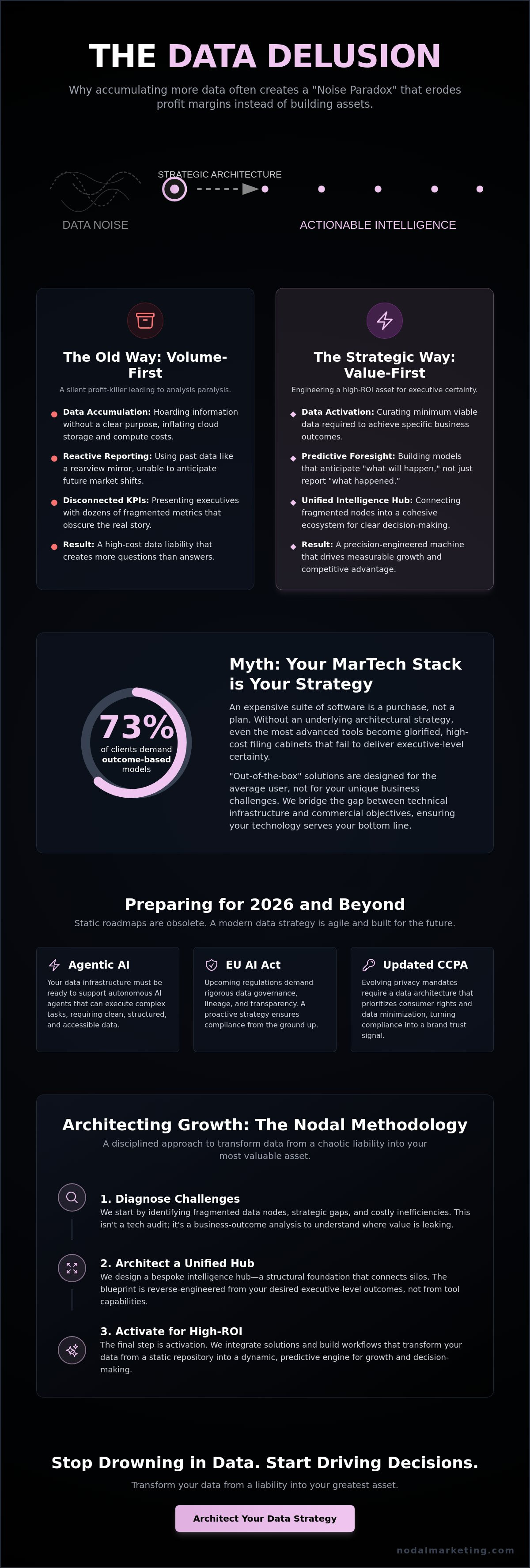
The belief that more data equals a sharper competitive edge is a fundamental misunderstanding of modern business intelligence. We call this the Noise Paradox. As the global data analytics market scales toward an estimated $345.30 billion by 2030, many organizations find themselves paralyzed by the very information meant to liberate them. True data strategy consulting isn't about building bigger buckets to catch more rain. It's an architectural discipline. We focus on connecting fragmented nodes into a unified intelligence hub that serves the executive suite with clarity, not just spreadsheets.
In 2026, being "data rich" is easy; being "insight wealthy" is rare. Most enterprises are currently drowning in the exhaust of their own operations. They capture every click, every hover, and every micro-interaction, yet they can't answer simple questions about customer lifetime value or attribution with any degree of certainty. This is where the Strategic Architect steps in. We don't just collect; we curate. We don't just store; we activate. Our role is to provide the intellectual rigor needed to transform a chaotic digital landscape into a structured ecosystem of growth.
The High Cost of Data Hoarding
Data hoarding is a silent profit killer. Redundant collection and "dirty data" do more than just clutter your dashboards; they actively inflate cloud storage costs and compute fees. When your infrastructure lacks a rigorous framework for data governance, you're essentially paying a premium to store digital trash. This leads to a dangerous state of analysis paralysis. When executives are presented with 50 disconnected KPIs, they often choose none. A "Volume-First" mentality assumes that the truth is hidden somewhere in the pile. A "Value-First" approach, which we champion, starts with the business outcome and reverse-engineers the minimum viable data required to achieve it. It's the difference between having a warehouse full of parts and a precision-engineered machine.
From Reactive Reporting to Predictive Foresight
Traditional reporting is a post-mortem. It tells you what happened last month, last week, or yesterday. In a landscape defined by rapid shifts, looking at past performance is like trying to drive a car by only looking in the rearview mirror. We're shifting the focus toward predictive foresight. This isn't just about knowing where you've been; it's about modeling where you're going. Intelligent Growth requires a move away from reactive "exhaust" data toward proactive intelligence. By identifying high-impact applications for your data early, we help you build an ecosystem that anticipates market movements. This transition from "what happened" to "what will happen" is the hallmark of a sophisticated data strategy that delivers measurable ROI and executive-level certainty.
Myth: Your MarTech Stack is Your Strategy
Many executives mistake an expensive suite of software for a robust data strategy. It's a costly error that often leads to a "sunk cost" trap. Buying the latest Salesforce module or an enterprise-level HubSpot instance isn't a strategy; it's a purchase. True data strategy consulting focuses on the underlying architecture that makes those tools functional. Without a structural foundation, even the most advanced platforms become glorified filing cabinets that consume budget without returning executive-level certainty.
You need experts who act as translators between marketing outcomes and technical infrastructure. This dual fluency is rare in a landscape saturated with generalist agencies. Most vendors lean too far into creative branding or too far into raw code, leaving a gap where strategy should live. Our approach sits at the intersection, ensuring that every technical node serves a commercial objective. If you aren't sure how your current stack directly supports your bottom line, it might be time to audit your bespoke reporting solutions to identify where the intelligence is leaking.
The Seduction of "Out-of-the-Box" Solutions
Standard SaaS dashboards are designed for the average user, which means they often ignore the specific nuances of your business model. Tool-first thinking prioritizes the platform over the problem, leading to generic insights that fail to drive growth. In enterprise environments, these "out-of-the-box" solutions lack the hyper-granular visibility required for precision decision-making. By following the core practices outlined in the Federal Data Strategy, we treat data as a strategic asset rather than a byproduct of your software. This requires moving beyond standard automation toward bespoke systems that mirror your unique organizational goals.
Architecting the Unified Intelligence Hub
The Unified Intelligence Hub serves as the central nervous system of your marketing ecosystem. It connects disparate data sources—including Paid Search, SEO, and CRM data—into a single, verifiable source of truth. This level of integration is essential for scaling ROI through an AI performance marketing agency. By centralizing your intelligence, you do more than just clean up your reporting. You prepare your infrastructure for the next evolution: Agentic AI. This ensures your foundation is ready for autonomous agents that can execute complex workflows with precision, moving your organization from reactive analysis to proactive market leadership.
The ROI Reality Check: Bridging the Gap Between Analytics and Action
"We already have analytics." It's a common refrain from executives who see their screens filled with charts but their bank accounts stagnant. However, as of May 2026, the gap between possessing data and generating profit has never been wider. While the global strategic consulting market has climbed to $77.53 billion this year, many firms still struggle to turn raw numbers into executive-level certainty. This is where data strategy consulting differs from simple technical implementation. It's the difference between owning a library and knowing how to write the book that changes the industry.
It's vital to distinguish between data science and data strategy. Data science provides the tools to process information; data strategy provides the architectural intent. One builds the algorithm, while the other ensures the algorithm serves a commercial purpose. This distinction is at the heart of what UC Berkeley Executive Education defines as using data for competitive advantage. Without a strategy, your data science team is just solving puzzles in a vacuum. You don't need more models; you need the right models integrated into your decision-making loop.
Our Nodal approach focuses on identifying hyper-granular audience segments that standard, out-of-the-box tools routinely miss. By connecting fragmented dots across your SEO, PPC, and CRM, we reveal hidden revenue streams. It's about finding the specific nodes where customer intent meets your unique value proposition. This isn't just about broader buckets. It's about the precision required to isolate high-intent users within a saturated digital landscape, transforming "noise" into a predictable pipeline of growth.
Generalist Agencies vs. Strategic Architects
Generalist agencies operate with a "vendor" mindset, focusing on execution and checking boxes. They struggle in complex data environments because they lack the technical depth to see the whole ecosystem. In contrast, a Strategic Architect acts as a growth partner. We bring intellectual rigor to your marketing spend, ensuring that every dollar is backed by data science rather than creative guesswork. This shift is why 73% of clients now prefer value-based pricing models over traditional hourly rates, as reported in April 2026. They want results, not just hours logged. They want a partner who is deeply integrated, not a detached third party.
Measuring What Matters: Beyond Vanity Metrics
Board-level decisions aren't driven by click-through rates or social impressions. They're driven by Executive KPIs like customer acquisition cost (CAC) efficiency and predictive lifetime value. Effective data strategy consulting solves the attribution nightmare by providing a unified view of the customer journey, even across fragmented platforms. We move you past the "exhaust" of past performance into a state of predictive foresight. Marketing ROI is the product of data fluency and technical execution.
Preparing for Agentic AI: Why Static Roadmaps Are Obsolete in 2026
A static, three-year roadmap is no longer a strategic asset; it's a blueprint for obsolescence. As of May 2026, the digital landscape has shifted from generative assistance to agentic autonomy. Agentic AI represents a fundamental evolution where AI systems don't just suggest content but execute complex, multi-step workflows across your entire marketing ecosystem. This rapid pace of change is why a strategy drafted in 2025 is already a relic. Modern data strategy consulting has transitioned from a one-off project into a continuous architectural partnership that prioritizes agility over fixed milestones.
We've entered an era where "Dual Expertise" is the only currency that matters. You cannot architect a successful data environment with a partner who only understands marketing dynamics or only understands raw data science. You need a Strategic Architect who speaks both languages fluently to manage the intersection of human intent and machine execution. This requires a shift toward "Dynamic Roadmapping," a methodology where the strategy evolves in real-time as new AI models and regulatory frameworks, such as the EU Data Act and the latest 2026 US state AI statutes, come into full effect. If you're ready to move beyond static planning, explore our bespoke reporting solutions to build a foundation for autonomous growth.
The Shift to Autonomous Optimization
By mid-2026, over 60% of top strategy consulting firms have integrated AI-driven services to manage autonomous optimization. These AI agents are now capable of handling hyper-granular bidding, real-time creative testing, and sophisticated audience refinement without manual intervention. However, these agents aren't magic; they're only as effective as the data they consume. Without a "clean" and "strategized" foundation, you risk the "Black Box" effect, where autonomous systems make high-stakes decisions based on fragmented or biased inputs. Effective strategy provides the guardrails and the high-quality data fuel these agents require to deliver executive-level certainty rather than unpredictable fluctuations.
Future-Proofing Your Data Infrastructure
Architectural flexibility is the only hedge against the rapid technological shifts expected in 2027 and 2028. Future-proofing your infrastructure means building an ecosystem that can swap out models and integrate new data nodes without a total system overhaul. We utilize predictive modeling to forecast market trends, allowing our partners to lead rather than just react. This approach embodies "quiet power." We don't chase every hype-heavy tech trend; we build the disciplined, forward-thinking foundations that allow for transformative growth. By focusing on depth over breadth, we ensure your organization remains indispensable in an increasingly automated world.
Architecting Your Growth: The Nodal Approach to Data Strategy
Most consulting firms leave you with a thick PDF of recommendations that gather digital dust while your competitors pull ahead. Nodal Marketing operates differently. We aren't just advisors; we're Strategic Architects who build the infrastructure of your future. Our approach to data strategy consulting is rooted in the "Nodal" concept, the disciplined practice of connecting fragmented data points to create a unified, high-functioning whole. We don't just provide a plan. We deliver a functioning ecosystem that transforms raw technical capabilities into executive-level certainty.
Success in a 2026 market requires a rare kind of fluency. You need a partner capable of translating the high-level ROI requirements of a CMO into the granular technical requirements of a CTO. This dual expertise allows us to serve as an elite growth partner, moving your organization from a state of reactive reporting to one of predictive foresight. By bridging the gap between marketing dynamics and data science, we ensure your investments in SEO, PPC, and Paid Social are backed by structural rigor rather than creative guesswork.
The Nodal Methodology: Precision Over Volume
Our methodology is a tripartite process designed to eliminate waste and maximize intelligence. It begins with the Diagnose phase, where we identify the specific "noise" sabotaging your ROI and isolate the high-impact nodes within your current data streams. We don't believe in collecting everything; we believe in collecting what matters. The second phase is Identify and Integrate. Here, we build your Unified Intelligence Hub, connecting disparate sources into a single source of truth. This isn't a static roadmap but a live infrastructure powered by our proprietary platform, "Connect."
The final phase is Continuous Optimization. In an era where 60% of top firms are already utilizing AI-driven services, we leverage Agentic AI and advanced data science to ensure your strategy evolves in real-time. We don't just set up a system and walk away. We provide the ongoing intellectual rigor required to navigate a landscape defined by rapid technological shifts and complex regulatory mandates like the EU Data Act.
Why Certainty is the Ultimate Competitive Edge
The difference between market leaders and those who merely compete is the quality of their foresight. In a saturated digital environment, guesswork is a liability you can't afford. You deserve a partner that values depth over breadth, one that views your data infrastructure as a precision-engineered machine rather than a collection of isolated tools. It's time to move beyond the "more data" myth and start architecting for measurable results. If you're ready to lead your industry through intelligent growth, Schedule a consultation with our Strategic Architects to begin your transformation.
From Data Accumulation to Architectural Intelligence
The transition from a "more data" mentality to a "more intelligence" architecture is the defining shift of 2026. You've seen why bloated MarTech stacks and static roadmaps fail to deliver the executive-level certainty required in an era of Agentic AI. Success now depends on the precision of your infrastructure and the fluency with which you connect fragmented nodes into a unified hub. Effective data strategy consulting provides the structural rigor needed to turn your information from a costly liability into a high-ROI asset.
With a global presence spanning London, HK, and NYC, Nodal Marketing offers the bespoke reporting and deep technical expertise necessary for enterprise growth. Our proprietary "Connect" platform serves as the engine of this transformation; it ensures your decision-making is rooted in predictive foresight rather than reactive reporting. It's time to stop hoarding noise and start building a foundation that scales. Architect your certain growth with Nodal Marketing and lead your market with unprecedented clarity.
Frequently Asked Questions
What is the difference between data strategy and data analytics?
Data strategy is the architectural blueprint, while data analytics is the technical execution. Strategy defines the "why" and the structural intent of your information ecosystem; analytics simply processes the "what" of past events. Specialized data strategy consulting ensures that your technical outputs aren't just accurate, but are fundamentally aligned with executive-level commercial objectives.
How long does a typical data strategy consulting engagement take?
Foundational architectural projects typically span 12 to 24 weeks depending on the complexity of your silos. As of April 2026, 73% of clients prefer outcome-driven pricing models over hourly rates, which has shifted the industry toward faster, high-impact deployments. We focus on diagnosing challenges and integrating solutions in phases to ensure you see measurable ROI throughout the transition.
Do we need to replace our current tech stack for a new data strategy?
You don't necessarily need to replace your existing tools to achieve structural integrity. We focus on building architectural flexibility, which involves connecting your current CRM, PPC, and SEO nodes into a Unified Intelligence Hub. Our approach is designed to rescue you from the "sunk cost" trap by making your current MarTech investments work with unprecedented precision.
How does data strategy consulting directly impact PPC and SEO performance?
Strategy identifies hyper-granular audience segments that standard, out-of-the-box algorithms often miss. By data strategy consulting, we bridge the gap between fragmented search data and customer intent, allowing for more accurate attribution and predictive bidding. This move from reactive reporting to predictive foresight directly reduces customer acquisition costs and maximizes organic visibility.
Is data strategy consulting only for large enterprise organizations?
Strategic architecture is a necessity for any brand managing fragmented data, regardless of its size. While the global data analytics market is scaling toward $345.30 billion by 2030, mid-market firms often face the most significant risks from the "noise paradox." Any organization that values depth over breadth requires a disciplined foundation to compete in a saturated digital landscape.
What are the first signs that our current data strategy is failing?
Escalating MarTech spend with diminishing returns is the most common sign of a failing infrastructure. If your leadership team is presented with disconnected KPIs that lead to analysis paralysis, your current strategy is likely producing noise rather than intelligence. Data silos that prevent a unified view of the customer journey indicate that your data is currently a liability rather than an asset.
How does Nodal Marketing handle data privacy and security during integration?
We maintain strict adherence to the EU AI Act and the specific 2026 statutes enforced in states like California, Texas, and Colorado. Our proprietary "Connect" platform utilizes privacy-by-design principles to ensure all data-use disclosures and algorithmic logic are transparent and compliant. We provide the expert guidance needed to navigate a complex regulatory environment without sacrificing technical edge.
What is Agentic AI and why does it matter for my 2026 marketing plan?
Agentic AI represents a shift toward autonomous systems that can execute multi-step workflows across your marketing ecosystem. Unlike traditional AI, these agents don't just suggest actions; they perform them. To succeed in 2026, your infrastructure must be clean and strategized to fuel these agents. Without a solid foundation, autonomous optimization becomes a "black box" that lacks strategic oversight.