
The era of the "gut-feeling" executive is over, replaced by the strategic architect who treats information not as a byproduct, but as the primary infrastructure for growth. While the data science platform market is projected to reach $204.05 billion in 2026, many organizations still struggle with fragmented silos that prevent a single source of truth. You've likely felt the sting of high ad spend paired with diminishing returns, where the inability to predict customer lifetime value makes every campaign feel like a calculated risk rather than a guaranteed investment.
This guide shows you how to leverage advanced data science services to transform these disconnected points into a unified intelligence hub. We'll provide a clear roadmap for MarTech integration that moves beyond simple prediction toward real-time decision optimization. You'll learn to architect a growth engine that offers predictive foresight into market shifts, replacing marketing guesswork with the quiet power of mathematical certainty.
Key Takeaways
- Identify the technical boundary where standard analytics ends and machine learning begins to drive marketing performance.
- Learn how Agentic AI serves as the infrastructure to unify fragmented data silos into a single source of truth.
- Analyze the strategic trade-offs between internal recruitment and external data science services to ensure a cross-pollinated perspective.
- Follow a methodical five-step roadmap to audit your existing ecosystem and define measurable growth objectives.
- Explore the Nodal "Connect" methodology to bridge the gap between marketing dynamics and technological execution.
What are Data Science Services in a Modern Marketing Context?
In the current digital climate, data science services are not merely a collection of tactical tools. They represent the strategic intersection of machine learning, statistical modelling, and marketing strategy. While standard analytics platforms tell you what happened yesterday, they often fail in the high-velocity digital environments where consumer behavior shifts in real-time. Descriptive analytics might show that your cost-per-acquisition rose by 14% over the last quarter, but it lacks the predictive foresight to prevent that trend from continuing. Modern Data Science shifts the focus from historical reporting to future-state certainty. Marketing data science is the architectural process of converting raw signals into revenue-driving intelligence.
The distinction between a generalist approach and a data-driven architecture is found in the ability to handle complexity. Organizations today are drowning in noise, yet they're starving for actionable clarity. By the end of 2025, 19 US states enforced comprehensive privacy laws, making first-party data more valuable than ever. Standard tools struggle to synthesize these fragmented signals into a coherent narrative. You need a framework that doesn't just collect data, but interprets it through the lens of business growth, ensuring every decision is backed by intellectual rigor.
The Core Components of an Enterprise Data Science Offering
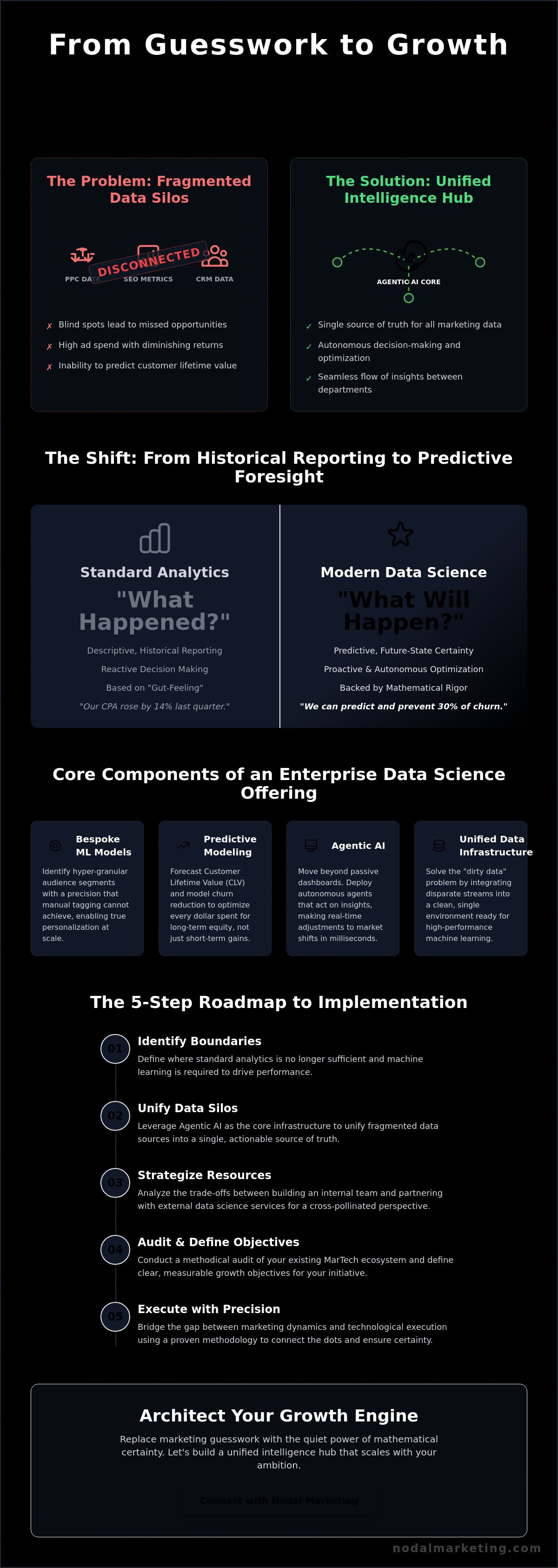
At the enterprise level, these offerings move beyond basic spreadsheets. They involve bespoke machine learning models that identify hyper-granular audience segments, allowing for precision that manual tagging cannot reach. Predictive modelling for Customer Lifetime Value (CLV) and churn reduction ensures that every dollar spent is optimized for long-term equity. Rather than reacting to customer loss, you can anticipate it and intervene before the churn occurs. Agentic AI further transforms these insights into action; it moves your team away from passive dashboards and toward autonomous marketing optimisations that respond to market shifts in milliseconds.
Moving Beyond the Generalist Agency Model
Most generalist agencies lack the technical rigor required to manage these complex ecosystems. They often provide surface-level insights because they don't possess dual fluency in both marketing dynamics and advanced AI technology. Employing specialized data science services through an AI Performance Marketing Agency: Scaling Executive ROI through Data Science ensures that your growth partner understands the underlying data architecture as well as the creative strategy. This level of precision is the difference between a vendor that reports on noise and a partner that architects certainty. It's about building a foundation that scales with your ambition, rather than a temporary fix for a permanent problem.
The Anatomy of a Unified Intelligence Hub
A unified intelligence hub isn't just a collection of dashboards; it's a living ecosystem where every data point informs the next. Most organizations operate in silos, where PPC results, SEO metrics, and CRM data exist in isolation. This fragmentation creates blind spots that lead to inefficient spend and missed opportunities. By utilizing comprehensive data science services, you can bridge these gaps, creating a single source of truth that powers autonomous decision-making. This hub serves as the central nervous system for your marketing operations, ensuring that insights flow seamlessly between departments.
Agentic AI serves as the connective tissue in this architectural framework. Unlike passive reporting tools that require manual interpretation, Agentic AI acts on the intelligence it receives. It connects the dots between your ad platforms and web analytics, making micro-adjustments to bids or audience targeting based on predicted outcomes. This shift from manual, hindsight-heavy reporting to real-time, bespoke intelligence hubs allows your team to focus on high-level strategy rather than data entry. It's a move from observing the market to actively shaping your position within it.
Architecting the Data Infrastructure
The foundation of marketing certainty lies in the structural integrity of your data. Before you can deploy high-performance machine learning models, you must solve the "dirty data" problem. In 2026, with cloud-based deployment accounting for 66% of the market share, the focus has shifted to integrating disparate streams into a unified environment. This means connecting your Paid Social platforms directly to your backend CRM. It's about ensuring that the signals driving your Data Science for Marketing efforts are accurate and real-time. Without this architectural rigor, even the most advanced AI will produce flawed outputs. Selecting the right MarTech stack is less about individual features and more about long-term scalability and interoperability.
Predictive vs. Reactive Marketing Strategies
Reactive marketing is a defensive posture. It's the process of looking at last month's performance and trying to fix what went wrong. Predictive modelling, powered by data science services, allows you to adopt an offensive stance. You can proactively allocate budgets across channels based on where the market is moving, not where it was. This foresight helps identify "hidden" audience segments, those hyper-granular groups that your competitors are overlooking because they're relying on standard, broad-stroke analytics. For the executive, this provides a level of certainty that is otherwise unattainable in a noisy digital landscape. If you're ready to move beyond fragmented reporting, it might be time to architect a unified hub that scales with your ambition.
Buy vs. Build: Choosing a Data Science Consulting Firm
Deciding whether to assemble an internal team or engage external data science services is a foundational choice that determines your speed to market. While the allure of in-house control is strong, the hidden costs often outweigh the benefits. In 2026, data science consulting rates range from $40 to $500 per hour, reflecting a highly competitive talent market where the cost of recruitment, retention, and maintaining a $204 billion-market-tier infrastructure is substantial. Choosing an external partner provides a cross-pollinated perspective; they bring insights from multiple industries that an internal team, focused on a single product line, might never encounter.
Intellectual rigor should be the primary filter for evaluation. It's not enough for a firm to have proficiency in Databricks or Google Vertex AI; they must possess the persona of a Strategic Architect. They need to understand your business objectives as deeply as they understand your Python scripts. Many organizations fail to see results because of a disconnect between technical execution and strategic vision. As highlighted in Harvard Business Review's analysis of Marketing AI, the failure to integrate these systems into a broader business strategy is why many investments underperform.
Evaluating Technical Expertise and MarTech Fluency
A true growth partner acts as a translator between the CMO's goals and the data engineer's code. You should look for bespoke reporting solutions that align with your specific KPIs rather than generic, off-the-shelf dashboards. In a globalized economy, ensure your partner has the experience to manage complex, multi-region data environments. They must be fluent in the nuances of international privacy regulations, such as the Colorado Artificial Intelligence Act (CAIA) taking effect June 30, 2026, or the EU AI Act's August 2, 2026 mandates. This dual fluency ensures your architecture is both powerful and compliant.
ROI of Expertise: Why Precision Beats Volume
Precision is the hallmark of elite data science services. Standard platform automation often prioritizes volume, but specialized AI-driven bidding focuses on high-value outcomes. While generalist agencies might overlook subtle inefficiencies in your attribution model, a dedicated consultancy identifies these leaks to preserve your margins. This is why a project-based setup often provides more long-term value than a perpetual management retainer. It focuses on building a robust, self-sustaining architecture rather than just maintaining the status quo. You don't just want a vendor to manage your spend; you want an architect to build your certainty.
How to Implement Data Science Services: A 5-Step Roadmap
Implementing an advanced intelligence framework is not a software project; it's a growth roadmap. To transition from fragmented noise to mathematical certainty, your organization must follow a methodical progression. This journey moves from the foundational cleanup of information to the deployment of autonomous systems that drive measurable ROI. By treating data science services as a strategic architecture, you ensure that every technical integration serves a specific business outcome. This is how you move beyond the limitations of standard reporting to build a self-optimizing engine.
This structured approach to planning is vital in any complex transition. For example, Aging in Place North Carolina provides strategic planning and assessments to help seniors navigate the complexities of living independently, ensuring that every modification serves a specific safety outcome.
- Step 1: The Ecosystem Audit. Begin by diagnosing the structural integrity of your current data. You must identify silos where information is trapped and pinpoint "dirty data" points that could skew machine learning outputs.
- Step 2: Defining Growth Objectives. Precision requires a target. You need to define specific, quantifiable goals, such as reducing Customer Acquisition Cost (CAC) by 20% through predictive modelling or increasing retention by identifying churn signals before they manifest.
- Step 3: Architecting the Unified Intelligence Hub. This involves the physical and logical connection of disparate sources. You are building the infrastructure that allows your CRM, ad platforms, and web analytics to communicate in a single, clean environment.
- Step 4: Deployment of Agentic AI. With the hub established, you can deploy custom machine learning models. These Agentic AI systems perform real-time optimisation, adjusting bids and segments faster than any human operator could.
- Step 5: Executive Transparency. The final step is integrating bespoke reporting. This ensures that the complexity of the underlying data is translated into clear, actionable insights for executive-level tracking.
Diagnosing Challenges and Identifying Applications
Success begins with a rigorous "data health check" before you invest in advanced AI. You don't need more data; you need data that is reliable. By identifying the "low-hanging fruit," such as predictive bidding for high-value search terms, you can deliver immediate ROI while the broader architecture is being finalized. Setting realistic benchmarks is essential during this phase. It's about establishing a baseline of truth so that the subsequent improvements in performance are both visible and undeniable.
Integrating Solutions into Daily Workflows
The most sophisticated hub is useless if it remains an island. Your marketing team must become fluent in the new intelligence hub to move from "gut feel" to data-backed certainty in weekly strategy meetings. This cultural shift is what allows for continuous optimisation in a post-setup environment. When everyone speaks the same language of data, decisions become faster and more precise. If you are ready to stop guessing and start scaling, you can request a strategic data audit to begin your implementation journey.
The Nodal Approach: Connecting the Dots for Certainty
Nodal Marketing operates at the critical intersection of technical infrastructure and commercial strategy. We don't just provide data science services; we architect the foundations of your future growth. In a market projected to reach $631.09 billion by 2030, the distinction between leaders and followers lies in the ability to bridge the gap between complex algorithms and marketing dynamics. Our proprietary platform, "Connect," serves as the catalyst for this transformation, unifying fragmented signals into a coherent, high-velocity intelligence hub. We don't just compete; we lead by ensuring your data is a strategic asset rather than a liability.
Our dual expertise eliminates the friction often found between generalist agencies and technical consultancies. We speak the language of the CMO while managing the technical rigour of Agentic AI. This dual fluency ensures that your data isn't just "clean," but commercially relevant. We provide the foresight necessary to lead in a saturated landscape, replacing the noise of entry-level digital marketing with the quiet power of mathematical certainty. By connecting the dots between your CRM, ad platforms, and market shifts, we transform raw signals into a unified growth engine that operates with unprecedented precision.
Visionary Confidence Rooted in Intellectual Rigour
Enterprise brands trust us because our methodology is grounded in measurable ROI, not speculative hype. We've helped organizations scale global ad spend efficiently by moving from descriptive reporting to predictive foresight. This methodical approach to diagnosing challenges and integrating solutions ensures that your marketing ecosystem remains resilient against sudden market shifts. It's about building a legacy of growth that's structured, earned, and entirely predictable. Our commitment to intellectual rigour means we value depth over breadth, positioning ourselves as an indispensable part of your executive team.
Your Growth Partner in the AI Revolution
The shift toward operationalized AI requires more than a third-party vendor; it demands a deeply integrated partner. We don't shout about potential; we deliver results through disciplined execution and architectural excellence. As global regulations like the Colorado Artificial Intelligence Act (CAIA) redefine the landscape by June 30, 2026, having a partner that understands both compliance and performance is indispensable. It's time to move beyond the frantic pace of the "noisy" digital world and adopt a posture of visionary confidence. You can enquire about our bespoke Data Science & Analytics implementation to begin architecting your marketing certainty today.
Architecting a Future of Marketing Intelligence
The path to marketing certainty isn't found in the volume of your data, but in the integrity of your architecture. We've explored how a unified intelligence hub transforms fragmented silos into a single source of truth, allowing Agentic AI to drive real-time optimizations. By leveraging specialized data science services, you move beyond the noise of standard analytics and adopt a posture of predictive foresight. This shift ensures that every marketing dollar is an investment in measurable growth rather than a calculated risk.
Nodal Marketing, founded in 2018, operates as an independent consultancy with a global presence in London, NYC, and Hong Kong. We specialize in the Strategic Architecture of Agentic AI and Unified Intelligence Hubs, focusing exclusively on delivering executive-level ROI. Our deep technical fluency allows us to act as the bridge between marketing dynamics and technological execution. It's time to stop reacting to market shifts and start shaping them through mathematical rigor. You can architect your growth with Nodal Marketing’s data science services today. Build the foundation your ambition deserves.
Frequently Asked Questions
What are the most common use cases for data science services in marketing?
Data science applications center on high-impact strategic outcomes. Common cases include hyper-granular audience segmentation, predictive modeling for Customer Lifetime Value (CLV), and churn reduction. By the end of 2025, organizations using these methods saw better resource allocation by identifying high-value cohorts before they converted. It's about moving from broad-stroke targeting to surgical precision in every campaign.
How does data science differ from standard marketing analytics?
Standard analytics focus on descriptive reporting, whereas data science services provide predictive and prescriptive foresight. Traditional tools tell you what happened last month. Data science uses machine learning to tell you what will happen next and how to optimize for it. This architectural shift allows you to stop reacting to historical noise and start shaping future market share.
Is our data "ready" for data science and AI implementation?
Readiness is determined through a rigorous data health check rather than the sheer volume of information you possess. Most enterprises struggle with "dirty data" and fragmented silos that obscure the truth. We begin by auditing your ecosystem to ensure your foundational signals are clean. If your infrastructure is cloud-based, which accounts for 66% of the market in 2026, you're likely positioned for rapid integration.
How long does it take to see ROI from a data science project?
ROI typically manifests in two stages: immediate tactical wins and long-term architectural gains. You can often see improvements in bid efficiency within the first 90 days by deploying predictive models on "low-hanging fruit." Full-scale transformation of your marketing ROI requires a deeper integration of a unified intelligence hub. This creates a self-sustaining growth engine that compounds value over several quarters.
What is the difference between a generalist agency and a data science consultancy?
Generalist agencies prioritize execution volume, while a data science consultancy focuses on strategic architecture and technical rigor. Many agencies lack the dual fluency required to translate complex code into CMO-level business objectives. A consultancy acts as an elite growth partner, building bespoke solutions rather than relying on off-the-shelf platform tools. It's the difference between a vendor and a strategic architect.
Can data science services help with multi-channel attribution challenges?
Yes, data science solves attribution by connecting disparate dots into a unified environment. Standard models often fail because they can't account for the non-linear nature of modern customer journeys. By architecting a single source of truth, we eliminate the blind spots between your CRM, Paid Social, and Search data. This provides the mathematical certainty needed to allocate budgets where they actually drive incrementality.
How do you ensure GDPR and data privacy compliance in AI models?
Compliance is architected into the model's foundation through robust governance and transparency protocols. With the Colorado Artificial Intelligence Act (CAIA) taking effect June 30, 2026, and the EU AI Act mandates on August 2, 2026, regulatory scrutiny is at an all-time high. We ensure every model adheres to these specific statutes. Our approach prioritizes data integrity and privacy as prerequisites for any AI-driven strategy.
What is Agentic AI and how does it apply to performance marketing?
Agentic AI refers to autonomous systems that move beyond passive dashboards to perform real-time marketing optimizations. Unlike standard AI that requires human intervention, agentic systems act as the connective tissue between your data and your ad platforms. They identify shifts in market dynamics and adjust bids or segments in milliseconds. This provides a level of foresight and speed that manual operations simply can't match.