
The era of treating AI as a collection of disconnected productivity hacks has ended; the future belongs to those who architect a unified intelligence layer. While 88% of digital marketers now use AI in their daily tasks, most remain trapped in fragmented data silos that obscure the path to actual revenue. You've likely seen your ad spend drift due to poor predictive modeling or struggled to prove the ROI of complex AI investments to an executive board that demands precision over potential. It's a common frustration to feel that your technology stack is a series of isolated islands rather than a cohesive engine.
This guide provides the strategic framework to transform your ai driven marketing from a series of automated tasks into a predictive powerhouse. You'll learn how to move beyond basic automation to build a system that identifies high-value behaviors, synthesizes disparate data streams, and finally links every marketing activity to measurable revenue. We will outline a clear roadmap for integration that replaces guesswork with granular audience analysis and bespoke reporting solutions. Our approach moves from the diagnosis of current inefficiencies to the identification of predictive triggers and finally to the integration of a unified intelligence model that secures your commercial future.
Key Takeaways
- Shift from reactive automation to systemic intelligence by adopting probabilistic machine learning models that evolve alongside your customer data.
- Architect a unified data ecosystem where ai driven marketing transforms fragmented signals into clear, high-value audience segments.
- Avoid the common trap of tool proliferation by focusing on a central intelligence layer that eliminates data silos and prevents wasted ad spend.
- Follow a structured five-step framework to audit your current data health and align AI capabilities with executive-level revenue targets.
- Bridge the gap between commercial vision and technical execution through bespoke reporting that links complex marketing activity to measurable business growth.
The Evolution of Marketing Intelligence: From Automation to AI-Driven Synthesis
The transition from rule-based automation to true machine learning marks a fundamental pivot in how brands interact with the digital economy. While legacy systems relied on rigid "if-then" logic to execute repetitive tasks, modern Artificial intelligence marketing (AI marketing) operates on probabilistic models that learn and adapt in real-time. It is not about pre-programmed responses; it's about an architecture that anticipates intent. By 2026, the era of "isolated AI", where a single tool manages a single channel, has been superseded by systemic intelligence. This involves a unified framework where every data point informs the entire ecosystem, moving the executive focus from reactive analytics that explain what happened to predictive forecasting that dictates what will happen next.
This evolution allows organizations to bridge the historical gap between commercial dynamics and technical execution. Instead of marketing teams working in a vacuum, ai driven marketing acts as a translator, converting complex data science into actionable revenue strategies. With the AI marketing industry projected to reach $107 billion by 2028, the shift toward synthesis is no longer a theoretical advantage. It is a structural necessity for any brand aiming to maintain a competitive edge in an increasingly automated marketplace.
The Three Pillars of Modern AI Marketing
- Data Orchestration: This is the sophisticated process of linking fragmented touchpoints across the customer journey into a single source of truth. It's not about collecting more data; it's about ensuring that data is connected and accessible.
- Algorithmic Decisioning: We move beyond manual bidding and static rules. By utilizing real-time performance optimization, the system makes granular adjustments to budgets and targeting that human operators cannot replicate at scale.
- Predictive Synthesis: This involves using machine learning to forecast Customer Lifetime Value (CLV) and churn. Data shows that AI-assisted personalization campaigns are delivering an average of 57% higher CLV compared to non-personalized efforts.
Why Traditional Digital Marketing is Reaching Diminishing Returns
The rising cost of customer acquisition in non-AI-optimized channels has created a margin squeeze that traditional methods cannot alleviate. Manual audience segmentation is simply too slow to keep pace with the granular consumer shifts occurring in 2026. Brands no longer seek mere visibility. They demand "Marketing Certainty." In a volatile global economy, the ability to synthesize disparate data into a unified intelligence hub provides the stability required for long-term growth. Traditional marketing is a game of averages; ai driven marketing is a discipline of precision. We move from the diagnosis of current inefficiencies to the identification of high-value triggers and finally to the integration of systems that link every dollar spent to a measurable executive outcome.
The Mechanics of an AI-First Marketing Engine: Data, Models, and Action
Constructing a functional intelligence layer requires more than the adoption of disparate tools; it demands a rigorous hierarchy of information. At the base of this structure lies raw, unstructured data. This fuel must be refined through unified hubs before it can ever manifest as executive insights. While generalist agencies might focus on the creative output of generative tools, the strategic designer understands that true ai driven marketing relies on the underlying data science. It is the difference between a superficial facade and a structurally sound engine that powers every commercial decision.
Machine learning models excel where manual analysis inevitably falters. Human analysts can identify broad trends, yet they lack the cognitive bandwidth to process the millions of micro-signals that define modern consumer behavior. By deploying sophisticated algorithms, brands can identify high-value audience segments that remain invisible to the naked eye. Simultaneously, Natural Language Processing (NLP) provides the linguistic mastery required to map customer intent and sentiment across thousands of touchpoints. This synthesis of "who" and "why" transforms marketing from a guessing game into a disciplined execution of probability.
Data Orchestration: The Foundation of Intelligence
The primary technical challenge in 2026 remains the "Unified Intelligence Hub." Most enterprise brands suffer from fragmented data silos where CRM records, web analytics, and ad platform metrics never speak the same language. Data orchestration is the architectural prerequisite for AI success. By using advanced analytics to clean and normalize "dirty data," organizations ensure their machine learning models aren't learning from noise. This process moves a brand from a state of diagnosis to one of total integration, creating a single source of truth that feeds the entire MarTech stack.
From Insights to Execution: The Feedback Loop
Once the foundation is secure, the focus shifts to the feedback loop. AI-powered insights don't just sit in a report; they inform real-time bidding in Paid Search (PPC) and granular targeting in Paid Social. This transition from static, monthly reporting to dynamic, bespoke reporting solutions allows for immediate tactical pivots based on live performance data. For organizations looking to move beyond surface-level metrics, our Data Science Consulting Services provide the technical roadmap necessary to bridge the gap between commercial vision and algorithmic precision. The result is a system where every automated action is anchored in measurable revenue growth.
Beyond the Toolset: Why Fragmented AI Implementation Fails Enterprise Brands
The primary inhibitor of marketing maturity in 2026 isn't a lack of technology; it's the proliferation of it. Many enterprise brands have fallen into the 'Shiny Object' trap, believing that a collection of high-energy SaaS subscriptions constitutes a strategy. It doesn't. True ai driven marketing is not about the volume of tools you possess, but the depth of synthesis you achieve. When tools remain isolated, they create fragmented intelligence that obscures rather than illuminates. This leads to data leakage and massive attribution blind spots that hide your true ROI from executive view.
A common objection we encounter is the belief that a brand's data isn't "ready" for AI. This perspective misinterprets the role of modern data science. You don't wait for a pristine ecosystem to begin; you use advanced analytics to architect one. Generalist digital agencies often lack the technical rigor to solve this, focusing instead on creative output while ignoring the underlying structural decay. Solving the "dirty data" problem requires a methodical tripartite process: moving from the diagnosis of existing silos to the identification of predictive triggers and finally to the integration of a unified intelligence hub.
The Myth of 'Plug-and-Play' AI
Generic AI tools offer the illusion of efficiency but rarely provide a competitive advantage. Because these off-the-shelf solutions are available to your competitors, they cannot deliver unique market insights. Proprietary machine learning models, conversely, are built on your specific commercial dynamics. Fragmented, plug-and-play implementations create "intelligence silos" where your Paid Social data never informs your SEO strategy. This lack of connectivity forces executives to make decisions based on incomplete pictures, leading to wasted ad spend and missed opportunities for granular audience analysis.
Solving the Attribution Crisis with AI
Traditional tracking mechanisms have reached their limit. As cookies have become obsolete, AI-driven modeling has emerged as the only viable method for mapping the complex customer journey. We move away from simple last-click models toward a state of "Marketing Certainty" through Marketing Attribution Consulting. This approach uses probabilistic machine learning to fill the gaps left by privacy regulations and browser limitations. By architecting a system that understands the interplay between every touchpoint, you transform marketing from a speculative expense into a predictable revenue engine. It's a shift from guessing where your growth comes from to knowing exactly how to scale it.
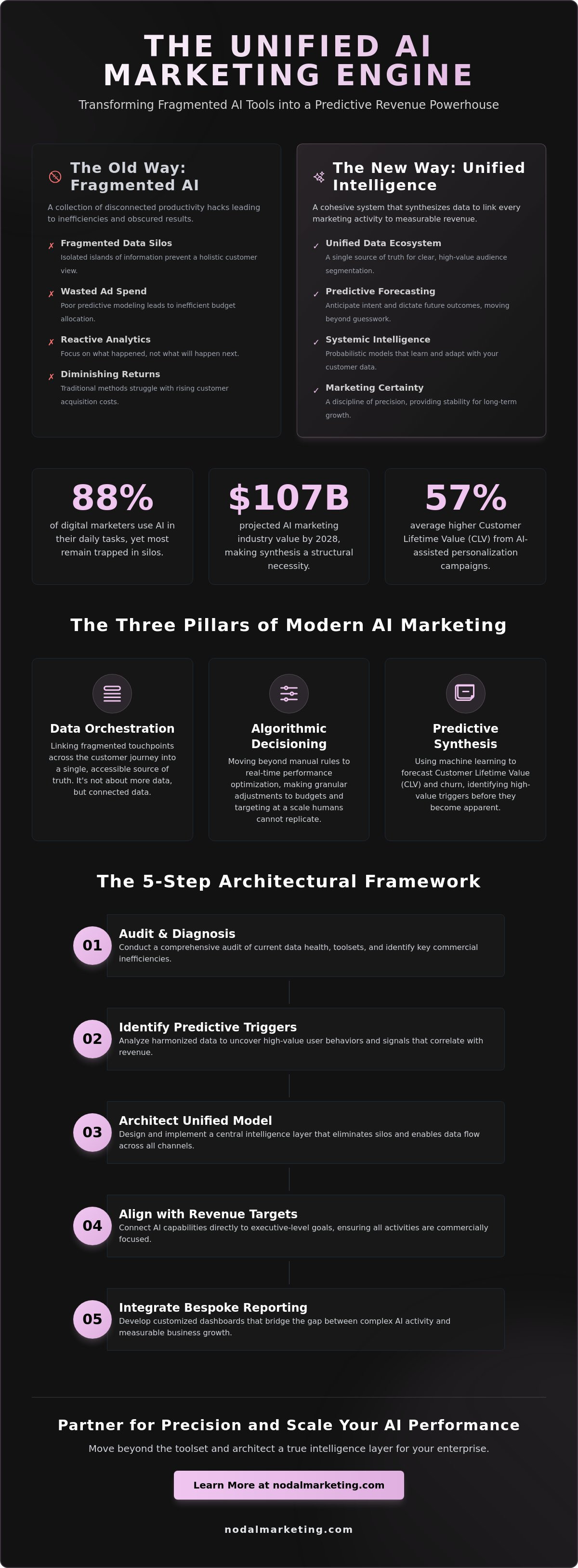
How to Implement AI-Driven Marketing: A 5-Step Architectural Framework
Transitioning to a state of unified intelligence isn't a software installation; it's a structural redesign of your commercial engine. While generalist competitors often provide high-level advice, an enterprise-level implementation requires specific technical milestones. Successful ai driven marketing follows a logical progression from the diagnosis of existing inefficiencies to the integration of a predictive intelligence layer. This framework ensures that your technology serves your strategy, rather than dictating it.
- Step 1: The Data Audit. Diagnosing the health and connectivity of your current ecosystem to identify where data silos are obstructing performance.
- Step 2: Defining the North Star Metric. Aligning AI goals with executive revenue targets to ensure algorithmic outputs translate into commercial growth.
- Step 3: Architecting the Hub. Integrating disparate data sources into a unified intelligence environment where CRM and ad platforms communicate seamlessly.
- Step 4: Model Deployment. Implementing bespoke machine learning models designed for predictive performance rather than generic automation.
- Step 5: Continuous Optimization. The transition from implementation to a performance retainer that focuses on stability and incremental growth.
Step 1 & 2: Diagnosis and Identification
The initial phase focuses on identifying low-hanging fruit within your existing ad spend. We don't simply look for more traffic; we look for the specific behaviors that signal high-intent. This requires a fundamental shift in how you define success. We move away from vanity metrics like clicks and toward predictive revenue value. The North Star Metric serves as the architectural anchor for all AI modeling, ensuring every algorithmic adjustment aligns with executive revenue targets. By establishing this foundation, you ensure that your ai driven marketing efforts remain grounded in fiscal reality rather than technological novelty.
Step 3, 4 & 5: Integration and Scaling
Once the strategy is defined, the technical process of connecting your MarTech stack begins. This integration must occur without disrupting current operations, requiring a sophisticated approach to data orchestration. As your unified intelligence hub matures, you gain the ability to scale global ad spend with a level of precision that manual management can't match. This is where the expertise of an AI Performance Marketing Agency becomes indispensable. We bridge the gap between commercial vision and technical execution, providing the stability needed for aggressive growth. To begin architecting your unified intelligence layer, contact our strategic consultants today.
Partnering for Precision: Scaling AI Performance with Nodal Marketing
Nodal Marketing operates as a strategic designer in a landscape where most are merely tool-users. We don't just implement software; we bridge the gap between commercial vision and technical execution by architecting systems that transform raw data into measurable executive ROI. Our methodology is built on the belief that ai driven marketing should not be a series of disconnected experiments. Instead, we move brands from the chaos of fragmented data silos to the clarity of unified intelligence hubs. This transition is essential for organizations that have outgrown the surface-level capabilities of entry-level digital marketing and require a partner capable of navigating the complexities of modern data science.
The traditional agency model is often optimized for volume and creative output, yet it frequently lacks the technical rigor required for predictive performance. We offer a data science-led performance retainer that prioritizes precision over simple activity. By integrating Data Science & Advanced Analytics into the core of your strategy, we provide "Marketing Certainty" in an otherwise volatile digital economy. We don't guess where your growth comes from; we use bespoke machine learning models to identify the exact triggers that drive revenue. This approach allows us to deliver ai driven marketing strategies that are both ambitious in scale and pragmatic in their focus on stability.
The Nodal Advantage: Bespoke Intelligence
Our focus on sophisticated technical execution creates a sustainable competitive edge that off-the-shelf tools cannot replicate. We are committed to executive-level reporting that speaks the language of the C-suite, moving beyond vanity metrics to focus on real-world commercial outcomes. Our Bespoke Reporting Solutions ensure that every stakeholder has a clear, unified view of performance across all channels. The journey with Nodal Marketing begins with a strategic consultancy phase, where we diagnose your current architecture and identify the high-value opportunities for integration. From there, we move into full-scale performance management, acting as a deeply integrated ally rather than a detached third party.
Next Steps: Architecting Your Future
The time to move beyond the hype and begin building your unified intelligence layer is now. As global markets move toward a state of total AI-driven synthesis, those who fail to architect a predictive engine will find themselves trapped in a cycle of diminishing returns and rising acquisition costs. We invite you to a strategic consultation to diagnose your current marketing architecture and identify the structural gaps preventing a unified view of your data. Let's move your organization from a state of reactive analytics to a future of predictive growth. The inevitability of AI-driven synthesis is clear; the only question is whether your brand will be a designer of that future or a spectator to it.
Architecting the Future of Commercial Certainty
The transition into 2026 demands a departure from the trap of isolated tools and fragmented data. True success in ai driven marketing lies in the creation of a unified intelligence layer that links every disparate signal to executive revenue targets. By moving through a methodical process of diagnosis, identification, and integration, enterprise brands can finally overcome the attribution crisis and solve the persistent challenge of unrefined data. This isn't just about tactical efficiency; it's about building a predictive engine that secures your market position in an increasingly volatile digital economy.
Nodal Marketing stands as your strategic designer in this complex landscape. We utilize proprietary AI tools for granular audience analysis and specialize in connecting disparate data sources into unified intelligence hubs. As an authoritative partner in performance marketing for enterprise brands, we bridge the gap between commercial ambition and technical execution. Architect your AI-driven future with Nodal Marketing and transform your fragmented data into a source of absolute commercial clarity. Your data holds the blueprint for your growth. It's time to build.
Frequently Asked Questions
What is the difference between AI-driven marketing and standard marketing automation?
Standard automation operates on rigid, pre-defined "if-then" rules that execute repetitive tasks without variation. In contrast, ai driven marketing utilizes probabilistic machine learning to adapt to new information and predict future consumer intent. Automation follows a script; AI-driven systems evolve their own logic based on the commercial dynamics they observe within your data ecosystem.
How much data do I need before AI-driven marketing becomes effective for my brand?
Effectiveness is dictated more by data connectivity and quality than by sheer volume. While larger datasets provide more training material for machine learning, even mid-sized enterprise sets yield high-value insights when normalized through proper data orchestration. The goal is to move from fragmented noise to a structured environment where algorithms can identify high-intent behaviors that manual analysis misses.
Will AI-driven marketing replace my internal marketing team?
AI doesn't replace human expertise; it reallocates it from manual execution to high-level strategic design. Your team shifts from managing repetitive campaign adjustments to overseeing the architecture of the intelligence layer. This transition allows your professionals to function as strategic designers who interpret AI-powered insights to drive complex commercial outcomes rather than getting bogged down in administrative tasks.
What are the primary ethical considerations when using AI in marketing?
The core ethical pillars involve data privacy, algorithmic transparency, and the elimination of bias in predictive modeling. Regulatory frameworks like the EU AI Act now mandate clear disclosure for synthetic content and deepfakes. Maintaining "Marketing Certainty" requires a disciplined approach to compliance that protects brand reputation while utilizing advanced data science to personalize the customer experience responsibly.
How do I measure the ROI of an AI-driven marketing implementation?
We measure ROI by linking specific algorithmic optimizations directly to incremental revenue growth and reduced customer acquisition costs. Instead of relying on vanity metrics like clicks or impressions, we utilize bespoke reporting solutions to track "predictive revenue value." This methodical approach ensures that every technological investment is anchored in measurable executive outcomes rather than abstract potential.
Can AI-driven marketing solve the problem of cookie-less tracking and attribution?
AI-driven modeling is the primary solution for the attribution crisis caused by the decline of traditional cookies. By using probabilistic machine learning, these systems synthesize disparate signals across the customer journey to fill data gaps. This creates a cohesive view of performance that respects user privacy while providing the granular audience analysis required for effective budget allocation.
What is a 'Unified Intelligence Hub' and why is it necessary for AI success?
A Unified Intelligence Hub is a centralized data architecture that connects your CRM, web analytics, and ad platforms into a single source of truth. It is the structural prerequisite for AI success because machine learning models cannot function effectively in silos. Without this synthesis of fragmented data points, your AI tools lack the context needed to provide accurate predictive forecasting.
How long does it take to see results from an AI-driven marketing strategy?
Initial gains from "low-hanging fruit" optimizations in Paid Search or Social often manifest within the first 90 days of implementation. However, the true power of an AI-driven engine matures over six to twelve months as models ingest more historical data. This steady progression moves your brand from the diagnosis of current inefficiencies to the full-scale integration of a predictive performance model.