
The era of "skinning" ChatGPT to pass as a digital strategist is over. In a market where the Advertising Standards Authority's AI-powered system will review 40 million advertisements in 2026, the gap between superficial automation and true architectural intelligence has become a chasm. Identifying the best ai search marketing agencies 2025 requires looking past the hype to find partners who treat data as a unified ecosystem rather than a series of fragmented silos. You've likely seen the diminishing returns of traditional PPC and felt the opacity of standard agency workflows that promise results without explaining the underlying logic.
We'll help you move beyond this frustration by detailing the elite agencies currently redefining search through agentic AI and rigorous data science. This article provides the blueprint for achieving predictive ROI certainty and dominance across both legacy SERPs and new AI answer engines. You'll learn how to select a growth partner that speaks the dual languages of marketing dynamics and technical infrastructure, ensuring your brand doesn't just compete, but leads in a post-generative world.
Key Takeaways
- Master the transition from keyword-focused SEO to entity-based intelligence, ensuring your brand remains visible as search engines evolve into generative answer engines.
- Evaluate the best ai search marketing agencies 2025 based on their data science fluency and whether they provide proprietary infrastructure or merely skin existing SaaS tools.
- Deploy the "Agentic AI" test during your selection process to verify if an agency possesses the technical depth to build autonomous workflows within their own tech stack.
- Prioritize a unified intelligence hub that resolves fragmented data silos, providing the clean foundation necessary for training high-performance predictive models.
- Shift your focus from standard PPC automation to bespoke reporting solutions that offer real-time executive foresight and measurable ROI certainty.
Beyond Keywords: The 2025 Evolution of Search and Answer Engines
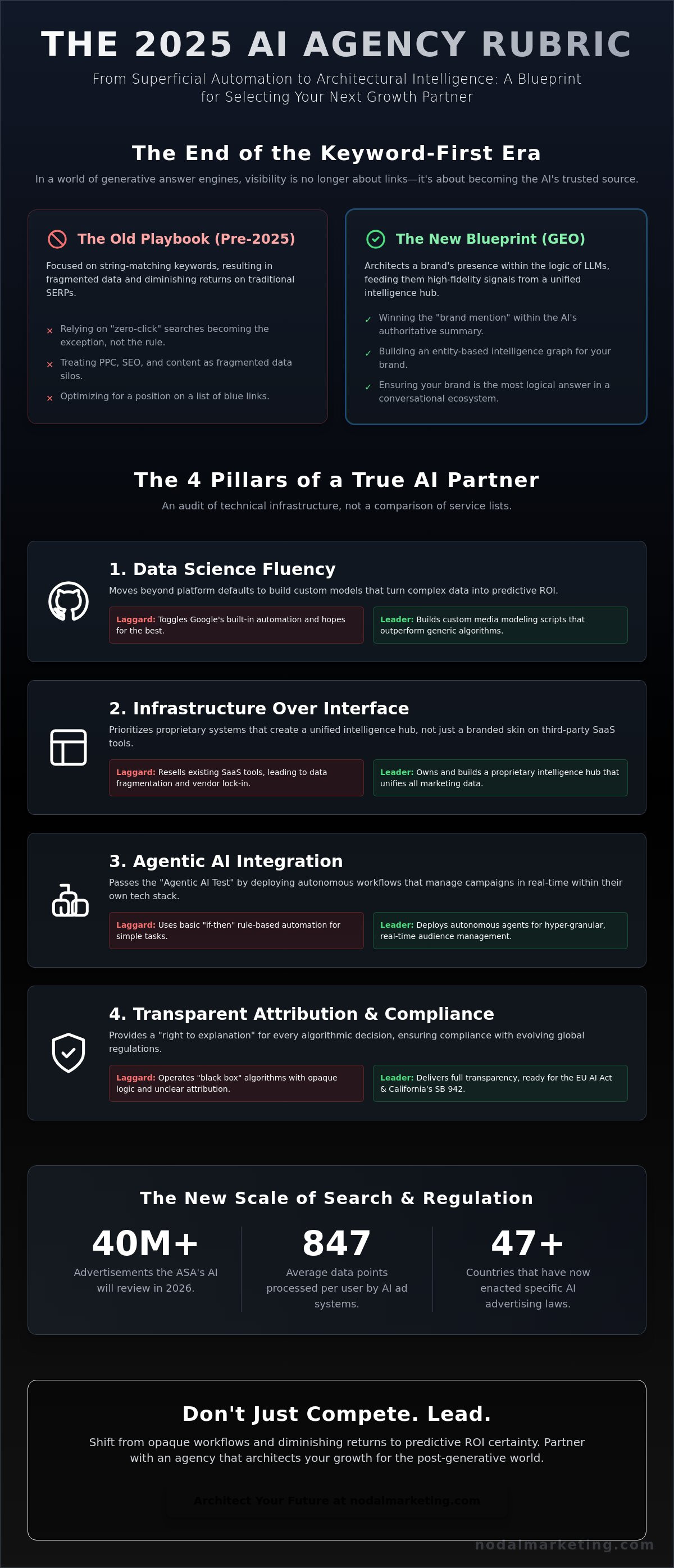
2025 marked the definitive end of the "keyword-first" era. Traditional search engines have matured into sophisticated answer engines, fundamentally altering how brands maintain visibility. This transition to Generative Engine Optimization (GEO) isn't a mere trend; it's a structural realignment of the digital ecosystem. For the best ai search marketing agencies 2025, the focus has moved from simple string matching to deep entity-based intelligence. They don't just optimize for clicks; they architect a brand's presence within the very logic of Large Language Models. This shift requires a move away from isolated tactics toward a unified intelligence hub that connects fragmented data points into a coherent brand narrative.
The evolution of AI in marketing has replaced the vanity metrics of the past with a focus on "unified intelligence." By May 2026, the average AI advertising system processes 847 data points per user, making old-school SEO tactics look like relics. Success now requires a dual fluency in both marketing dynamics and technical data science. As 47 countries have now enacted specific AI advertising regulations, the "best" partners are those who prioritize transparency and data integrity over "black box" automation.
The Decline of Traditional SERP Real Estate
The Search Generative Experience (SGE) has fundamentally compressed the traditional organic results page. Top-of-funnel traffic is no longer guaranteed by a blue link; it's captured by the AI's synthesized response. In 2025, "zero-click" searches became the baseline performance metric for most industries. You aren't just competing for a position. You're competing for a "brand mention" within the AI's authoritative summary. This shift demands a move away from fragmented data silos. It requires a unified hub that feeds high-fidelity signals to the engines that now act as gatekeepers to consumer attention.
From Search Queries to Conversational Intent
LLMs don't read keywords; they interpret the latent space of human intent. They analyze the context surrounding a query to provide a synthesized answer rather than a list of options. This is where the best ai search marketing agencies 2025 distinguish themselves. By using structured data and hyper-granular audience segments, these agencies provide the "foundations" that AI models need to trust a brand's information. It's less about guessing what people type and more about ensuring your brand is the most logical answer in a conversational ecosystem. This level of precision requires an agency that functions as a strategic architect, building the infrastructure that makes growth a certainty rather than an accident.
The 2025 Rubric: Criteria for the Best AI Search Marketing Partners
Selecting a partner in the current landscape isn't a matter of comparing service lists. It's an audit of technical infrastructure. The best ai search marketing agencies 2025 distinguish themselves through four critical pillars of maturity. First, data science fluency. Most agencies simply toggle Google's built-in automation; elite partners build custom media modelling scripts that outperform generic algorithms. Second, infrastructure over interface. You aren't looking for a team that uses third-party SaaS tools. You need architects who build proprietary intelligence hubs. Third, the integration of agentic AI. This involves deploying autonomous agents that manage hyper-granular audience segments in real-time. Finally, transparent attribution. With the EU AI Act in full effect as of early 2026, agencies must provide a "right to explanation" for every algorithmic decision.
Rigorous transparency is no longer optional. When designing an AI marketing strategy, brands must prioritize partners who offer more than just an interface for third-party tools. As of May 2026, California's SB 942 requires AI-generated content to include provenance metadata. This means your agency must have the technical depth to manage complex compliance data alongside performance metrics. It's not enough to be fast. You must be precise.
The Necessity of a Unified Intelligence Hub
A unified intelligence hub is the prerequisite for performance. Without connecting disparate data sources, your AI models are training on noise. Elite agencies use a nodal approach to resolve these fragments, providing bespoke reporting that gives executives a clear view of their ROI certainty. A strategic audit of your data ecosystem often reveals these hidden opportunities for architectural growth, turning fragmented silos into a singular source of truth.
Predictive Modeling vs. Reactive Optimization
The industry has shifted from looking at what happened to predicting what will happen next. Machine learning now allows us to forecast Customer Lifetime Value (CLV) with unprecedented precision by analyzing the 847 data points the average AI system processes per user in 2026. This foresight enables brands to bid on the future value of a user rather than the historical cost of a click. Predictive Search Analytics serves as the primary driver of 2025 performance by transforming historical data into a roadmap for future market capture.
Strategic Shortlist: Top AI Search Agencies Leading the 2025 Landscape
The distinction between an agency that uses AI and one that is built upon it has become the primary filter for executive selection. As we move deeper into 2025, the best ai search marketing agencies 2025 are those that have transitioned from reactive service providers to strategic architects. These firms don't just manage budgets; they build the technical infrastructure required to dominate a search environment defined by the evolution of AI in search. While many generalist agencies struggle with the "black box" nature of modern algorithms, this shortlist represents the elite tier of partners capable of delivering predictive ROI certainty.
Nodal Marketing: The Strategic Architect
Nodal Marketing operates at the intersection of data science and marketing dynamics. Their proprietary platform, Connect, serves as a unified intelligence hub that resolves the data fragmentation plaguing most enterprise ecosystems. By focusing on agentic AI rather than basic machine learning bidding, Nodal Marketing deploys autonomous agents that optimize for high-fidelity brand signals in real-time. This approach is designed for brands that require less guesswork and more certainty in high-stakes environments. They don't just run campaigns; they architect foundations for unprecedented growth by speaking the dual languages of technology and performance.
The 2025 Global Leaders
- Publicis Sapient: Recognized for global digital transformation, they excel at large-scale implementation for multinational corporations. Their strength lies in integrating AI search strategies across massive, complex organizational structures.
- WPP (Choreograph): This is the premier choice for heritage brands seeking AI-integrated media buying. They leverage deep historical data sets to inform modern agentic AI workflows, ensuring legacy brands maintain relevance in the generative era.
- Darkroom: Best for DTC growth, Darkroom focuses on the intersection of AI-driven creative testing and performance search. They use machine learning to process the 847 data points the average system now reviews per user to ensure creative resonance.
Comparing Generalist Agencies vs. Technical Consultancies
Creative-heavy agencies often fail the technical requirements of Generative Engine Optimization (GEO). They lack the data science fluency needed to handle the "dirty data" that often sabotages AI training models. Choosing the right partner depends on your internal maturity. If your data is fragmented across silos, you need a technical consultancy that can build a unified hub. The best ai search marketing agencies 2025 possess dual expertise. They understand the nuances of consumer psychology and the architectural requirements of the EU AI Act. This balance ensures your brand doesn't just capture traffic but dominates the conversational intent of the modern answer engine.
From Hype to ROI: How to Pressure-Test an Agency’s AI Maturity
The marketplace is currently saturated with agencies claiming AI superiority. Distinguishing the best ai search marketing agencies 2025 from those merely using "ChatGPT skins" requires a rigorous technical audit. You must look past the polished case studies and interrogate their actual infrastructure. A primary differentiator is the "Agentic AI" Test. Ask if they deploy autonomous agents via a proprietary tech stack or if they're simply leveraging standard Google Ads scripts. True architects build their own foundations; they don't just rent them from third-party SaaS providers.
Data integrity is the second critical hurdle. Training a predictive model on "dirty data" leads to catastrophic algorithmic drift. An elite partner will always insist on a comprehensive data integrity audit. They'll work to resolve fragmented silos before a single dollar is spent on media. They understand that by May 2026, systems process an average of 847 data points per user. Any noise in that data stream compromises the entire ecosystem. If an agency promises "instant AI results" without a mandatory 60-day data integration and cleaning phase, it's a significant red flag. Real intelligence takes time to architect.
Questions Your CMO Should Ask in the RFP
Your Request for Proposal must move beyond surface-level metrics. Force the agency to explain their technical "how" with these three questions:
- How do you integrate our first-party CRM data into your proprietary AI bidding models to ensure we aren't just bidding on clicks, but on predicted lifetime value?
- Can you demonstrate the specific machine learning process used to identify hyper-granular audience segments that standard Google automation misses?
- What is your methodology for protecting brand voice within generative search to ensure AI-synthesized answers don't hallucinate our value proposition?
Avoiding the "ChatGPT Skin" Trap
Many agencies are currently using wrappers for standard Large Language Models. This is a "ChatGPT Skin." It lacks the technical depth required for complex performance marketing and offers no competitive advantage. You need bespoke machine learning models built on your brand's unique data sets. Fluency in data science is your only hedge against the commoditization of AI. Without it, you're just paying a premium for tools you could license yourself.
Transparency is a non-negotiable requirement in the post-generative era. With the EU AI Act imposing penalties of up to €15 million or 3% of global turnover for non-compliance by August 2026, your agency must provide visibility into their "Black Box" algorithms. You have a right to an explanation for every algorithmic decision. If they can't explain the logic behind a bid, they don't have control over the outcome. Request a technical audit of your AI search infrastructure to ensure your growth partner possesses the depth required to lead in this high-stakes environment.
Nodal Marketing: Architecting the Future of AI-Powered Search
Nodal Marketing doesn't view search as a series of isolated campaigns. We see it as a complex data ecosystem that requires a specialized architect to navigate. While many firms claim to be the best ai search marketing agencies 2025, few possess the technical depth to bridge the gap between marketing dynamics and data science. We don't just optimize for clicks; we build a unified intelligence hub that transforms fragmented data into unprecedented growth. This shift from a vendor relationship to a high-level consultancy partnership is essential for brands that value precision over volume and certainty over guesswork.
The Nodal Method: Diagnose, Identify, Integrate
Our methodology is grounded in intellectual rigor and methodical thoroughness. We begin by diagnosing the structural challenges within your current data silos, ensuring that "dirty data" doesn't compromise your future results. Once identified, we apply bespoke agentic AI solutions tailored to your specific market position. Finally, we integrate these tools into your existing infrastructure, creating a seamless flow of intelligence. As a specialized AI performance marketing agency, we ensure that every algorithmic decision is backed by a right to explanation, meeting the transparency requirements of the 2026 EU AI Act.
Scaling global ad spend with precision requires more than standard Google automation. Our proprietary platform, Connect, processes the 847 data points the average system reviews per user to provide real-time executive foresight. This isn't just reporting; it's a foundation for ROI certainty. We provide the clarity needed to lead in a saturated digital landscape, moving beyond the noise of entry-level marketing. By connecting the dots between disparate data sources, we provide the foresight that generalist agencies lack.
Leading the Revolution in Performance Marketing
The architectural shift in performance marketing demands a partner that speaks the dual languages of technology and strategy. To lead in 2026, brands must transition away from reactive bidding toward predictive modeling. This requires a fundamental rethink of your marketing ecosystem. We invite you to book a consultation to diagnose your current infrastructure and architect a roadmap for dominance in both traditional SERPs and new answer engines. It's time to move beyond the hype and secure your position at the forefront of the generative era. In a world of increasing digital noise, precision is the only currency that matters.
Securing Dominance in the Generative Era
The transition from traditional search to generative answer engines isn't a temporary disruption; it's a permanent architectural shift. By May 2026, the proliferation of global AI regulations will have already filtered out the generalist agencies that lack technical depth. Success now depends on your ability to resolve fragmented data silos and deploy agentic AI that interprets conversational intent with precision. Identifying the best ai search marketing agencies 2025 requires an executive-level focus on infrastructure rather than superficial interfaces.
Nodal Marketing provides the dual expertise in data science and marketing dynamics necessary to bridge this gap. Through our proprietary "Connect" Intelligence Hub and bespoke reporting solutions, we offer the executive foresight required for ROI certainty. We don't just manage campaigns; we architect foundations for unprecedented growth. It's time to move past the noise and secure your brand's future. Architect your growth with Nodal Marketing and lead the performance revolution with confidence.
Frequently Asked Questions
What is an AI search marketing agency, and how does it differ from a digital agency?
An AI search marketing agency operates as a technical consultancy focused on data science and architectural intelligence rather than just creative execution. While a standard digital agency manages bid adjustments manually, an AI specialized partner builds a unified intelligence hub to automate hyper-granular audience segments. This distinction is critical for identifying the best ai search marketing agencies 2025 that can handle the 847 data points processed per user in modern systems.
How does Generative Engine Optimization (GEO) impact my SEO strategy in 2025?
GEO shifts the focus from capturing traditional blue-link clicks to securing brand mentions within AI-synthesized responses. By 2025, search has evolved into an answer engine where LLMs interpret user context rather than matching simple string patterns. Your strategy must move toward entity-based intelligence and structured data to feed high-fidelity signals directly into the latent space of these generative models.
What should I budget for a high-level AI marketing consultancy?
Industry data from May 2026 indicates that enterprise-level AI SEO programs typically range from $10,000 to $50,000 per month. Mid-market companies generally invest between $5,000 and $10,000 for specialized services. Project-based AI automation work, such as building proprietary tech stacks or technical audits, often costs between $3,000 and $30,000 depending on the architectural complexity of the ecosystem.
Can an AI search agency help reduce my customer acquisition costs (CAC)?
Yes, an AI specialized agency reduces CAC by transitioning from reactive bidding to predictive modeling. By analyzing the 847 data points available for every user, these agencies identify high-value prospects before they enter the standard conversion funnel. This precision eliminates wasted spend on low-intent traffic. It ensures your budget is allocated only to segments with the highest predicted Customer Lifetime Value.
How do I know if an agency is actually using proprietary AI or just standard tools?
Interrogate their infrastructure during the RFP process by asking for a "right to explanation" for their algorithmic decisions. Agencies using "ChatGPT skins" won't be able to demonstrate a proprietary unified intelligence hub or show how they integrate first-party CRM data into their models. The best ai search marketing agencies 2025 will have their own tech stack, such as the Nodal "Connect" platform, rather than relying on third-party SaaS wrappers.
What is the role of first-party data in AI-driven search marketing?
First-party data serves as the foundational training set for bespoke machine learning models. Without integrating your CRM and conversion data, an AI system is merely guessing based on generic market signals. High-fidelity data allows an agency to architect a predictive search strategy that speaks the specific language of your brand's unique customer journey. It's the only way to achieve certainty in a noisy landscape.
How long does it take to see ROI from an AI-powered performance marketing pilot?
Expect a mandatory 60-day integration and calibration phase before seeing significant performance shifts. This period is essential for a data integrity audit and the cleaning of "dirty data" that often sabotages model training. Once the unified intelligence hub is established, the shift toward predictive ROI certainty usually begins to manifest in the third month of operation as the models gain fluency.
Is there a brand risk associated with using AI for search and content?
Compliance risk is significant due to new regulations like California's SB 942 and the EU AI Act. Failure to include provenance metadata or maintain transparency can lead to penalties of up to €15 million or 3% of global turnover. A strategic partner mitigates this risk by ensuring human oversight and rigorous data quality standards. This protects your brand from hallucinations and regulatory non-compliance while maintaining a consistent voice.